
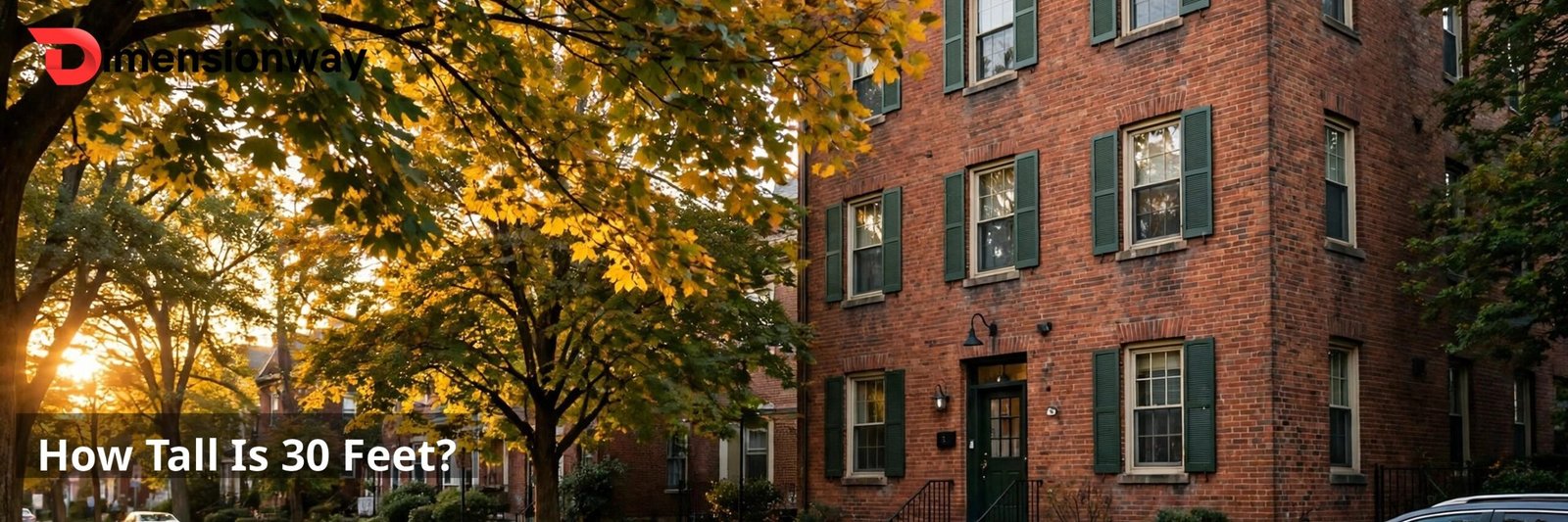
30 feet is 360 inches (9.144 meters), about the height of a typical three-story residential building.
That one sentence is the whole answer, but it probably still does not feel real in your head. Thirty feet is one of those measurements that shows up everywhere in daily life, on road signs, in building plans, in sports broadcasts, and in do-it-yourself projects, yet most people have never stood next to a tape measure stretched a full 30 feet. The good news is that you already know what 30 feet looks like. You have walked past it, driven beside it, and watched games played across it. You just never had a name for the distance.
This guide turns 30 feet into pictures you already carry in your memory. You will see it as a building, a pole, a bus, a bowling lane, and a football field, with real numbers behind every comparison so you can trust what you are picturing.
Thirty feet also shows up in practical places you may not have connected before. Extension ladders are commonly sold in lengths that reach about 30 feet when fully extended, which is why roof work on a three-story home calls for the biggest ladder in the store. Tree services talk about 30-foot clearances around power lines. Fence builders measure runs in 30-foot stretches. Once you can picture the distance, you will start noticing it in hardware stores, on job sites, and in neighborhood planning, because so much of the built world is sized in round multiples of 10 feet.
30 Feet in Plain Numbers
Before the comparisons, here are the exact conversions. Thirty feet is a round number in feet, and it converts to equally round numbers in several other units, which is part of why it shows up so often.
| Unit | 30 Feet Equals |
|---|---|
| Inches | 360 in |
| Meters | 9.144 m |
| Centimeters | 914.4 cm |
| Yards | 10 yd |
| Kilometers | 0.00914 km |
| Miles | 0.00568 mi |
The yard conversion is the one worth remembering. Ten yards is exactly 30 feet, and that fact alone gives you one of the best visual anchors in American sports, which you will meet in comparison 4 below.
10 Comparisons That Make 30 Feet Click
1. A Three-Story Residential Building
The single best way to picture 30 feet is to look at a three-story apartment building or townhouse. In the United States, one residential story averages about 10 feet from floor to floor. That figure covers an 8 to 9 foot ceiling plus the floor slab, joists, and framing between levels. Stack three of those stories and you land almost exactly on 30 feet from the ground to the roofline.
Walk down almost any residential street and you will see this reference for free. Three-story walk-up apartments, townhouse rows, and small condo buildings all sit right around this height. Commercial buildings run taller per floor, usually 12 to 14 feet, so a three-story office block would overshoot 30 feet. For homes, though, the rule is simple: three floors up is 30 feet up.

2. A Utility Pole on Your Street
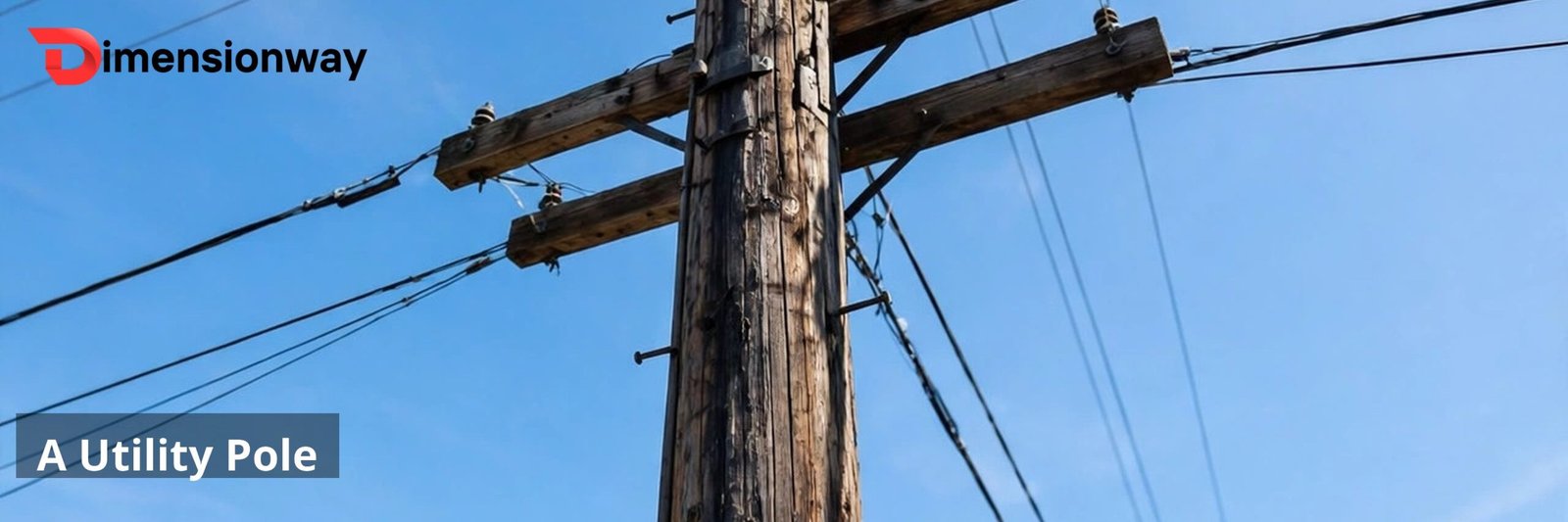
The wooden pole carrying power and telephone lines along your street is one of the most accurate 30-foot references in everyday life. The standard utility pole in the United States is about 35 feet tall in total, and roughly 6 feet of that length is buried in the ground to keep it standing. Subtract the buried section and about 29 to 30 feet of pole shows above the ground.
That is why the pole looks so tall when you stand under it, and why it makes such a good measuring stick. Next time you are out for a walk, stop beside a pole and look up. The wires at the top are roughly 30 feet over your head. Some poles run taller, up to 40 feet above ground on wider roads, but the ordinary neighborhood pole is a near-perfect 30-foot ruler that never moves. As a bonus reference, poles are typically spaced about 125 feet apart in urban areas and about 300 feet apart in rural areas, so the gap between two poles is roughly four to ten times the height of one pole.
3. Most of a Full-Size School Bus
A full-size school bus is longer than 30 feet, but not by much, which makes it a great vehicle comparison. The average full-size Type C school bus, the classic yellow bus most districts run, measures about 36 feet from front bumper to rear bumper. Common models fall in the 35 to 40 foot range depending on seating capacity.
Do the math and 30 feet covers about five sixths of that bus. If you picture a school bus parked at the curb and then chop roughly one sixth off the back, what is left is 30 feet. Smaller Type A buses, the short ones built on van chassis, run 20 to 30 feet long, so a short bus parked end to end is right at the 30-foot mark. Either way, the next time a school bus pulls up beside you, you are looking at a vehicle that is only a little longer than 30 feet. For scale, a full-size bus typically seats around 72 passengers, so the 30-foot section you are picturing would hold most of a busload of students all by itself.

4. A First Down in Football
If you watch American football, you already see 30 feet on every series of downs. A team must gain 10 yards for a first down, and 10 yards is exactly 30 feet. The yellow first-down line drawn on television broadcasts sits exactly 30 feet ahead of the line of scrimmage.
This is one of the few comparisons on this list that is exact rather than approximate. There is no “about” here. When the officials bring out the chains to measure, the distance between the two markers is 10 yards, which is 30 feet on the nose. It is also the depth of each end zone, which is 10 yards deep. So a football field gives you two perfect 30-foot references: every first down, and every end zone.

5. Half a Bowling Lane
Bowlers get a perfect 30-foot reference every time they roll a ball. Under United States Bowling Congress rules, the distance from the foul line to the center of the head pin is exactly 60 feet. Cut that lane in half and you have exactly 30 feet.
Stand at the foul line and look down the lane. The pins sit 60 feet away. The halfway point, 30 feet out, falls right around the arrows printed on the lane that bowlers use as targeting guides. That is a useful way to feel the distance: stand at one end of a bowling lane, and the middle of the lane is 30 feet from you. Two of those halves make the full journey a bowling ball travels on every roll.

6. Four and a Half Standard Doors
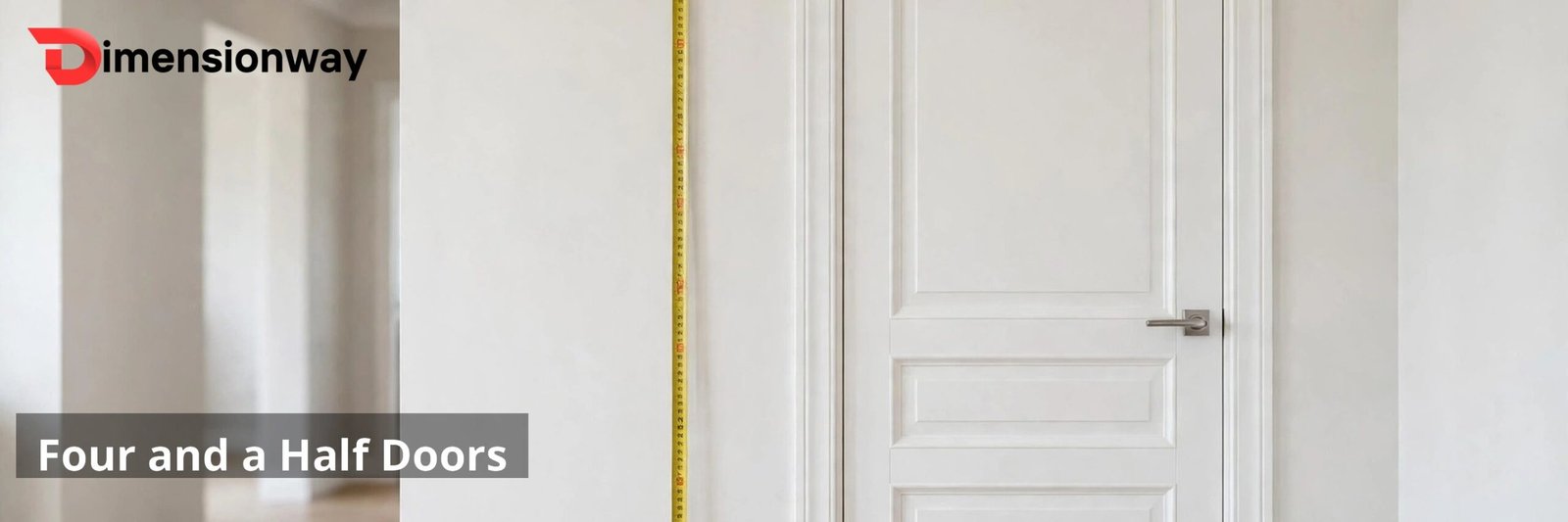
Doors are everywhere, and their size is standard, which makes them a handy indoor measuring tool. A standard interior door in the United States is 80 inches tall, which is 6 feet 8 inches. Divide 30 feet by that height and you get four and a half doors.
Picture four doors stacked on top of each other, and then add half of a fifth door. That stack reaches 30 feet. Or think of it the other way: five standard doors stacked would reach 33 feet 4 inches, which overshoots 30 feet by a little more than three feet. This comparison is useful indoors, where buildings and poles are out of sight. If you can picture a door, you can build 30 feet out of four and a half of them.
7. Three Basketball Hoops Stacked
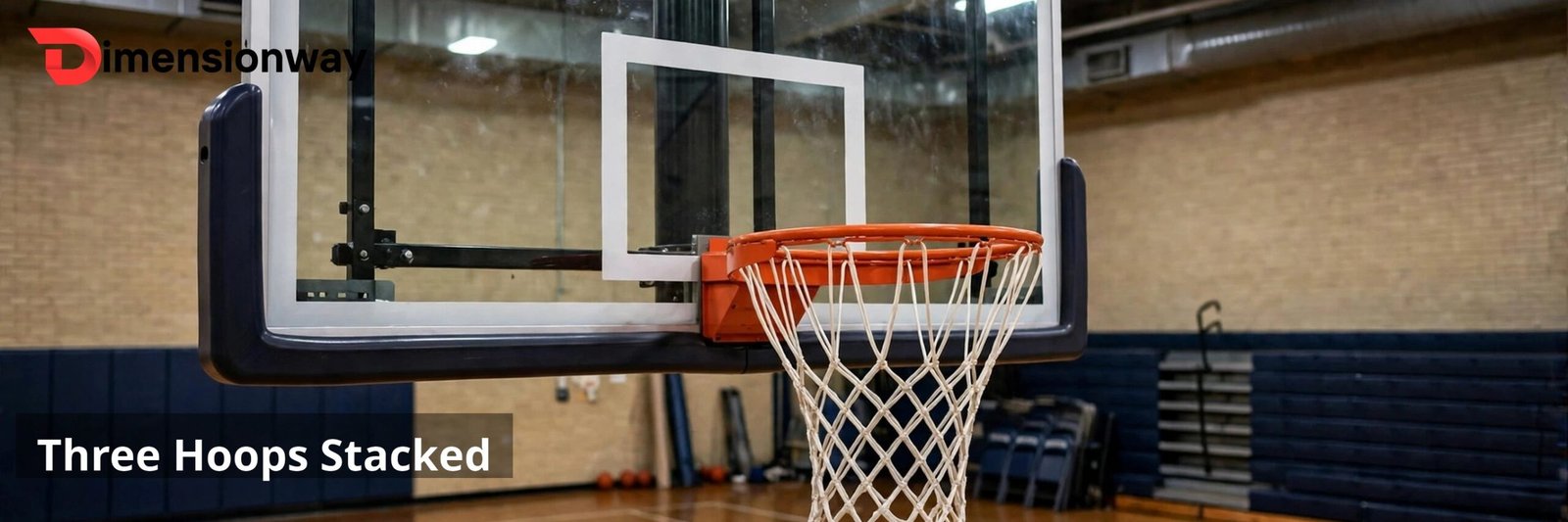
A basketball rim sits exactly 10 feet above the floor at every level of the game, from school gyms to the NBA. Stack three of those rims on top of each other and the top rim sits at 30 feet.
This comparison works because the 10-foot rim is one of the most familiar heights in sports. Almost anyone who has played or watched basketball has looked up at a rim and felt how high 10 feet is. Triple that feeling. Three rims stacked would tower over the backboard, over the gym lights, and well past the top of a two-story house. It is a vivid way to feel 30 feet: take a height you already know, and multiply it by three.
8. Two Great White Sharks Nose to Tail
For a wilder comparison, look to the ocean. An adult great white shark averages about 14 to 18 feet long, and most adults measure close to 15 feet. Put two average great whites nose to tail and they stretch about 30 feet.
This one surprises people, because a single great white already feels enormous. Two of them end to end would span the length of a three-story building laid on its side. Females run larger than males, often reaching 15 feet or more, while mature males usually measure 11 to 13 feet. So two large females would overshoot 30 feet slightly, while two average adults land right on it. Either way, it is a memorable image: 30 feet is two apex predators long.

9. Two Thirds of a Hollywood Sign Letter
The Hollywood Sign is one of the most photographed landmarks in the world, and its letters are far bigger than they look from the ground. Each letter of the sign stands 45 feet tall. Thirty feet is exactly two thirds of one letter.
Stand at the base of a single letter and look up. The letter rises 45 feet above you. Now imagine slicing off the top third. What remains, 30 feet of white steel letter, is still taller than a three-story building. That is a fun way to grasp the scale: a single Hollywood letter is one and a half times 30 feet. The whole sign stretches 350 feet across the hillside, which is more than eleven 30-foot sections laid end to end.

10. About One Third of a Basketball Court
A regulation NBA and college basketball court is 94 feet long and 50 feet wide. Thirty feet covers just under one third of that length. Three 30-foot sections laid end to end would run 90 feet, leaving only 4 feet of court to spare.
This comparison pairs nicely with the hoop comparison above. The court is 94 feet long, the rim is 10 feet high, and 30 feet sits right between those two familiar numbers. Walk from one baseline to the free-throw line and you have covered about 30 feet of court. It is also close to the distance from the baseline to the three-point arc at the top of the key in many gyms. If you have ever played on a court, you have run 30 feet hundreds of times without thinking about it.

The 10 Comparisons at a Glance
| Comparison | Measurement | How It Relates to 30 Feet |
|---|---|---|
| Three-story building | About 30 ft | The same, the best match |
| Utility pole above ground | About 29 to 30 ft | The same, near perfect |
| Full-size school bus | About 36 ft | About 6 ft longer |
| Football first down | 30 ft | Exact |
| Half a bowling lane | 30 ft | Exact |
| Standard doors | 80 in each | 4.5 doors |
| Basketball hoops stacked | 10 ft each | 3 hoops |
| Great white sharks | About 15 ft each | 2 sharks |
| Hollywood sign letter | 45 ft | Two thirds of one letter |
| Basketball court length | 94 ft | About one third |
30 Feet Compared to Nearby Heights
Thirty feet sits in an interesting middle zone. It is far taller than a person, clearly taller than a two-story house, and far shorter than a tall building. This table puts it in context.
| Object or Height | Measurement | Compared to 30 Feet |
|---|---|---|
| Average adult man | 5 ft 9 in | About one fifth of 30 ft |
| Standard ceiling | 8 ft | About one quarter of 30 ft |
| Basketball rim | 10 ft | Exactly one third of 30 ft |
| Two-story house | 20 to 25 ft | 5 to 10 ft shorter than 30 ft |
| 30 feet | 30 ft | The reference itself |
| Full-size school bus | About 36 ft | About 6 ft longer than 30 ft |
| Bowling lane | 60 ft | Exactly double 30 ft |
| Three-story building | About 30 ft | The same as 30 ft |
How to Picture 30 Feet Without a Tape
You do not need a tape measure to use 30 feet. Pick the anchor that matches where you are standing. Outdoors on a street, look at the utility pole or the nearest three-story building. At a school or on a road, picture a school bus and shave a little off the back. On a sports field, count a first down or half a bowling lane. Indoors, stack doors in your head.
For estimating a real distance, the door trick is the most practical. Standard doors are 80 inches tall, and most rooms you stand in have at least one. Five door heights is a little too long, four is too short, and four and a half is right. Walk the distance in door heights and you will land close to 30 feet.
Another practical trick is the 10-yard trick. If you can picture a football first down, you can picture 30 feet anywhere, because 10 yards and 30 feet are the same distance. Coaches, players, and fans carry that distance in their heads already.
Try it as a worked example. Suppose you want to know whether a tree in your yard stands farther than 30 feet from your house. Stand at the house wall and walk toward the tree while picturing a first-down distance. If you reach the tree before you have covered a full first down, the gap is under 30 feet. If you pass the first-down mark and keep walking, it is over 30 feet. The same walk works with doors indoors: count four and a half door heights along a hallway and you have walked about 30 feet. These tricks will not replace a tape measure for building work, but they will keep you from guessing wildly, which is the whole point of learning a measurement by eye.
30 Feet on the Sports Field
Sports give some of the cleanest 30-foot references because their measurements are fixed by rulebooks rather than by habit.
| Sports Distance | Measurement | In Units of 30 Feet |
|---|---|---|
| Football first down | 30 ft | Exactly 1 |
| Football end zone depth | 30 ft | Exactly 1 |
| Bowling lane, foul line to head pin | 60 ft | Exactly 2 |
| Basketball court length (NBA) | 94 ft | About 3.1 |
| Basketball rim height | 10 ft | Exactly one third |
| Soccer field length | About 344 ft | About 11.5 |
| Football field, goal line to goal line | 300 ft | Exactly 10 |
Notice how often 30 feet divides evenly into sports dimensions. That is no accident. Thirty feet is 10 yards, and yards are the native unit of American field sports.
Common Questions About 30 Feet
How tall is 30 feet in meters?
Thirty feet is 9.144 meters. Multiply feet by 0.3048 to convert, so 30 times 0.3048 gives 9.144 meters.
How many stories is 30 feet?
Thirty feet is about three residential stories. With a typical floor-to-floor height of about 10 feet, three stories stack to roughly 30 feet. Commercial buildings have taller floors, so three commercial stories would reach 36 to 42 feet instead.
Is 30 feet taller than a two-story house?
Yes. A typical two-story house measures about 20 to 25 feet to the roofline, so 30 feet stands about 5 to 10 feet taller than a two-story house.
How many inches are in 30 feet?
There are 360 inches in 30 feet. Each foot holds 12 inches, and 30 times 12 is 360.
How many yards is 30 feet?
Thirty feet is exactly 10 yards. Each yard holds 3 feet, and 30 divided by 3 is 10.
How long is a school bus compared to 30 feet?
A full-size school bus is about 36 feet long, so 30 feet is roughly five sixths of a full-size bus. Smaller buses run 20 to 30 feet long, putting a short bus right at the 30-foot mark.
What is 30 feet compared to a basketball court?
Thirty feet is just under one third of a regulation NBA court, which is 94 feet long. Three 30-foot sections would cover 90 feet of the court.
How can I picture 30 feet using doors?
Stack four and a half standard doors. Each standard door is 80 inches tall, and 30 feet divided by 80 inches gives 4.5 doors.
How tall is a telephone pole compared to 30 feet?
A standard utility pole is about 35 feet tall in total with about 6 feet buried underground, leaving roughly 29 to 30 feet of pole visible above the ground.
Is 30 feet a big height for a building?
It depends on the building. For a house, 30 feet is a full three stories, which is a large home. For an apartment block or office building, 30 feet is small, since those buildings commonly rise well past 100 feet.
Why 30 Feet Feels Bigger Than It Sounds
Thirty feet sounds small on paper, yet it feels big in person, and there is a reason for that. Human beings judge height against their own bodies. A 30-foot pole is more than five times the height of an adult, and a three-story building puts the roofline well above anything you can reach, climb, or touch. Our brains are good at judging arm’s length and room size, but they stretch distances upward. That is why a three-story drop looks far scarier than a 30-foot walk sounds. Knowing the comparisons in this guide does not just give you a number. It gives you a set of anchors that turn an abstract measurement into something your eyes already understand.
Related Reading
If this guide helped 30 feet click, these DimensionWay guides use the same visual approach for nearby sizes: How Tall Is 8 Feet?, How Tall Is 20 Feet?, How Tall Is 100 Feet?, How Tall Is 6 Feet?, How Tall Is 10 Feet?, How Tall Is a Door?, How Long Is 100 Feet?, and How Big Is a Soccer Field?.
Sources
- Wikipedia
- United States Bowling Congress
- NBA
- Hollywood Sign Trust
- SeaWorld
- IEEE
- National Football League
- History Tools

James Carter is the founder and editor of DimensionWay, where he researches, measures, and verifies real-world dimensions, from everyday objects to world-famous landmarks. Every number published on DimensionWay is cross-checked against manufacturer specifications and official sources, so readers always get accurate, easy-to-visualize comparisons.
