
A standard door in the United States is 80 inches tall, which is 6 feet 8 inches. It is the same height for interior and exterior doors alike, and it gives the average adult roughly a foot of headroom.

You walk through doors a hundred times a day and never once think about how tall they are. Then the day comes when you have to move a refrigerator, order a replacement slab, or fit a Christmas tree into the house, and suddenly that opening you have taken for granted becomes a measurement problem. The good news is that the answer is almost always the same number.
That number is 80. A standard American door stands 80 inches tall, or 6 feet 8 inches. In the building trades it is called a “6/8 door,” pronounced “six-eight,” and it is one of the most consistent measurements in your entire house. Framing, furniture, appliances, and even sports equipment are all quietly designed around it. This guide makes the number visible: what it is, why it is that way, and what it looks like next to the things you already know.
Why 80 Inches Became the Standard
The 80 inch door did not come from an architect’s imagination. It came from a wall.
American houses are typically framed so the finished ceiling lands just under 8 feet, or 96 inches. The wall plates, the horizontal timbers that carry the roof load, sit at a consistent height all the way around. Placing the door header above an 80 inch opening leaves 16 inches of wall above the door, a comfortable margin that keeps the framing simple and the header heights identical from room to room. The rough opening, the framed hole the door unit sits in, is cut to about 82.5 inches from the subfloor, leaving room for the frame, shims, and adjustment during installation.
Once builders settled on 80 inches, manufacturers followed. Pre-hung doors, slabs, jambs, and hardware all lined up behind the same dimension, which made doors cheap, interchangeable, and easy to replace. That standardization is why a door bought from any big-box store fits the frame of almost any modern American home.
The number is not universal. In the United Kingdom the standard interior door is 1981 millimeters, about 78 inches. Older American homes, especially those built before the 1950s, often have 78 inch doors as well. And modern luxury builds have started pushing past the standard entirely, which you will see in the comparisons below. But 80 inches remains the default that everything else is measured against.
| Door type | Height | Width | Thickness |
|---|---|---|---|
| Interior passage | 80 in (6 ft 8 in) | 28 to 32 in | 1 3/8 in |
| Bedroom or bath, most common | 80 in (6 ft 8 in) | 30 in | 1 3/8 in |
| Exterior entry | 80 in (6 ft 8 in) | 36 in | 1 3/4 in |
| Closet bifold or sliding | 80 in (6 ft 8 in) | 24 to 72 in | 1 3/8 in |
| Patio slider | 80 in (6 ft 8 in) | 60 to 72 in | varies |
| Commercial passage | 84 in (7 ft) | 36 in | 1 3/4 in |
| Tall residential | 96 in (8 ft) | 36 in | 1 3/4 in |
The 30 by 80 inch door is the workhorse of the American house. It is the bedroom door, the bathroom door, and the hallway door, all the same height, all roughly the same width, all replaceable from the same shelf.
10 Comparisons That Make a Door Click
A standard door, 80 inches tall, 6 feet 8 inches. Here is what that looks like next to things you already know.
Taller Than Your Fridge
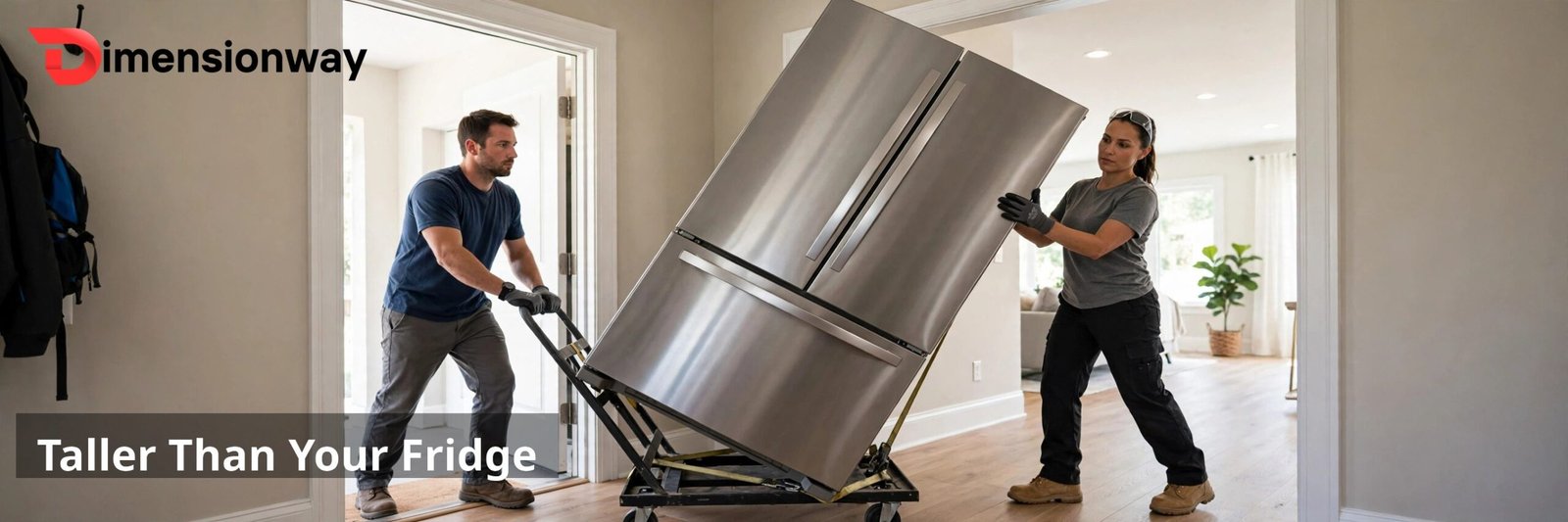
A full-size refrigerator stands 66 to 72 inches tall, depending on the model. Set it in a doorway and the 80 inch opening rises 8 to 14 inches above it, which is why delivery crews can tilt a fridge through a door on a dolly without clipping the frame. The height is rarely the problem on moving day. The width is.
The comparison works in both directions. If your fridge is 70 inches tall, picture it standing in the doorway with a shoebox of air above it. That gap, roughly 10 inches, is the clearance that an 80 inch door gives almost every appliance in your kitchen. Our guide to how tall a refrigerator is breaks down fridge dimensions in full, including the widths that actually cause moving-day drama.
A Foot Over the Average Man
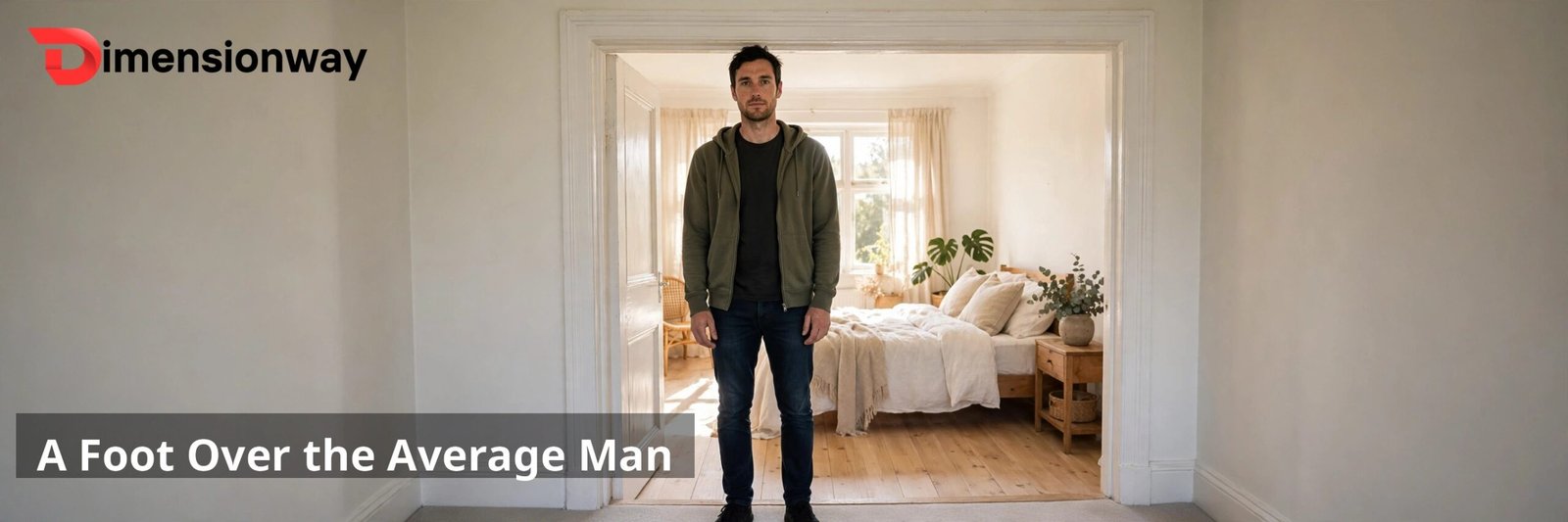
The average American man stands 69.3 inches tall, about 5 feet 9 inches. Walking through an 80 inch door, he has about 10.7 inches of headroom, nearly a full foot of air between his scalp and the top of the frame.
This is the comparison that explains the standard. Door heights are not sized for the average person. They are sized so that a person who is well above average can still walk through comfortably. The 80 inch number was chosen with headroom to spare, because a door that only works for average people is a door that fails the moment a tall guest arrives.
Exactly One King Bed
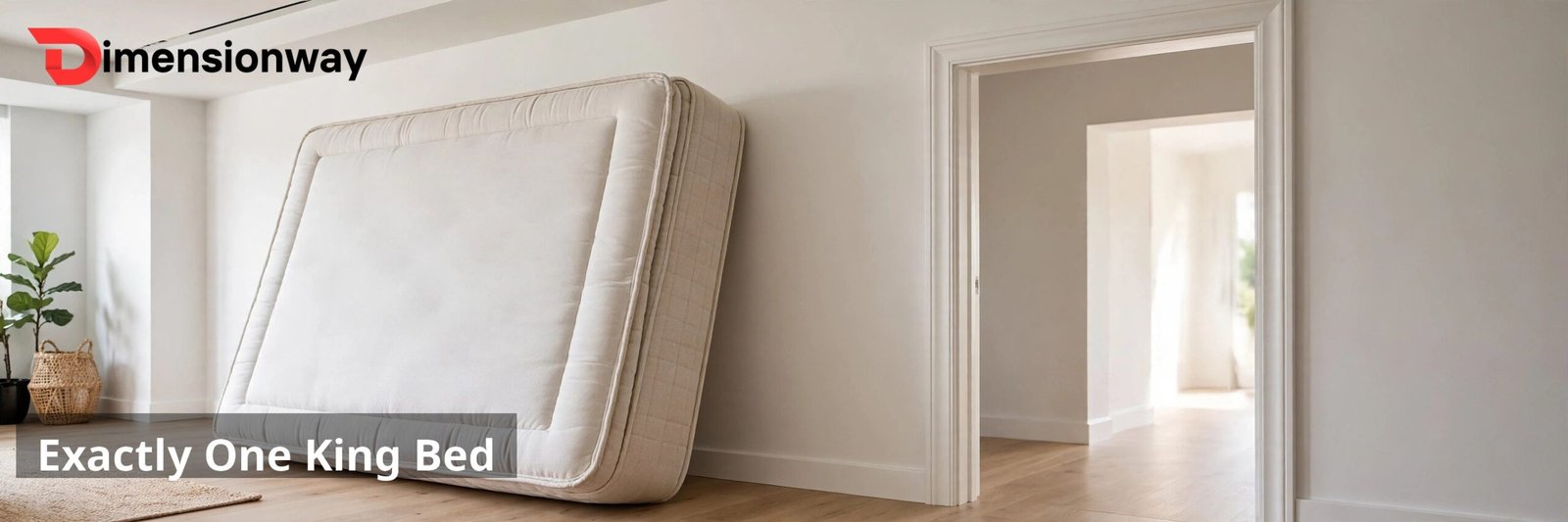
A king-size mattress is 80 inches long. Stand it on its end against a wall and it matches the height of a standard door exactly, top to bottom. It is one of the neatest coincidences in household measurements, and it is not really a coincidence at all. Both numbers converged on the same standard: big enough for a very tall adult, small enough to manufacture and move.
This is also the picture to keep for moving day. If you have ever watched movers stand a mattress on end to get it around a corner, you have watched them exploit this fact. The mattress fits under the header because the mattress and the door were designed for the same person. Our guide to how big a king size bed is covers what those 80 inches mean for sleepers.
Shorter Than a Christmas Tree

A 7-foot Christmas tree stands 84 inches tall, four inches taller than a standard door. That four inches is the difference between sliding the tree through the doorway and wrestling it, branches bent, into the living room.
The tree comparison is useful because Christmas trees are one of the few objects most people buy by the foot. When the tag says 7 feet, you are really being told something about your doors. A 7-foot tree will not clear an 80 inch opening upright. A 6-foot tree at 72 inches walks through with 8 inches to spare.
An NBA Player Barely Clears It

The average NBA player stands about 78.3 inches tall, roughly 6 feet 6 inches. That leaves him less than two inches of clearance under an 80 inch door frame, which is why very tall people develop the habit of ducking slightly through ordinary doorways.
The image of a professional basketball player tilting his head under a normal door is the best proof that 80 inches is a practical, not a generous, standard. It covers the vast majority of the population with room to spare, but it is not tall. Anyone above about 6 feet 6 inches knows every doorway in the house by its header.
Above a 6-Foot Bookshelf

A tall bookshelf stands 72 inches, exactly 6 feet. Put one next to an interior door and the door rises 8 inches above it, about the height of a hardcover book stood on end.
This is a handy one for furniture shopping. Bookcases, wardrobes, and entertainment centers are often built to 72 or 84 inches. The 72-inch pieces slip under any door header with room to spare. The 84-inch pieces do not, and they need the 8-foot door or the room with tall ceilings to match.
The 8-Foot Upgrade

Modern luxury builds are replacing the 80 inch door with 96 inch, or 8-foot, doors. The taller door stands a full 16 inches above the standard, and it changes the feel of a room the way a vaulted ceiling does. The taller opening carries more light, makes furniture look smaller, and pairs with the 9-foot ceilings that new construction favors.
The catch is that an 8-foot door does not fit an 80 inch frame. Retrofitting means reframing the opening, moving the header up, and patching the wall above. It is one of the more expensive single changes you can make to a room, which is why most people meet the tall door in new construction rather than in renovations.
Two-Thirds of a Hoop

A regulation basketball hoop hangs at 120 inches, or 10 feet. A standard door at 80 inches reaches exactly two-thirds of the way up to the rim.
The hoop comparison puts the door in sports scale. From the floor to the top of a door is the distance a good high school player can touch flat-footed. From the top of the door to the rim is the part that actually takes jumping. It is also the reason door-mounted basketball hoops are a compromise: the frame is sturdy, but the shooting angle is all wrong.
16 Inches Over the Average Woman

The average American woman stands 63.8 inches tall, about 5 feet 4 inches. Under an 80 inch door she has 16.2 inches of headroom, more than the length of a standard ruler.
Pair this with the man comparison from earlier and you get the full picture of the standard. The 80 inch door gives the average woman over a foot of clearance and the average man nearly a foot, and it still just barely clears the tallest athletes. One number, sized to cover almost everyone.
20 Inches Longer Than a Bathtub
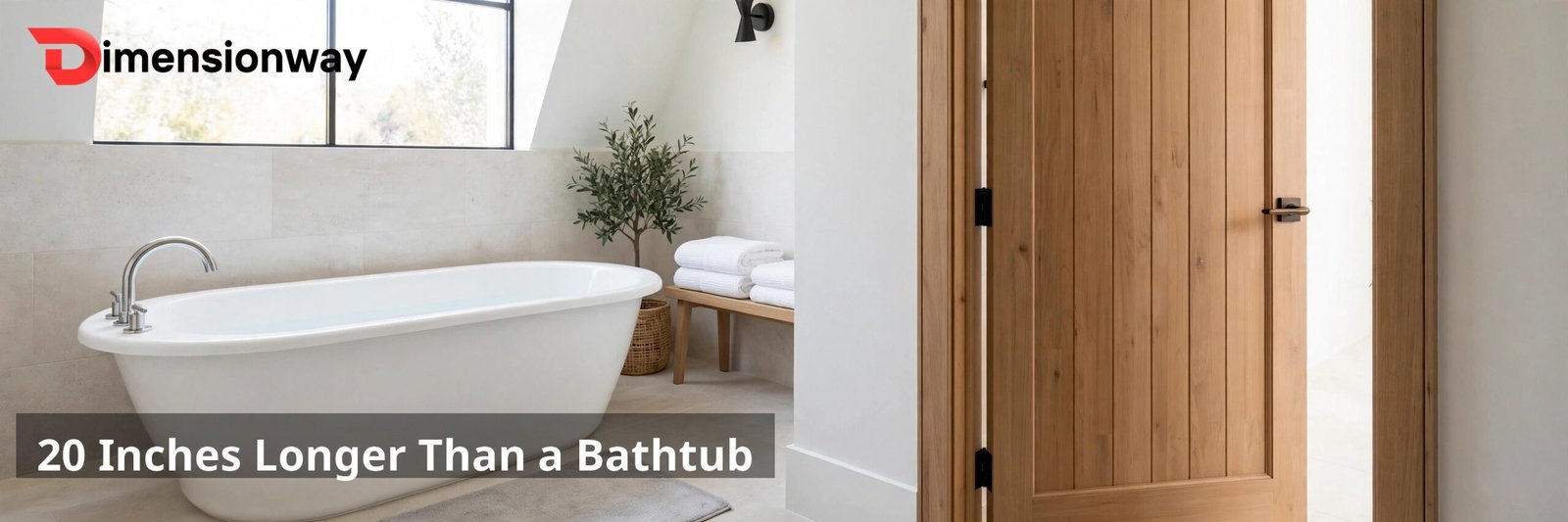
A standard alcove bathtub is 60 inches long, exactly 5 feet. Stand a door on its end next to the tub and the door extends 20 inches beyond it, a full foot and eight inches of extra length.
The tub comparison is a bathroom-planning classic. A 60 inch tub fits the standard 5-foot alcove, and the 80 inch door beside it shows why bathroom ceilings feel the way they do: the tallest thing in the room is usually the door itself. Everything else in a bathroom, the vanity at 32 inches, the toilet at 28, the tub at 60, lives well under the header.
How to Picture 80 Inches Without a Tape Measure
Three tricks that stick.
First, use the king bed. A king mattress is 80 inches long, exactly the height of a standard door. If you can picture a king bed, stand it on its end in your mind, and you are looking at a door.
Second, use the average man plus a hand. The average man is about 69 inches tall. Add the length of your hand, wrist to middle fingertip, which is about 7 to 8 inches for most adults, and a couple of inches more. That stack lands right on 80.
Third, use the ceiling. Standard ceilings are 96 inches, or 8 feet. The top of a door sits 16 inches below the ceiling, about the length of a forearm. Measure down a forearm from the ceiling and you have found the header. Our guide to estimating distance without a tape measure has more of these built-in rulers.
Door Heights Against Everyday Objects
Doors are the reference height of the house. Here is how the rest of the household measures up against the 80 inch standard.
| Object | Height | Compared to an 80 in door |
|---|---|---|
| Full-size refrigerator | 66 to 72 in | 8 to 14 in shorter |
| Average American man | 69.3 in | 10.7 in shorter |
| Average American woman | 63.8 in | 16.2 in shorter |
| NBA player, average | 78.3 in | 1.7 in shorter |
| King-size mattress | 80 in | exactly the same |
| 7 ft Christmas tree | 84 in | 4 in taller |
| 8 ft door | 96 in | 16 in taller |
| Basketball hoop | 120 in | 40 in taller |
The NBA row is the one that surprises people. An entire league of athletes lives in the top two inches of the standard door, which is why the number feels roomy to almost everyone and tight to the very tall.
Will It Fit Through the Door?
Height is rarely the issue on moving day. Width is. Interior passage doors are typically 28 to 32 inches wide, and after the stops and hinges, the clear opening is about an inch narrower. Exterior doors are 36 inches wide, which is why big items go through the front door. The ADA sets 32 inches as the minimum clear width and 80 inches as the minimum clear height for accessible doors, so those numbers double as the legal baseline.
| Item | Typical width | Fits a 32 in passage? | Fits a 36 in exterior? |
|---|---|---|---|
| Compact fridge | 30 in | yes, barely | yes |
| Full-depth fridge | 36 in | no, remove doors or hinges | yes, tight |
| Standard sofa depth | 35 to 38 in | no | yes, angled |
| Front-load washer | 27 in | yes | yes |
| King mattress | 76 in wide | no | yes, bent |
| Treadmill, folded | 30 to 33 in | tight | yes |
| Upright piano | 52 to 58 in | no | no, needs double doors |
The honest rules: measure the item, measure the clear opening (not the slab), and remember that removing a fridge door buys about 2 inches. Our fridge guide covers which refrigerator widths fit which doors in detail.
Inches to Centimeters for Door Measurements
| Inches | Centimeters | What it is |
|---|---|---|
| 28 | 71.1 | Narrow interior door |
| 30 | 76.2 | Common bedroom door |
| 32 | 81.3 | Wide interior or ADA minimum |
| 36 | 91.4 | Standard exterior door |
| 78 | 198.1 | UK standard, some older US homes |
| 80 | 203.2 | US standard door height |
| 84 | 213.4 | Tall or commercial door |
| 96 | 243.8 | 8-foot luxury door |
FAQs

How tall is a standard interior door?
80 inches, or 6 feet 8 inches. It is the same height for interior and exterior doors in almost every modern American home, and in the trade it is called a 6/8 door.
How tall is a standard front door?
Also 80 inches in most homes. Newer and higher-end builds often use 84 or 96 inch front doors for a grander entry, especially under 9-foot ceilings, but 80 inches remains the default.
Why are doors 6 feet 8 inches tall?
Standardization around wall framing. Finished ceilings land just under 8 feet, and an 80 inch opening leaves 16 inches of wall above the door for a consistent header. Once builders, manufacturers, and hardware makers all aligned on the number, it became cheap and universal.
What is the rough opening for an 80 inch door?
About 82.5 inches tall from the subfloor. The extra space leaves room for the frame, shims, and adjustment during installation. Width rough openings run about 2 inches wider than the door slab.
Can a refrigerator fit through a standard door?
Usually, but check the width, not the height. A 30 inch compact fridge slides through a 32 inch passage. A 36 inch full-depth fridge will not clear a 32 inch interior door and usually needs its doors removed; it will fit a 36 inch exterior door. The 80 inch height clears nearly every fridge with room to spare.
How tall are doors in the UK?
The UK standard interior door is 1981 millimeters, about 78 inches, two inches shorter than the American 80 inch standard. Older American homes also commonly have 78 inch doors.
Are 8-foot doors worth it?
They make rooms feel taller and brighter, and they suit 9-foot ceilings, but they cost more than standard doors and cannot be dropped into an 80 inch opening. Retrofitting means reframing, moving the header, and patching the wall above, which is a real carpentry job.
What does ADA require for doors?
The ADA requires a minimum 32 inch clear width and 80 inch minimum clear height for accessible doorways. The 80 inch height matches the residential standard, which is why almost every modern home door already meets the height side of the rule.
How tall are closet doors?
Also 80 inches in most homes. Bifold and sliding closet openings run 24 to 72 inches wide, with 48 inches the most common, but the height matches the rest of the house.
Do tall people need taller doors?
Not usually. An 80 inch door clears anyone up to about 6 feet 8 inches, which covers nearly everyone, including the average NBA player at about 6 feet 6 inches with less than two inches to spare. People above 6 feet 8 inches are the ones who start appreciating 84 inch doors.
Conclusion
A standard door is 80 inches tall, 6 feet 8 inches, the same on the bedroom door and the front door. It is exactly one king bed stood on end, about a foot over the average man, just barely enough for an NBA player, and two-thirds of the way to a basketball hoop.
Keep the three pictures that matter. The king bed stood upright. The football player ducking. The forearm below the ceiling. The next time you are ordering a door, moving a fridge, or buying a Christmas tree, you will already know the number that decides whether it fits.
Related Reading
– How Tall Is a Refrigerator? 10 Comparisons: the 66 to 72 inch appliance that fits under every standard door with room to spare. – How Big Is a King Size Bed? 10 Things That Size, Visualized: the 80 inch mattress that matches a door exactly. – How to Estimate Distance Without a Tape Measure: more household-object measuring tricks, including door-height references.
Sources
- Mothers Always Right
- Milgard
- EngineerFix
- Zonle Doors
- CDC
- NBA

James Carter is the founder and editor of DimensionWay, where he researches, measures, and verifies real-world dimensions, from everyday objects to world-famous landmarks. Every number published on DimensionWay is cross-checked against manufacturer specifications and official sources, so readers always get accurate, easy-to-visualize comparisons.
