
A FIFA standard soccer field is 105 by 68 meters, about 115 by 74 yards, covering roughly 1.76 acres. It is about a third bigger than an American football field, and you could tile 16 basketball courts across it.
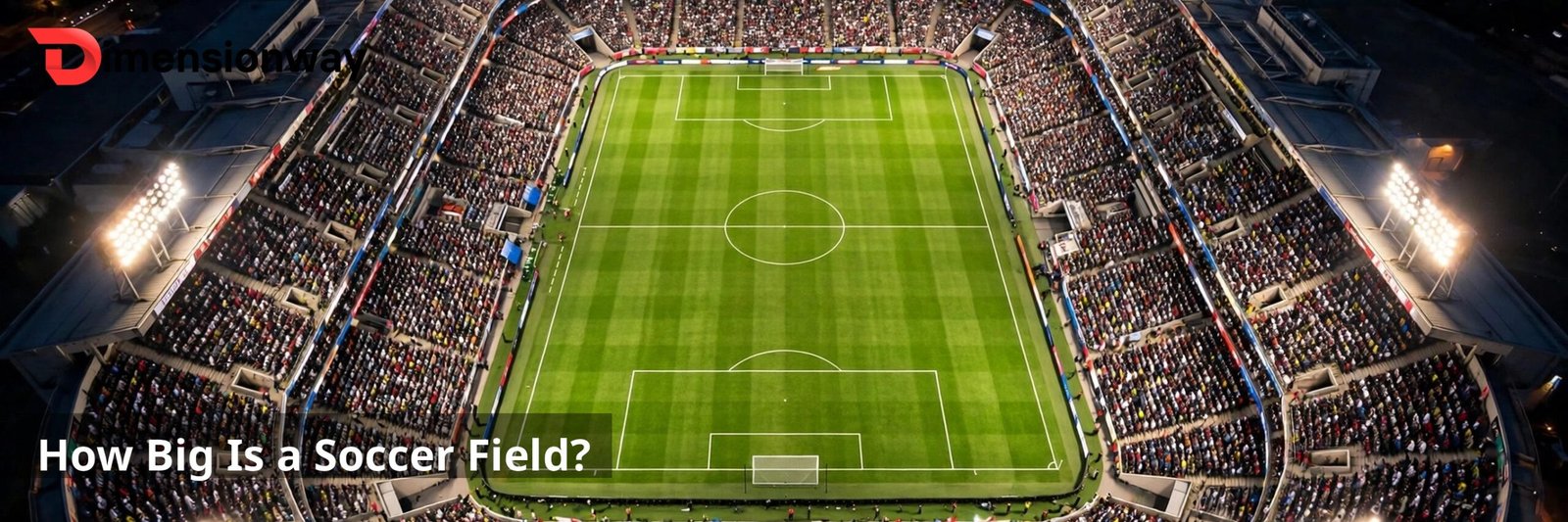
You have watched a hundred games on one and never really measured it. From the couch the pitch looks huge. From the front row it looks even bigger. And the weird part is that no two are exactly the same. Unlike American football, where every field is identical to the yard, soccer lets its fields vary, and that variation is written right into the laws of the game.
So how big is a soccer field, actually? It depends on who is playing. A World Cup final is not played on the same size pitch as your kid’s high school game, and a stadium built for its home team’s style of play can be measurably different from the one across town. The official FIFA recommendation is 105 by 68 meters, and that is the number this guide is built around. Hold onto it and every comparison below will snap into place.
One more thing to file away. Soccer people call it a pitch, not a field. Both words mean the same grass, but the pitch word survives from the days when cricket pitches gave English sport its vocabulary. Use either word and you will be understood. Use “pitch” and you will sound like you belong.
The Official Dimensions
The rules of soccer are written by the International Football Association Board, IFAB, and Law 1 covers the field of play. For international matches it sets a range: length between 100 and 110 meters, width between 64 and 75 meters. The FIFA recommended size sits near the middle of that range, 105 by 68 meters, and most top-flight professional stadiums build very close to it.
American fields have more slack. US high school soccer, under NFHS rules, allows fields from 100 to 120 yards long and 55 to 80 yards wide. College soccer allows up to 120 by 75 yards. But every field in the world, from a youth park to Wembley, shares the exact same markings, and those markings are what the table below lists.
| Marking | Official size | What it means on the grass |
|---|---|---|
| Touchline | 105 m (115 yd) | The long sides of the pitch |
| Goal line | 68 m (74 yd) | The short ends behind each goal |
| Penalty area | 16.5 m (18 yd) each direction | The “18 yard box,” 44 yards wide in total |
| Goal area | 5.5 m (6 yd) each direction | The “6 yard box,” 20 yards wide in total |
| Penalty spot | 11 m (12 yd) from the goal line | Where penalty kicks are taken |
| Penalty arc | 9.15 m (10 yd) radius | The D, keeps players 10 yards from the spot |
| Center circle | 9.15 m (10 yd) radius | 20 yards across, opponents wait outside it at kickoff |
| Goals | 7.32 m (8 yd) wide by 2.44 m (8 ft) high | The posts are 8 yards apart, the bar is 8 feet up |
| Corner arc | 1 m (1 yd) radius | The quarter circle at each corner flag |
| Line width | max 12 cm (5 in) | All markings, the same width everywhere |
Those markings are the constants. The 18 yard box is 18 yards at every level of the game, and the penalty spot is always 12 yards out. Only the outer rectangle is allowed to breathe, and it breathes within the ranges above. A World Cup pitch is always FIFA size, 105 by 68 meters or very close. Your local high school’s pitch might be a little narrower, a little shorter, or a little rounder. The goals never change.
10 Comparisons That Make a Soccer Pitch Click
A FIFA pitch: 105 by 68 meters, 115 by 74 yards, 7,140 square meters, about 76,850 square feet, 1.76 acres. Here is what that looks like next to things you already know.
One and a Third American Football Fields

An American football field, end zones included, is 360 by 160 feet, 57,600 square feet, 1.32 acres. Divide the pitch by that and you get 1.33. A soccer field is about a third bigger than an NFL field, mostly because it is so much wider: 74 yards of width against football’s 53.3.
Strip out football’s end zones and the gap widens. The 100 yards of actual playing field are 48,000 square feet, which means a soccer pitch holds 1.6 football playing fields. That extra width is the whole tactical story of soccer. Football plays on a track. Soccer plays on a lawn, and the lawn gives wingers somewhere to run.
Sixteen Basketball Courts
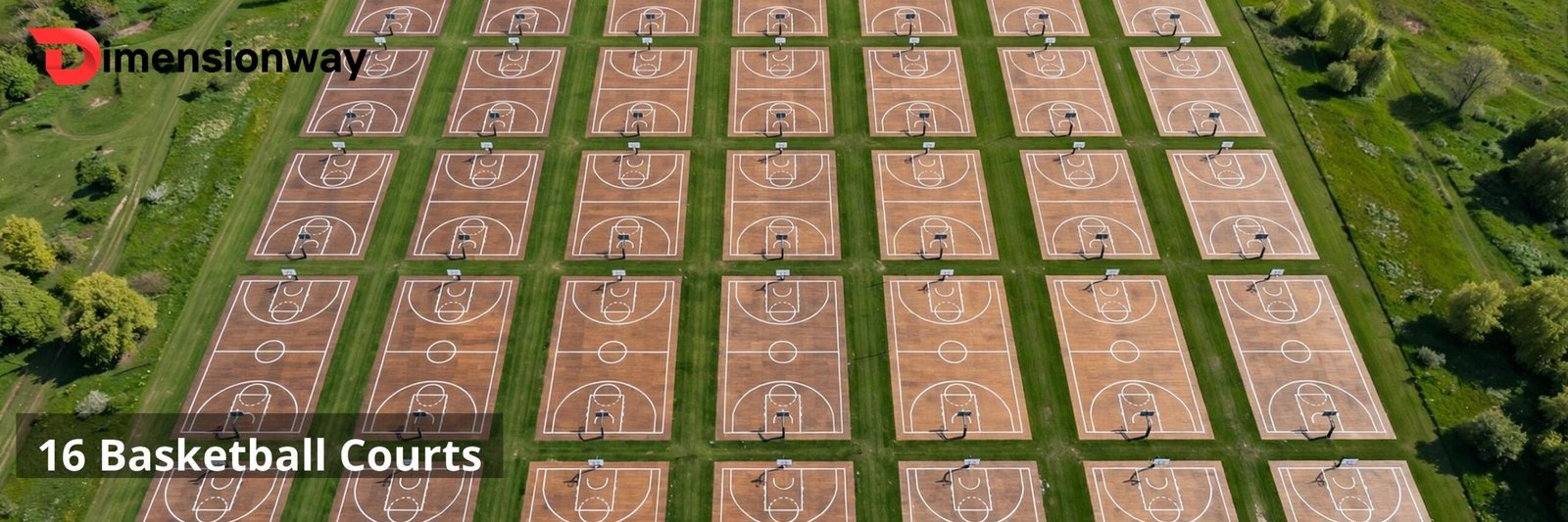
A regulation basketball court is 94 by 50 feet, 4,700 square feet. The pitch is 76,850 square feet. Divide one by the other and you get about 16.3, so call it sixteen basketball courts tiled across the pitch with room to spare.
This is the indoor version of the football comparison and it works for a different audience. Almost everyone has played on a basketball court. A court is 94 feet long, so the pitch is nearly four courts end to end, and two courts side by side only cover a third of the width. That is the width again. Soccer’s width is its defining dimension.
Twenty Seven Tennis Courts
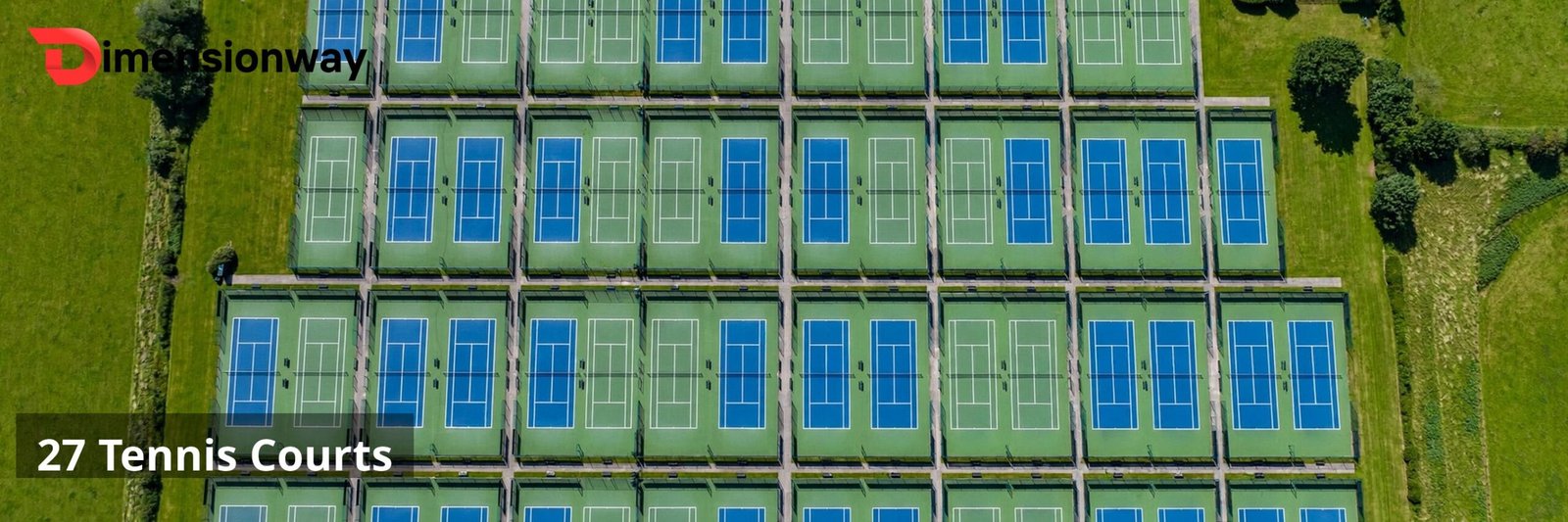
A tennis court is 78 by 36 feet, 2,808 square feet. Twenty seven of them tile across a soccer pitch with breathing room. If basketball is the court you played on as a kid, tennis is the court you played on as an adult, and both of them look small against the pitch.
The comparison works because tennis courts and soccer pitches are both measured in nice round meters at the elite level, but the scale gap is enormous. Twenty seven of one fit in one of the other. A soccer team defends space the way a tennis player never has to.
Forty Two Pickleball Courts

A pickleball court with the commonly recommended total playing space of 30 by 60 feet takes up 1,800 square feet. That means about 42 pickleball courts fit inside one soccer pitch. Forty two.
Pickleball is the fastest growing sport in America precisely because its footprint is tiny, and this comparison shows why. You can build a thriving pickleball club on a patch of ground that a soccer team would barely warm up on. Four pickleball courts fit on a single tennis court, and 42 of them vanish inside one pitch.
About One Fifth of Ten Acres

Ten acres is 435,600 square feet. A soccer pitch is 76,850. Divide and you get 5.7, so one pitch is about one fifth of ten acres. Our guide to how big 10 acres is uses the pitch as one of its anchor comparisons, and now you can see why. Land and sports venues translate well in both directions.
Five pitches plus a little parking is a ten acre community park. That is how most American youth soccer complexes are actually built: a ten acre parcel, five or six fields, a parking lot in the middle. The math of the park matches the math of this guide.
Two Hundred Seventy Five Parked Cars

A standard parking space with its share of driving lanes needs about 279 square feet per car. That puts roughly 275 cars on a soccer pitch. Our guide to how big a parking space is breaks down the space math in full.
Two hundred seventy five cars is a decent-sized matchday lot, which is exactly the point. Stadiums are ringed by parking because the pitch and the lot are close in scale. When the game ends, the crowd walks across a sea of cars roughly the size of the grass they were just watching.
Nearly Six Olympic Swimming Pools
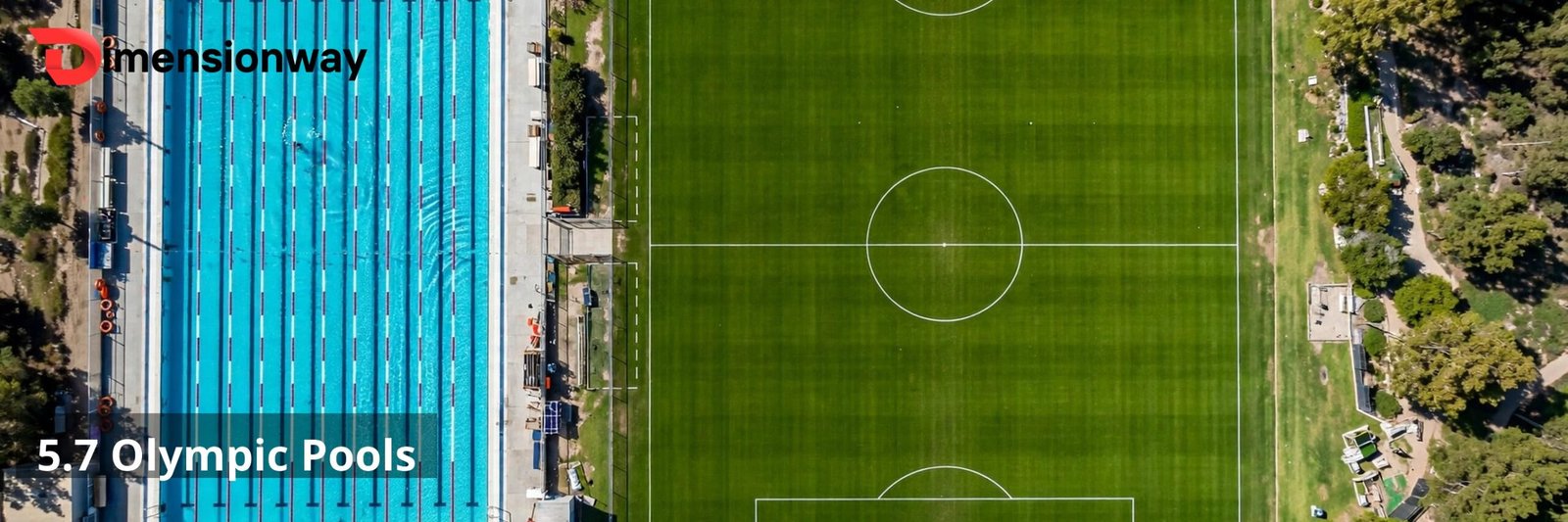
An Olympic pool is 50 by 25 meters, 1,250 square meters. A soccer pitch at 7,140 square meters holds 5.7 of them. Line up six Olympic pools and you have roughly covered the pitch.
The pool comparison is the water sport world’s answer to the football comparison, and the ratio is fun: 5.7 pools, 5.7 pitches on ten acres. The two numbers mirror each other because the area math is the same arithmetic. Big flat rectangles all translate.
Seven Tenths of a City Block

City blocks vary, but a widely used planning figure is about 2.5 acres per block. A 1.76 acre pitch covers roughly seven tenths of one. Put differently, a city block is one decent soccer pitch plus the sidewalks around it.
This is the urban version of the acres comparison. In a dense city, a full-size pitch is the biggest open space most neighborhoods have. When kids play soccer in a city park, they are usually playing on something smaller than FIFA size, often half a pitch or less, because the real thing is enormous by downtown standards.
A Four Minute Walk Around the Edge

The perimeter of a 105 by 68 meter pitch is 346 meters, about 1,135 feet, roughly 0.22 miles. At a relaxed 3 miles per hour you walk it in about 4 minutes. Walking straight across the width, 68 meters, takes under a minute.
This is the comparison you can test yourself. Any decent park path with a loop of about 350 meters is the boundary of a World Cup pitch. Our guide to how far a mile is has more of these walkable benchmarks, and the pitch is a good one: four laps around it is roughly a mile.
Thirty One Average American Homes

The average new American home covers about 2,500 square feet of floor area. A soccer pitch at 76,850 square feet holds the floor plans of about 31 of them, stacked side by side with nothing between them.
The house comparison closes the scale ladder from small to large. A basketball court is the thing you played on. A tennis court is the thing you play on. A football field is the spectacle. And a soccer pitch is the neighborhood: thirty one houses of grass, the biggest single piece of recreational land most people will ever stand on.
Soccer Against Other Sports Fields
Pitches, fields, and courts are the most honest comparisons in any measurement guide because they are all standardized. Here is the soccer pitch against the other big rectangles.
| Venue | Dimensions | Area (sq ft) | Acres | In soccer pitches |
|---|---|---|---|---|
| Soccer pitch, FIFA | 115 x 74 yd | 76,850 | 1.76 | 1 |
| American football, incl. end zones | 120 x 53.3 yd | 57,600 | 1.32 | 0.75 |
| American football, playing field only | 100 x 53.3 yd | 48,000 | 1.10 | 0.62 |
| Basketball court | 94 x 50 ft | 4,700 | 0.11 | 16 per pitch |
| Tennis court | 78 x 36 ft | 2,808 | 0.064 | 27 per pitch |
| Pickleball court, 30 x 60 total | 30 x 60 ft | 1,800 | 0.041 | 42 per pitch |
| Olympic pool | 50 x 25 m | 13,450 | 0.31 | 5.7 per pitch |
| Ice hockey rink | 200 x 85 ft | 17,000 | 0.39 | 4.5 per pitch |
The pickleball row is the one that keeps surprising people. Forty two courts on one pitch is the density champion of the table, and it explains the sport’s growth better than any trend piece. When the land is this cheap in sport-space terms, the sport spreads.
How Many Pitches Fit?
| Landmark | Size | Soccer pitches |
|---|---|---|
| 10 acres | 435,600 sq ft | 5.7 |
| City block, typical | about 2.5 acres | 0.7 |
| American football stadium, pitch area | 1.32 acres | 0.75 |
| Standard parking lot, 275 cars | 76,850 sq ft | 1 |
| Square mile | 640 acres | 363 |
| Central Park | 843 acres | 479 |
A square mile holds 363 pitches, which is the kind of number that makes the pitch feel small again. Scale is always relative. Next to a tennis court the pitch is a country. Next to a square mile it is a postage stamp. Central Park holds nearly 480 of them, which is why the park reads as wilderness from the street.
Meters, Yards, and Feet
The pitch is measured in meters by the rulebook and yards by American fans, so here is every key measurement translated.
| Measurement | Meters | Yards | Feet |
|---|---|---|---|
| Field length | 105 | 115 | 344 |
| Field width | 68 | 74 | 223 |
| Penalty area depth | 16.5 | 18 | 54 |
| Goal area depth | 5.5 | 6 | 18 |
| Penalty spot | 11 | 12 | 36 |
| Center circle radius | 9.15 | 10 | 30 |
| Goal width | 7.32 | 8 | 24 |
| Goal height | 2.44 | 2.7 | 8 |
| Corner arc radius | 1 | 1 | 3.3 |
| Area of a FIFA pitch | 7,140 sq m | 8,540 sq yd | 76,850 sq ft |
The goal line deserves one note. The goal is 7.32 meters wide, which is 8 yards, and 2.44 meters high, which is 8 feet. Those odd-looking metric numbers are just the original imperial measurements converted: eight yards by eight feet. The sport was measured in yards long before it was measured in meters, and the conversions still show their work.
FAQs

What is the official size of a soccer field?
FIFA recommends 105 by 68 meters for international matches, about 115 by 74 yards, covering roughly 1.76 acres. The Laws of the Game allow a range of 100 to 110 meters long and 64 to 75 meters wide for international play, so not every professional pitch is identical.
Why are soccer fields not all the same size?
Because the rulebook allows a range on purpose. Unlike American football, where the field is fixed to the yard, soccer lets clubs build within the allowed limits to suit their style of play: wider pitches favor teams that attack down the wings, compact ones favor high intensity pressing. International matches use the tighter 100 to 110 by 64 to 75 meter range.
How big is a high school soccer field?
Under US NFHS rules, high school fields may be 100 to 120 yards long and 55 to 80 yards wide. That is a wide range, which is why a high school pitch can feel noticeably smaller or larger than the professional one you see on television. College soccer allows up to 120 by 75 yards.
How big is a soccer field compared to a football field?
A FIFA soccer pitch is about a third bigger than an American football field including end zones, 1.76 acres against 1.32. The pitch is much wider, 74 yards against 53.3, which is the dimension that matters most in how the game is played.
How many basketball courts fit on a soccer field?
About 16. A regulation basketball court is 94 by 50 feet, 4,700 square feet, and a 76,850 square foot pitch holds roughly 16.3 of them. Tennis courts fit about 27 times, and pickleball courts about 42 times.
How big is the penalty box?
The penalty area extends 16.5 meters (18 yards) from each goalpost along the goal line and 16.5 meters into the field, making it 44 yards wide in total. The smaller goal area reaches 5.5 meters (6 yards) in both directions. The penalty spot sits 11 meters (12 yards) from the goal line.
How big is a soccer goal?
A regulation goal is 7.32 meters wide, 8 yards, and 2.44 meters high, 8 feet. Those numbers are the metric conversions of the original 8 yard by 8 foot imperial measurements. The goalposts and crossbar may be at most 12 centimeters thick.
How long does it take to walk across a soccer field?
Walking straight across the 68 meter width at a relaxed 3 miles per hour takes under a minute, about 50 seconds. Walking the full 346 meter perimeter takes about 4 minutes. Players in a professional match cover far more than that: outfielders typically run 6 to 7 miles per game.
What is the biggest a soccer field can be?
Under IFAB laws for non international matches, a field can be up to 120 meters long and 90 meters wide, which is about 2.67 acres. In practice, professional stadiums cluster near the FIFA recommended 105 by 68 meters, and the largest famous pitches, like some older English grounds, sit around 110 by 75 meters.
Can a soccer field fit in a backyard?
Almost never a full size one. A FIFA pitch needs 115 by 74 yards of flat ground, plus safety runoff around the lines, which is about the size of a city block. Most suburban lots are a quarter acre or less. What fits in a backyard is a small-sided game: a youth 7v7 field runs about 60 by 40 yards, and a kickabout needs far less than that.
Conclusion
A soccer field is 105 by 68 meters, 115 by 74 yards, 1.76 acres. It is one and a third American football fields, sixteen basketball courts, twenty seven tennis courts, forty two pickleball courts, and one fifth of ten acres. You can walk its width in under a minute and its perimeter in about four.
Keep the three pictures that matter. The football field, a third smaller. The sixteen basketball courts tiled across the grass. The walk around the edge, four minutes, a lap that pros cover at a sprint and fans cover with a hot dog. The next time the game kicks off, you will know exactly how much ground is under it.
Related Reading
– How Big Is 10 Acres? 10 Comparisons: 5.7 soccer pitches side by side, plus football fields, city blocks, and mowing times. – How Big Is a Parking Space? 10 Things That Size, Visualized: the 9 by 18 foot space that 275 of fit on a soccer pitch. – How Far Is a Mile? 10 Everyday Comparisons: four and a half laps of a soccer pitch make a mile.
Sources
- IFAB
- EatChay
- The18
- ItsAGoal
- OHSAA
- Anthem Sports
- SoccerExpertise
- St. James Winery

James Carter is the founder and editor of DimensionWay, where he researches, measures, and verifies real-world dimensions, from everyday objects to world-famous landmarks. Every number published on DimensionWay is cross-checked against manufacturer specifications and official sources, so readers always get accurate, easy-to-visualize comparisons.
