Your GPS says “in one mile, turn left,” and you glance at the road ahead wondering how far that really is. Is it two minutes away or ten? Can you walk it, or should you keep driving? Most of us use the mile every single day without ever picturing it. So how far is a mile in terms you can actually see? It is 5,280 feet, or about 1.6 kilometers, which is roughly a 20-minute walk or a one-minute drive at highway speed. The mile shows up in road trips, fitness goals, and race distances, so having a real mental picture of it pays off constantly. This guide gives you the exact conversions plus 10 everyday things that measure a mile, so the number finally feels real.

How Long Is a Mile?
A mile is the standard long-distance unit on American roads, the number on every highway sign and car odometer. It is long enough that walking it takes real effort, yet short enough to picture in familiar pieces.
The exact numbers: one mile equals 5,280 feet, 63,360 inches, 1,760 yards, 1,609.344 meters, and 1.609344 kilometers. The metric figure is exact by international agreement, set when the yard was defined as 0.9144 meters in 1959.
Why does picturing it matter? Because a mile is the distance behind almost every everyday estimate: how far the store is, how long your run was, whether you can make it on foot. Once you can see a mile, those estimates get sharper.
A Mile Conversion Tables
A Mile to Inches
| Miles | Inches |
|---|---|
| 0.25 | 15,840 |
| 0.5 | 31,680 |
| 1 | 63,360 |
| 2 | 126,720 |
| 5 | 316,800 |
A Mile to Meters
| Miles | Meters |
|---|---|
| 0.25 | 402.34 |
| 0.5 | 804.67 |
| 1 | 1,609.34 |
| 2 | 3,218.69 |
| 5 | 8,046.72 |
A Mile to Kilometers
| Miles | Kilometers |
|---|---|
| 0.25 | 0.40 |
| 0.5 | 0.80 |
| 1 | 1.61 |
| 2 | 3.22 |
| 5 | 8.05 |
10 Things That Measure About a Mile
Four Laps of a 400-Meter Track (Almost)

Here is the correction most running articles get wrong. A standard outdoor track lap is 400 meters, so four laps is 1,600 meters. A true mile is 1,609.344 meters. Four laps leaves you about 9.3 meters, roughly 31 feet, short of the full mile.
Runners discover this gap the honest way. You finish your fourth lap, stop your watch, and your “mile” time is a few seconds faster than it should be, because you never ran the last 31 feet. Most tracks solve this with a separate mile start line, a small mark about 9 meters behind the common finish, so a mile race starts slightly behind and finishes at the same line.
Track fans even have a nickname for the near miss. The 1,500-meter race is called the “metric mile,” but it is 109 meters shorter than a real one. The true mile still gets its own spotlight at famous indoor meets like the Wanamaker Mile at the Millrose Games.
About 17 and a Half Football Fields, End to End

An American football field measures 100 yards from goal line to goal line, and a mile holds 1,760 yards. Divide the two and you get 17.6 fields laid end to end.
Make it personal with a kickoff. When the ball sails the length of the field, that is 100 yards gone. Now imagine that same flight repeating more than 17 times without stopping. That is the distance your GPS means when it says one mile.
The mile has deep roots in this kind of counting. It equals exactly 8 furlongs, and horse racing still measures in furlongs today. A one-mile horse race is an 8-furlong race, and the Kentucky Derby, at 1.25 miles, is a 10-furlong classic.
About 20 City Blocks

In Manhattan, the blocks running north to south sit about 1/20 of a mile apart, roughly 264 feet. Walk 20 of them in a row and you have covered a mile.
This is the most useful city version of the mile. When someone says a restaurant is “20 blocks uptown,” that is about a mile on foot, or roughly a 20-minute walk at a normal pace. You can decide instantly whether to walk or hail a cab.
One caution before you trust it everywhere. The rule only works going north to south. Manhattan's east-west blocks are about three times longer, and other cities lay out their blocks completely differently. Always check which direction the blocks run.
132 School Buses, Bumper to Bumper

A classic Type C school bus measures about 40 feet long, and the math here is beautifully clean. Divide 5,280 feet by 40 and you get exactly 132, with nothing left over.
Picture the morning drop-off line at a big school. Now stretch it past the parking lot, around the corner, and several streets down. One hundred thirty-two buses nose to tail is a full mile of yellow steel rolling down the road.
The color itself has a story worth knowing. That yellow, officially called National School Bus Glossy Yellow, was standardized at a national conference in 1939 because it stays visible in every direction at dawn and dusk.
Denver: The Mile High City

Denver, Colorado sits at an elevation of exactly 5,280 feet above sea level, which is precisely one mile. The 15th step of the Colorado State Capitol building is engraved with the words “One Mile Above Sea Level,” and tourists line up to stand on it.
Flip the mile on its side and then stand it upright. If you are on that step, the ground at sea level is a full mile straight down beneath your feet. It is the same distance as your walk to the store, pointed at the sky.
Living a mile high changes daily life in small ways. Water boils at about 202 degrees Fahrenheit in Denver instead of 212, so recipes and cooking times have to adjust. The thin air is also why visiting sports teams famously run out of breath in the fourth quarter.
Almost Two Burj Khalifas, Laid End to End

The Burj Khalifa in Dubai stands 828 meters tall, the tallest building in the world. Two of them laid end to end would stretch 1,656 meters, which is just 47 meters more than a mile. So a mile is slightly less than two Burj Khalifas.
Try seeing it. The tallest structure humans have ever built, lying across your city, gets you only halfway to a mile. You need nearly all of a second one to finish the distance.
The tower has held the world's tallest title since its completion in 2010, with 163 floors of offices, residences, and observation decks. It is so tall that visitors on the upper floors can watch the sunset twice in one evening by riding the elevator down quickly.
About 21 Boeing 747s, Nose to Tail

A Boeing 747-8 stretches 250 feet 2 inches from nose to tail. Divide 5,280 feet by 250.17 and you land at about 21.1, so 21 jumbo jets in a row is just about a mile.
Airports give you this picture for free. Stand at the window during a busy departure bank and watch the lineup. Twenty-one of those double-decker giants waiting their turn would stretch a full mile down the taxiway.
The 747's famous hump has a practical origin. Boeing raised the cockpit so the nose could swing open as a cargo door on freighter versions, letting crews drive vehicles straight into the plane. The upper deck, once a first-class lounge, exists because of that design choice.
About 32 Lengths of an Olympic Pool

An Olympic pool is exactly 50 meters long. Divide the mile's 1,609.344 meters by 50 and you get 32.19, so about 32 lengths down and back 16 times.
Swimmers feel this one in their shoulders. Thirty-two lengths without stopping is a serious workout, and it shows why distance swimmers talk about the mile with respect. Each length looks short from the deck and endless from the water.
Competitive swimming has its own twist on the distance. The famous “mile” event in American pools is actually the 1,650-yard freestyle, which is about 1,509 meters, a touch short of a true mile. The name stuck even though the math does not quite match.
About 17 Statues of Liberty, Stacked

The Statue of Liberty measures 305 feet 1 inch from the ground to the tip of her torch. Divide 5,280 feet by 305.08 and you get 17.3, so about 17 statues stacked head to toe.
Some articles round this down to 16, but the honest math lands just past 17. Picture that green copper figure multiplied down New York Harbor seventeen times in a row. That line of statues is a mile long.
Her full name is “Liberty Enlightening the World,” and she was dedicated in 1886 as a gift from France. Her copper skin was once as shiny as a new penny before decades of oxidation turned it the familiar green.
About 350 Cars, Bumper to Bumper
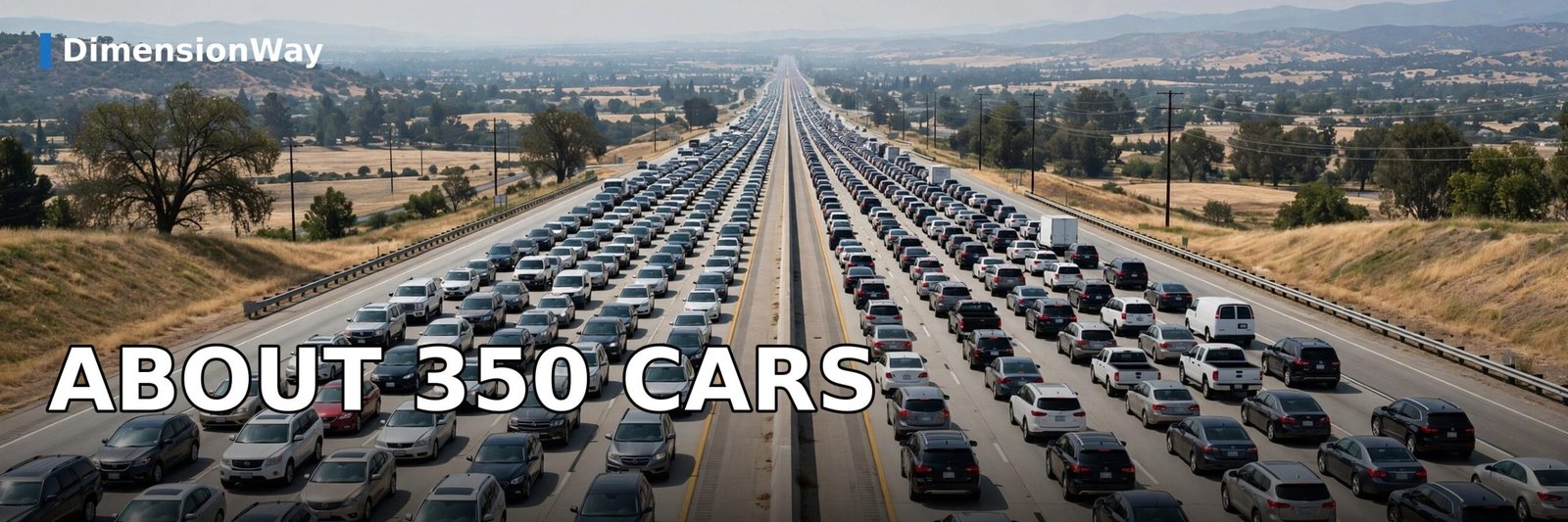
An average sedan is about 15 feet long. Divide 5,280 by 15 and you get 352, so roughly 350 cars parked bumper to bumper.
Every commuter has seen this one. Rush-hour traffic at a dead standstill, brake lights stretching as far as you can see down the highway, is a mile made visible. Three hundred fifty cars is what “a mile of traffic” actually looks like.
Here is the number that ties it to your drive. At 60 miles per hour, you roll past all 350 of those cars in exactly one minute. Next time traffic crawls, you will know precisely how long the jam is.
How Long Does It Take to Cover a Mile?
Time is the most practical way to feel a mile, because it changes completely with your speed. Here is how long one mile takes at common paces:
| Pace | Speed | Time for 1 Mile |
|---|---|---|
| Slow stroll | 2 mph | 30 min |
| Casual walk | 2.5 mph | 24 min |
| Normal walk | 3 mph | 20 min |
| Brisk walk | 4 mph | 15 min |
| Jog | 6 mph | 10 min |
| Run | 8 mph | 7 min 30 sec |
| Fast run | 10 mph | 6 min |
| Cycle | 12 mph | 5 min |
| Drive (city) | 30 mph | 2 min |
| Drive (highway) | 60 mph | 1 min |
Your stride decides how many steps the mile costs you. Using the common estimate that walking stride is about 0.413 times your height:
| Your Height | Approx. Stride | Steps for 1 Mile |
|---|---|---|
| 5 ft 4 in | 2.2 ft | About 2,400 |
| 5 ft 8 in | 2.3 ft | About 2,300 |
| 6 ft 0 in | 2.5 ft | About 2,110 |
| 6 ft 4 in | 2.6 ft | About 2,030 |
Research published in ACSM's Health and Fitness Journal backs up these ranges, finding about 2,252 steps per mile at a 20-minute pace and about 1,935 at a brisk 15-minute pace. If you want a precise number for your own pace, DimensionWay's Walk-Time Calculator does the math for you.
How to Visualize a Mile Yourself
Most people have said “it is about a mile away” a thousand times without ever testing what that means. The distance is memorized, not seen. Try these the next time a mile comes up. First, drive it. At 60 miles per hour on the highway, one mile takes exactly one minute, so time a minute on the clock between two mile markers. Second, walk it. At a normal pace a mile is about 20 minutes or roughly 2,000 steps, so anything a 20-minute walk away is about a mile. Third, count city blocks. In a gridded downtown, about 20 short blocks is close to a mile. Run any of these once and the distance stops being abstract. If you want to test your estimate on a map, DimensionWay's Distance Visualizer lets you draw a mile over your own neighborhood and see exactly where it lands.
FAQs
How many feet are in a mile?
A mile is exactly 5,280 feet. The figure was standardized in England in 1593 and has not changed since.
How many kilometers is a mile?
One mile equals 1.609344 kilometers, which most people round to 1.6 kilometers. Five miles is very close to 8 kilometers.
How long does it take to walk a mile?
At a normal walking pace of 3 miles per hour, a mile takes about 20 minutes. A brisk walker moving at 4 miles per hour can do it in about 15 minutes, while a slow stroll takes closer to 30.
How many steps are in a mile?
Most adults take about 2,000 steps to walk a mile, though it varies with height and pace. Taller people with longer strides may need closer to 1,900, while shorter walkers may take 2,400 or more.
How many laps around a track is a mile?
On a standard 400-meter track, four laps is 1,600 meters, which is about 9 meters short of a full mile. Competitive mile races start from a separate mile start line about 9 meters behind the common finish to make the distance exact.
Is a mile longer than a kilometer?
Yes. One mile is 1.609 kilometers, so a mile is about 61 percent longer than a kilometer. This is why a 5K race (3.1 miles) feels much shorter than a 5-mile race.
How long does it take to drive a mile?
At 60 miles per hour, one mile takes exactly one minute. At 30 miles per hour in city traffic, it takes two minutes.
How many football fields are in a mile?
About 17.6. A football field is 100 yards goal line to goal line, and a mile holds 1,760 yards, so 17 full fields plus a little more than half of another.
What is the difference between a statute mile and a nautical mile?
A statute mile, the mile used on roads, is 5,280 feet. A nautical mile, used in sea and air navigation, is 6,076 feet (1,852 meters), defined as one minute of latitude. They are different units for different jobs.
Why is a mile 5,280 feet?
The mile was set at 8 furlongs, and each furlong was 660 feet, giving 5,280 feet. Queen Elizabeth I standardized it by statute in 1593, and the odd-looking number has survived ever since.
Conclusion
So how far is a mile? It is 5,280 feet, 1.609 kilometers, about 17 and a half football fields, 20 city blocks, or 132 school buses in a row. Picture a 20-minute walk, a one-minute highway drive, or Denver standing a full mile above the sea, and you have it. The next time your GPS, your running app, or a road sign says one mile, you will not need to guess what that means. Once your eyes learn the distance, you will start spotting mile-long stretches everywhere you go.
Related Reading
- How Long Is 100 Feet?: a much shorter everyday distance, with ten visual comparisons.
- How Far Is 500 Feet?: a fraction of a mile, visualized with familiar objects.
- How Far Is 200 Feet?: another everyday distance, visualized with familiar objects.
Sources
- Wikipedia and Simple English Wikipedia, “Mile”: 5,280 feet, 1,760 yards, exactly 1,609.344 meters; international agreement of 1959; statute mile standardized at 8 furlongs in 1593.
- NOAA: nautical mile defined as 1,852 meters (about 6,076 feet).
- World Athletics: standard outdoor track lap is 400 meters; Millrose Games hosts the Wanamaker Mile.
- Boeing: 747-8 length 250 feet 2 inches.
- Burj Khalifa official facts: height 828 meters, 163 floors, completed 2010.
- National Park Service: Statue of Liberty measures 305 feet 1 inch from ground to torch; dedicated 1886, gift from France.
- National Association of State Directors of Pupil Transportation Services: full-size school buses 35 to 45 feet long; National School Bus Glossy Yellow standardized 1939.
- Colorado State Capitol: “One Mile Above Sea Level” marker on the 15th step; Denver elevation 5,280 feet.
- ACSM's Health and Fitness Journal: steps per mile by pace (2,252 at 20-minute mile pace; 1,935 at 15-minute pace).
- USA Swimming: the 1,650-yard freestyle is nicknamed the “mile” swim.

James Carter is the founder and editor of DimensionWay, where he researches, measures, and verifies real-world dimensions — from everyday objects to world-famous landmarks. Every number published on DimensionWay is cross-checked against manufacturer specifications and official sources, so readers always get accurate, easy-to-visualize comparisons.

1 thought on “How Far Is a Mile? A Visual Guide With Everyday Comparisons”