
You are standing at the edge of a parking lot, looking at a store sign that says “1 mile ahead.” Or maybe your fitness app just challenged you to walk a mile a day. Either way, the same question pops up. How long does it take to walk a mile?
It is one of the most common walking questions in the US, and the answer is refreshingly simple. For most adults, walking a mile takes about 20 minutes. That is the headline number. But your real time depends on your pace, your age, the terrain, and even the shoes on your feet.
A mile is 5,280 feet, or about 1.6 kilometers. It is the distance most Americans use to judge a walk, a run, or a commute. This guide gives you the exact answer: the real time at every common walking pace, how many steps a mile takes, what slows you down or speeds you up, and a few tricks to picture the distance while you walk it.
How Long Does It Take to Walk a Mile?

The short answer: about 20 minutes at an average walking pace.
Most healthy adults walk at roughly 3 miles per hour. At that speed you are moving at 4.4 feet per second, and covering 5,280 feet takes exactly 1,200 seconds, which is 20 minutes. Researcher Richard W. Bohannon’s gait studies found that comfortable walking speed in adults ranges from about 1.27 to 1.46 meters per second, roughly 2.8 to 3.3 miles per hour, right in line with that figure.
In real life, expect a range. A relaxed stroll can stretch a mile to 30 minutes. A brisk, purposeful walk can finish it in 15. Want the number for your own pace? The Walk-Time Calculator does the math for you: enter any speed and it converts it into exact travel time for any distance.
Walking Time at Every Common Pace

One number never fits every walker. The table below shows the exact time for one mile at seven common paces. The formula behind every cell is simple: feet per second equals miles per hour multiplied by 1.46667, and time equals 5,280 divided by feet per second.
| Walking Pace | Speed | Feet per Second | Time for 1 Mile |
|---|---|---|---|
| Leisurely stroll | 2 mph | 2.93 ft/s | 30.0 minutes |
| Easy walk | 2.5 mph | 3.67 ft/s | 24.0 minutes |
| Average walk | 3 mph | 4.40 ft/s | 20.0 minutes |
| Brisk walk | 3.5 mph | 5.13 ft/s | 17.1 minutes |
| Fast walk | 4 mph | 5.87 ft/s | 15.0 minutes |
| Very brisk walk | 4.5 mph | 6.60 ft/s | 13.3 minutes |
| Light jog | 6 mph | 8.80 ft/s | 10.0 minutes |
A few observations make this table more useful. The average American adult walks near 3 miles per hour, so 20 minutes is the number most people should carry in their heads. Notice how sensitive the time is to pace: dropping from 3 mph to 2 mph adds a full 10 minutes, while pushing from 3 mph to 4 mph saves 5. And the jog row shows the math working cleanly: doubling your speed from 3 mph to 6 mph cuts the time exactly in half.
How Many Steps Does It Take to Walk a Mile?

Around 2,000 steps for the average adult.
The commonly cited average step length is about 2.5 feet for men and 2.2 feet for women, based on published step-length research using real gait measurements. Divide 5,280 by 2.5 and you get 2,112 steps. Using the women’s average of 2.2 feet, it comes out to 2,400 steps. The round figure of 2,000 steps per mile is the one most fitness trackers and health guides use, and it is close enough for planning.
Steps per Mile by Height
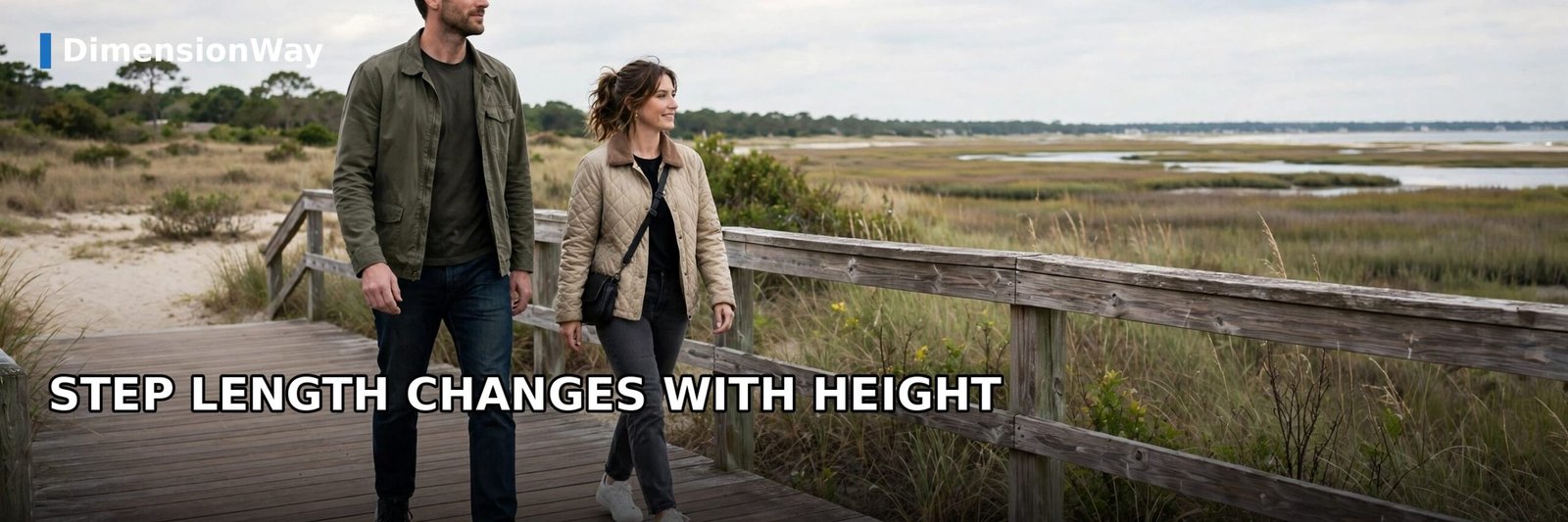
Taller people take longer steps, so height changes the count. A widely used estimate puts step length at roughly 41 percent of your height. Here is what that works out to for one mile:
| Your Height | Step Length | Steps per Mile |
|---|---|---|
| 5’0″ | 2.05 ft | About 2,580 |
| 5’4″ | 2.19 ft | About 2,410 |
| 5’8″ | 2.32 ft | About 2,270 |
| 6’0″ | 2.46 ft | About 2,150 |
| 6’4″ | 2.60 ft | About 2,030 |
The pattern is clear: a 6-foot-4 walker finishes a mile in roughly 500 fewer steps than a 5-foot walker. If you wear a fitness tracker, check its step count after a known mile walk once. That single calibration makes every future estimate personal and far more accurate.
What Affects Your Walking Speed
Your mile time is not fixed. These five factors move it up or down, sometimes by several minutes.
Your Age

Walking speed naturally slows with age. Bohannon’s gait research shows comfortable speed declining decade by decade after middle age. Adults in their 70s often walk closer to 2 to 2.5 miles per hour, which stretches a mile to roughly 24 to 30 minutes. That is completely normal. The health benefits of the walk do not depend on the stopwatch.
Your Fitness Level
Regular walkers are faster walkers. Someone who walks daily builds stronger legs and better cardio efficiency, often settling near 3.5 miles per hour without feeling rushed. A beginner starting from the couch may begin near 2.5 mph and gain speed within a few weeks of consistent walking. Fitness does not just change your mile time. It changes how easy the mile feels.
Terrain and Weather

A flat paved sidewalk is the fastest surface. Grass, gravel, sand, and muddy trails all slow you down, sometimes by 10 to 20 percent. Rain, strong headwinds, and extreme heat cost you time too. If your mile includes a park trail instead of a sidewalk, add a few minutes to whatever the table says.
What You Are Carrying
A light daypack barely matters. A heavy backpack, grocery bags, or a child on your shoulders absolutely does. Carrying a load changes your posture and shortens your stride. Hikers with full packs commonly plan on 2 to 2.5 miles per hour instead of 3, which turns a 20-minute mile into a 24 to 30-minute one.
Hills and Slopes: Naismith’s Rule

Hills are the biggest single factor. Naismith’s rule, the classic hill-walking formula from Scottish mountaineering, says to allow one hour for every 3 miles of distance plus 30 minutes for every 1,000 feet of climbing. Applied to a mile: at a 3 mph base pace the flat mile takes 20 minutes, and 500 feet of climbing adds 15 minutes, for a 35-minute uphill mile. On the way back down, you get most of that time back.
How to Visualize a Mile While You Walk

Numbers are abstract. Pictures stick. Here are four ways to feel what a mile really is.
First, the running track. Four laps around a standard 400-meter track totals 1,600 meters, which is just 9 meters short of a full mile. If you have ever jogged four laps, you have essentially covered a mile.
Second, the city grid. In a typical US city layout, a mile is about 20 short blocks. Next time someone says “it’s about a mile,” picture 20 blocks and you will be close.
Third, the football field. Laid end to end, it takes about 18 football fields (including end zones) to make a mile. For more ways to picture this classic American distance, see our full guide to how far a mile really is.
Fourth, the kilometer connection. A mile is about 1.6 kilometers, so it is roughly one and a half times the metric distance most of the world uses. Our kilometer visual guide shows what that looks like next to everyday objects.
5 Simple Tips to Walk a Mile Faster

You do not need to run. Small form fixes can shave minutes off your mile.
1. Stand tall. Imagine a string pulling the top of your head upward. Good posture opens your lungs and lets your legs swing freely.
2. Swing your arms. Bent elbows, arms pumping front to back (not across your body). Your legs naturally follow your arm tempo.
3. Take quicker, shorter steps. Overstriding slows you down and jars your joints. Aim for a faster cadence instead of longer lunges.
4. Wear real walking shoes. Cushioned, supportive shoes with a flexible forefoot make every step cheaper in energy.
5. Warm up the first two minutes. Start easy, then settle into your brisk pace. Your body moves more efficiently once blood is flowing.
Most people can cut 2 to 3 minutes off their mile within a month just by applying the first three tips.
FAQs

How long does it take to walk a mile at 3 mph?
Exactly 20 minutes. At 3 miles per hour you cover 4.4 feet per second, and 5,280 feet divided by 4.4 equals 1,200 seconds.
How many steps are in a mile?
About 2,000 steps for the average adult. Taller people take fewer steps (around 2,030 at 6’4″) and shorter people take more (around 2,580 at 5’0″).
Is a 20-minute mile good?
Yes, it is a solid average. A 20-minute mile means you are walking at 3 mph, the standard moderate pace. A 15-minute mile (4 mph) is brisk and athletic.
How long does it take to walk a mile on a treadmill?
The same as outdoors at the same speed: 20 minutes at a 3.0 mph treadmill setting. Treadmills make pacing easy because the belt sets your speed for you.
How many calories do you burn walking a mile?
Roughly 80 to 100 calories for an average-size adult. Heavier walkers burn more, lighter walkers burn less, and hills add to the total.
How long does it take to walk 2 miles?
About 40 minutes at an average 3 mph pace. Simply double the single-mile time from the pace table above.
Can you walk a mile in 10 minutes?
Only at 6 miles per hour, which is a light jog or a racewalking pace, not a normal walk. For most people, 10 minutes per mile means running.
How long does it take an older adult to walk a mile?
Often 25 to 35 minutes, at a comfortable 2 to 2.5 mph pace. Speed naturally declines with age, and a relaxed pace still delivers the health benefits.
How many city blocks is a mile?
About 20 short blocks in a typical US city grid. Longer blocks (common in the western US) can make it closer to 12 to 15.
What is a good mile walking time for a beginner?
Twenty to 25 minutes is a great starting goal. Walk at a pace where you can still hold a conversation, and let speed come with consistency.
Conclusion

Walking a mile takes about 20 minutes at an average pace of 3 miles per hour, which works out to roughly 2,000 steps. Slow down to a stroll and it becomes 30 minutes. Push to a brisk 4 mph and you are done in 15. Age, fitness, terrain, load, and hills all nudge the number, and Naismith’s rule keeps your hilly estimates honest.
The 20-minute mile is one of the most useful numbers in everyday fitness. It turns “about a mile away” into a real plan. Next time you see that sign, you will know exactly how long the walk will take. For the shorter version of this question, see how long it takes to walk 100 feet.
Related Reading
– How Long Does It Take to Walk 100 Feet? – How Far Is a Mile? A Visual Guide – How Long Is a Kilometer?
Sources
– U.S. Centers for Disease Control and Prevention (CDC): moderate-intensity walking pace of about 3 mph – Richard W. Bohannon, published gait-speed research: comfortable adult walking speed 1.27 to 1.46 m/s – Naismith’s rule (William W. Naismith, Scottish Mountaineering Club journal, 1892): 1 hour per 3 miles plus 30 minutes per 1,000 ft of ascent – World Athletics: standard outdoor running track of 400 meters per lap – Published step-length research: average step length about 2.5 ft (men) and 2.2 ft (women); step length roughly 41 percent of height

James Carter is the founder and editor of DimensionWay, where he researches, measures, and verifies real-world dimensions — from everyday objects to world-famous landmarks. Every number published on DimensionWay is cross-checked against manufacturer specifications and official sources, so readers always get accurate, easy-to-visualize comparisons.
