You have done it a hundred times without thinking: you park at the far corner of a lot, you walk a long office hallway, or you cross from one end of a sports field to the other. And somewhere in the middle of that short trip, a simple question pops up. How long does it take to walk 100 feet?
A hundred feet is one of those everyday distances. It is about a third of the length of an American football field between the goal lines, and it is roughly the length of a typical city sidewalk block segment. You will run into it when you time a commute, plan a wedding aisle, or track your daily steps. This guide answers the question exactly: the real time at every common walking pace, how many steps it takes, what changes your speed, and a few tricks to picture the distance while you walk it.
How Long Does It Take to Walk 100 Feet?
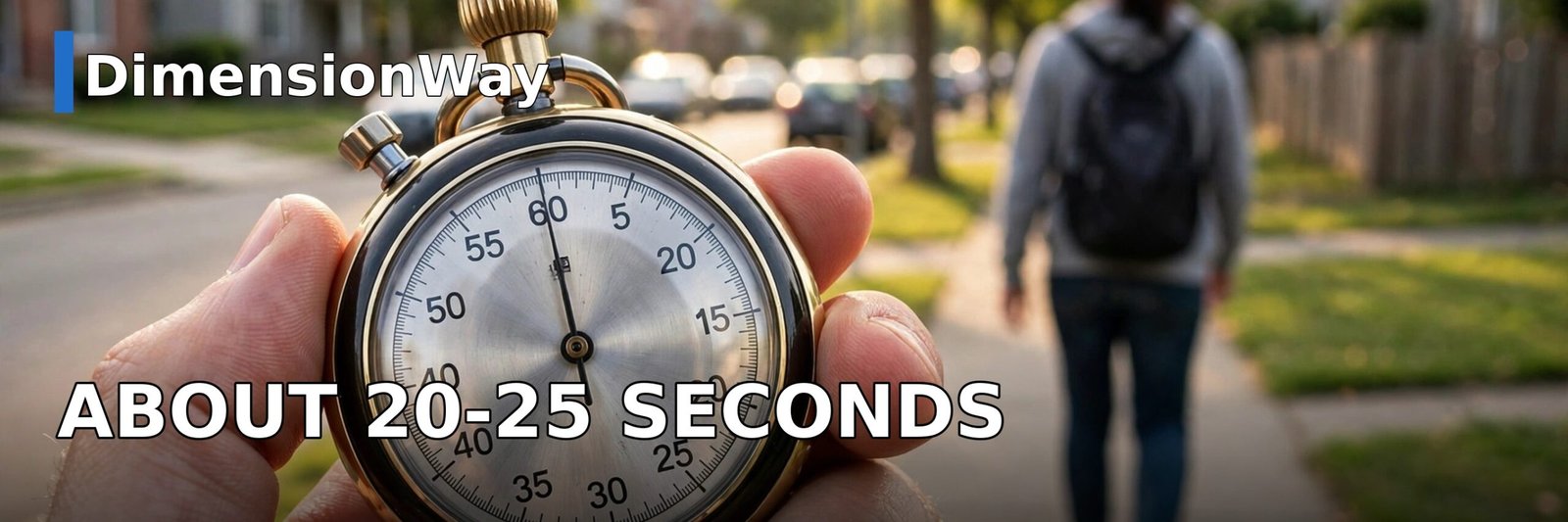
The short answer: about 20 to 25 seconds at an average walking pace.
Most healthy adults walk at roughly 3 to 4 miles per hour. At 3 miles per hour you are moving at 4.4 feet per second, so covering 100 feet takes about 22.7 seconds. Researcher Richard W. Bohannon’s gait studies found that comfortable walking speed in adults ranges from about 1.27 to 1.46 meters per second, which is roughly 2.8 to 3.3 miles per hour, right in line with that figure.
If you are in no hurry, expect closer to 30 seconds. If you are walking briskly, you can be done in under 20. Want the number for your own pace? Plug your speed into the Walk-Time Calculator and it does the math for you: it converts any speed into exact feet per second and travel time for any distance.
How Long It Takes at Different Walking Speeds

One number never fits every walker. Below is the exact time for 100 feet at five common walking paces, plus a light jog for comparison. The formula behind every cell is simple: feet per second equals miles per hour multiplied by 1.46667, and time equals 100 divided by feet per second.
| Walking Pace | Speed | Feet per Second | Time for 100 Feet |
|---|---|---|---|
| Leisurely stroll | 2 mph | 2.93 ft/s | 34.1 seconds |
| Easy walk | 2.5 mph | 3.67 ft/s | 27.3 seconds |
| Average walk | 3 mph | 4.40 ft/s | 22.7 seconds |
| Brisk walk | 3.5 mph | 5.13 ft/s | 19.5 seconds |
| Fast walk | 4 mph | 5.87 ft/s | 17.0 seconds |
| Light jog | 6 mph | 8.80 ft/s | 11.4 seconds |
A few observations make this table more useful. The average American adult walks near 3 miles per hour, so 22 to 23 seconds is the number most people should carry in their heads. A leisurely window-shopping pace of 2 mph stretches the same trip to 34 seconds, which is about one and a half times as long. And notice the jog row: doubling your speed from 3 mph to 6 mph cuts the time roughly in half, which is exactly what the math predicts.
How Many Steps Does It Take to Walk 100 Feet?
Around 40 steps for the average adult.
The commonly cited average step length is about 2.5 feet for men and 2.2 feet for women, according to published step-length research using real gait measurements. Divide 100 by 2.5 and you get exactly 40 steps. Using the women’s average of 2.2 feet, it comes out to about 45 steps.
Steps for 100 Feet by Height
Taller people take longer steps, so height changes the count. A widely used estimate puts step length at roughly 41 percent of your height. Here is what that works out to for 100 feet:
| Your Height | Estimated Step Length | Steps for 100 Feet |
|---|---|---|
| 5’0″ | 2.06 ft | about 48 |
| 5’3″ | 2.17 ft | about 46 |
| 5’6″ | 2.27 ft | about 44 |
| 5’9″ | 2.37 ft | about 42 |
| 6’0″ | 2.48 ft | about 40 |
| 6’3″ | 2.58 ft | about 39 |
Two honest caveats. First, these are estimates: your real step length depends on speed too, because steps stretch longer when you walk faster. Second, the simplest way to get your own number is to walk a measured 100 feet and count. Forty steps is the answer for most people, but your number is the one that matters for your fitness tracker.
What Affects Your Walking Speed
Two people can walk the same 100 feet and finish ten seconds apart. These are the reasons.
Your Age

Walking speed declines with age, and the research is consistent on it. Bohannon’s gait studies show comfortable speed dropping from about 1.46 meters per second for men in their forties to about 1.27 meters per second for women in their seventies. In practical terms, a fit 30-year-old covers 100 feet in about 22 seconds, while a 75-year-old strolling comfortably may need 30 to 35 seconds. That is completely normal, not a flaw.
Your Fitness Level
Regular walkers move faster than occasional ones. Cardio fitness, leg strength, and even posture all feed into pace. A sedentary person starting a walking habit might hold 2.5 mph comfortably, while the same person after a few months of daily walks often settles near 3.5 mph without trying. The gap between those two speeds over 100 feet is nearly 8 seconds.
Terrain and Weather

A flat, dry sidewalk is the fastest surface. Gravel, grass, mud, and uneven trails all cost time because each step needs more attention. Wet pavement, ice, wind, and extreme heat slow most people down further. If your 100 feet runs across a soggy lawn instead of a driveway, add several seconds to every estimate in the table above.
What You Are Carrying
A heavy grocery bag in each hand changes how you walk. Carrying a load shortens your steps and slows your cadence, sometimes by 10 to 20 percent. Parents carrying a toddler know this instinct well: the distance is the same, but the trip feels longer because your pace quietly drops.
Hills and Slopes: Naismith’s Rule

Uphill walking deserves its own rule. Back in 1892, Scottish mountaineer William W. Naismith published a famous rule of thumb for estimating walking time: allow one hour for every 3 miles of distance, plus an extra half hour for every 1,000 feet of climb. In metric terms, that is 5 kilometers per hour plus 30 minutes per 300 meters of ascent.
Naismith devised the rule while exploring the Crianlarich hills of Scotland, and he was one of the founders of the Scottish Mountaineering Club. For a short 100-foot stretch, the rule’s spirit still applies: a steep slope can easily double your time compared to flat ground. So if your 100 feet includes a hill, treat the table numbers as a floor, not a promise.
How to Visualize 100 Feet While You Walk

Numbers stick better when you can feel them. Try these mental anchors the next time you cover the distance.
First, the hallway test. Many office hallways, school corridors, and hotel corridors run close to 100 feet end to end. Walk one at your normal pace and notice how long it takes: about 22 seconds, about 40 steps. From then on, any hallway of that length is your built-in 100-foot ruler.
Second, the parking lot test. A standard parking space is about 18 feet deep, so 100 feet is roughly five and a half parking spaces in a row. Park at the far end of a lot, pick a landmark five or six spaces away, and walk to it. You have just walked 100 feet, and you now own the feeling of it.

Third, the stopwatch trick. Next time the question comes up in conversation, time yourself. Walk what you believe is 100 feet, count your steps, and check the seconds. Most people land between 38 and 45 steps and 20 to 27 seconds. That single experiment beats any table for making the measurement real.
For a deeper look at what 100 feet actually looks like from every angle, our illustrated guide to how long 100 feet is pairs measurements with everyday objects, and the walk-time calculator handles any distance you throw at it.
5 Simple Tips to Walk a Little Faster

If your goal is a brisker pace, small technique changes beat willpower. These five come from walking coaches and gait research.
1. Stand tall and look ahead. Slouching shortens your stride. Eyes forward, chin level, and your steps naturally lengthen.
2. Swing your arms. A relaxed arm swing, bent at roughly 90 degrees, counterbalances your legs and adds free speed.
3. Push off your back foot. Think about rolling through the step and pushing off the toes instead of shuffling flat-footed.
4. Shorten the warmup. The first few steps are always slower. After 10 to 15 feet you reach your cruising pace, so a 100-foot trip is mostly steady walking.
5. Track it once a week. Time the same hallway or sidewalk weekly. Seeing 26 seconds drop to 23 is the motivation that keeps the habit alive.
None of this requires athletic gear or a training plan. A slightly taller posture and a real arm swing can move a casual walker from 2.5 mph to 3 mph, which turns a 27-second trip into a 23-second one.
FAQs

How many seconds does it take to walk 100 feet?
About 20 to 25 seconds at an average walking pace of 3 to 4 miles per hour. The exact math: 3 mph equals 4.4 feet per second, so 100 feet takes 100 divided by 4.4, which is about 22.7 seconds.
How many steps is 100 feet?
Roughly 40 steps for an average adult with a 2.5-foot step length. Women with a shorter average step of 2.2 feet take about 45 steps, and taller people may take as few as 38.
What is Naismith’s rule?
It is a hiking time estimate created by Scottish mountaineer William W. Naismith in 1892. The rule: allow one hour per 3 miles of distance plus half an hour per 1,000 feet of climb (or 5 km per hour plus 30 minutes per 300 meters of ascent). It is still the most quoted rule of thumb in hillwalking.
How long does it take an elderly person to walk 100 feet?
Typically 30 to 40 seconds at a comfortable pace of around 2 miles per hour. Gait studies show comfortable walking speed declines with age, from about 1.46 meters per second in middle age to about 1.27 meters per second for adults in their seventies.
How long does it take a child to walk 100 feet?
About 30 to 35 seconds. Children have shorter step lengths, roughly 1.5 to 2 feet depending on age, so they need 50 to 65 steps to cover 100 feet, and their natural walking speed is slower than an adult’s.
How long does it take to run 100 feet?
About 11 seconds at a light jog of 6 mph, and roughly 7 seconds in an all-out sprint near 10 mph. For perspective, that is the speed range of a casual pickup game, not an Olympic final.
What treadmill speed equals a normal 3 mph walk?
Set the treadmill to 3.0 mph. At that setting you cover 4.4 feet per second, so 100 feet takes about 23 seconds. Most treadmills also show distance in miles; 100 feet is about 0.019 miles, so watch for the display to tick from 0.00 to 0.02.
Is 100 feet the same as 100 yards?
No. One yard is 3 feet, so 100 yards equals 300 feet, which is three times 100 feet. It takes about three times as long to walk: roughly 68 seconds at an average pace. Our guide to how far 300 feet is breaks that distance down in the same detail.
How many feet per second does an average person walk?
About 4.4 to 5.9 feet per second, which corresponds to 3 to 4 miles per hour. Researchers measure comfortable gait speed at roughly 1.27 to 1.46 meters per second in healthy adults, which converts to the same range.
How can I measure 100 feet without a tape measure?
Count 40 of your normal steps, which is the average step count for 100 feet. Alternatively, time about 22 seconds of steady walking, or use a free GPS measuring app on your phone while you walk the stretch once.
Conclusion

Walking 100 feet takes about 20 to 25 seconds at a normal pace, roughly 40 steps, and a little under half a minute if you are strolling. The table above gives you the exact number for any speed from a 2 mph amble to a 4 mph power walk, and the step chart adjusts for your height. Next time you cross a parking lot or walk a long hallway, count the seconds: you will feel how naturally the measurement fits into daily life.
Related Reading
Walk-Time Calculator: enter any speed and distance for an exact travel time in seconds, minutes, or hours.
How Long Is 100 Feet? 10 Examples, Visualized: see the distance itself, from football fields to blue whales, with a real picture of each.
How Far Is 300 Feet? 10 Examples, Visualized: the triple-size cousin of this guide, three times the walk and three times the examples.
Sources
Bohannon, R.W.: “Comfortable and maximum walking speed of adults aged 20-79 years: reference values and determinants,” Age and Ageing (1997): verified mean comfortable gait speed ranging from 127.2 cm/s (women in their seventies) to 146.2 cm/s (men in their forties).
Bohannon, R.W. & Williams Andrews, A.: “Normal walking speed: a descriptive meta-analysis,” Physiotherapy (2011): verified the general normal walking speed guideline of roughly 1.2-1.4 m/s cited in gait research.
Wikipedia: “Naismith’s rule”: verified the rule was devised by William W. Naismith in 1892; original form one hour per 3 miles plus one hour per 2,000 feet of ascent; modern metric form 5 km/h plus 30 minutes per 300 m of ascent.
grough.co.uk: “Just a minute, Mr Naismith, can that be right?”: verified Naismith was a founder of the Scottish Mountaineering Club and formulated the rule while walking the Crianlarich hills (Cruach Ardrain, Ben More, Stob Binnein).
Sensors (MDPI, 2022): “Real-Time Step Length Estimation in Indoor and Outdoor Scenarios”: verified average walking step length of 2.5 feet for men and 2.2 feet for women (76.2 cm and 67.1 cm).
Answers.com: “How long would it take you to walk 100ft?”: verified competitor consensus that an average 3-4 mph pace covers 100 feet in about 20-25 seconds.
adlmag.net: “How Long Does It Take to Walk 2,000 Feet”: verified the average human walking speed figure of 3.5 miles per hour and the 0.38-minute (22.7-second) time for 100 feet at 3 mph.

James Carter is the founder and editor of DimensionWay, where he researches, measures, and verifies real-world dimensions — from everyday objects to world-famous landmarks. Every number published on DimensionWay is cross-checked against manufacturer specifications and official sources, so readers always get accurate, easy-to-visualize comparisons.
