Five hundred feet is one of those distances you hear all the time but rarely picture. A delivery driver says the drop-off is 500 feet ahead. A trail sign says the viewpoint is 500 feet up the path. You nod, but in your head the number has no shape.
How far is 500 feet in terms you can actually see? This guide gives you the exact numbers, the walking time, and ten real things that measure about 500 feet, from football fields to famous landmarks. Read it once, and you will start spotting 500-foot stretches everywhere you go.
How Far Is 500 Feet?
Five hundred feet is a long city stretch, longer than a full football field but shorter than two. It is the kind of distance you can walk in about two minutes, and it is short enough that you can still see details at the far end on a clear day.
The exact numbers: 500 feet equals 6,000 inches, 15,240 centimeters, 152.4 meters, and 166.67 yards. In metric terms, that is just over 152 meters, roughly one and a half soccer fields laid end to end.
This distance shows up in running routes, golf courses, construction sites, and hiking trails. Once you can picture it, judging a 500-foot gap becomes as natural as judging the length of a room.
500 Feet Conversion Tables
500 Feet to Inches
| Feet | Inches |
|---|---|
| 400 | 4,800 |
| 450 | 5,400 |
| 500 | 6,000 |
| 550 | 6,600 |
| 600 | 7,200 |
500 Feet to Meters
| Feet | Meters |
|---|---|
| 400 | 121.92 |
| 450 | 137.16 |
| 500 | 152.40 |
| 550 | 167.64 |
| 600 | 182.88 |
500 Feet to Centimeters
| Feet | Centimeters |
|---|---|
| 400 | 12,192 |
| 450 | 13,716 |
| 500 | 15,240 |
| 550 | 16,764 |
| 600 | 18,240 |
Walking 500 Feet
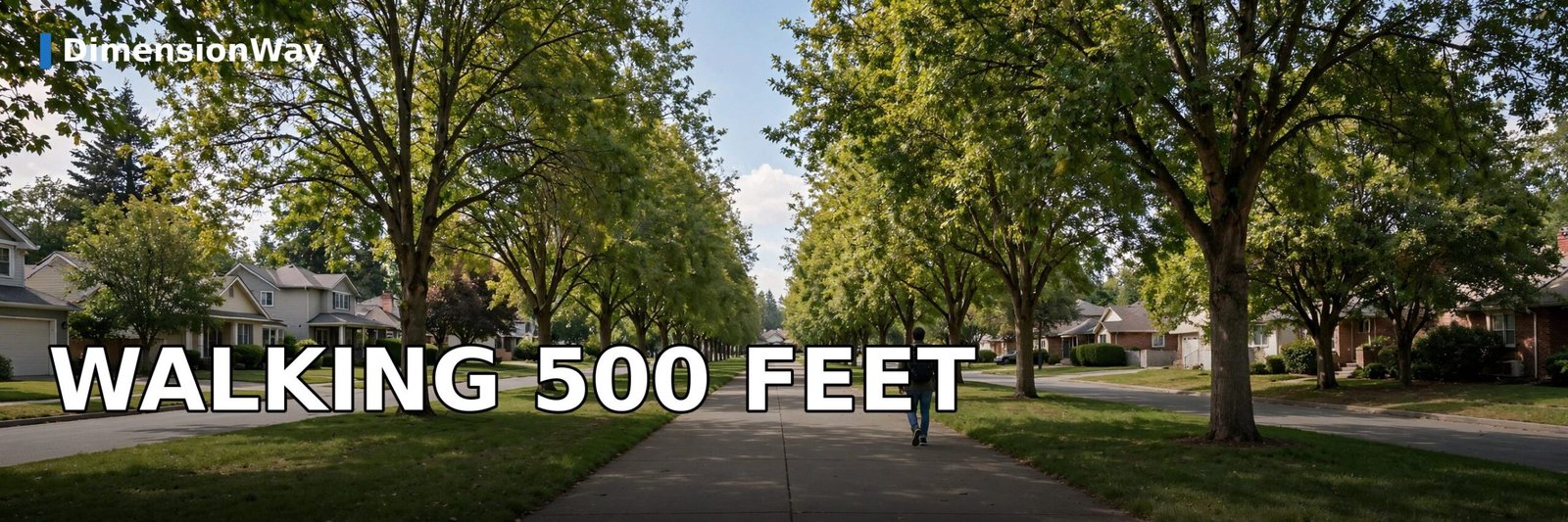
At a normal walking pace of about 3 miles per hour, you cover 500 feet in roughly 1 minute and 54 seconds, so most people round it to about 2 minutes. Expect around 200 steps, since the average adult step is about 2.5 feet. A slow stroll stretches the walk past 2 minutes, while a brisk pace gets you there in about 90 seconds.
One and Two-Thirds Football Fields
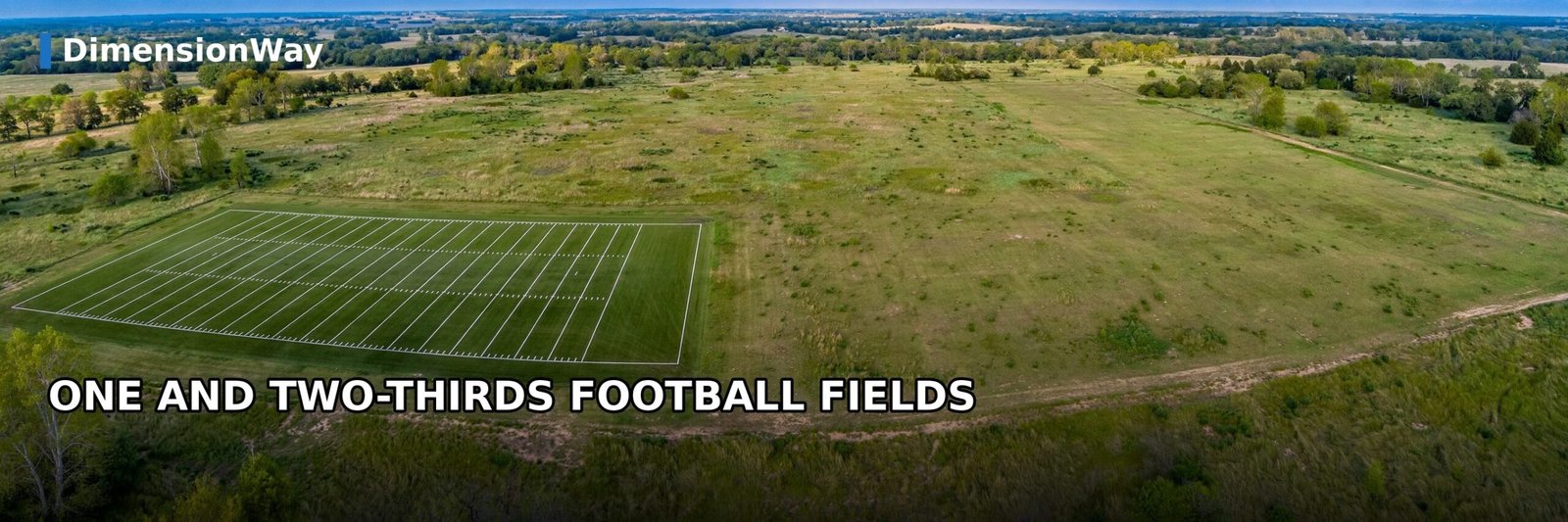
The playing area of an American football field measures exactly 300 feet from goal line to goal line. Divide 500 by 300 and you get about 1.67, so 500 feet is one full field plus two-thirds of another. Picture a touchdown drive that starts at one goal line and ends two-thirds of the way down the next field over.
This is probably the fastest way to lock in the distance. Almost everyone has watched football, so the field is already in your memory. One full field plus a strong two-thirds gets you to 500 feet.
If you count the end zones, the whole stadium complex is 360 feet long, which means 500 feet is still well short of one and a half full stadium lengths.
A 50-Story Building on Its Side

Commercial buildings average about 10 feet per story once you include floor slabs, ductwork, and ceiling space. Multiply by 50 stories and you land right at 500 feet. Tip a typical 50-story tower onto its side and it would stretch half a thousand feet down the avenue.
Fifty stories is serious downtown architecture. Most American cities have only a handful of towers this tall, which is why the comparison feels dramatic. You are picturing one of the tallest things in a skyline, lying flat.
City planners use the 10-feet-per-floor rule for quick estimates, and it holds up well for offices, hotels, and apartment towers alike.
Two and a Half Portland City Blocks

Portland, Oregon is famous for its compact 200-foot-square downtown blocks. Walk two full blocks and half of a third, and you have covered 500 feet. In most other American cities, where blocks run 300 to 600 feet, a single long block can get you most of the way there.
This example works because blocks are something you walk every day. Next time you are downtown, count two and a half short blocks. That rhythm of intersections and crosswalks is your 500-foot ruler.
Portland’s small blocks are a deliberate 19th-century planning choice, and urban designers still study them as a model of walkable street design.
Five Blue Whales Nose to Tail

Large blue whales reach about 80 to 100 feet long, and exceptional individuals push past that. Line up five big ones nose to tail and their combined length lands right around 500 feet. It is one of the most dramatic rulers in nature.
Each whale in that line is already longer than a city bus. Five of them together would stretch farther than a row of houses on a suburban street. Their hearts alone are the size of small cars.
Researchers measure whales with aerial photography and laser photogrammetry, and the 100-foot figure for large adults is well documented by marine science agencies.
Two and a Half Boeing 777s
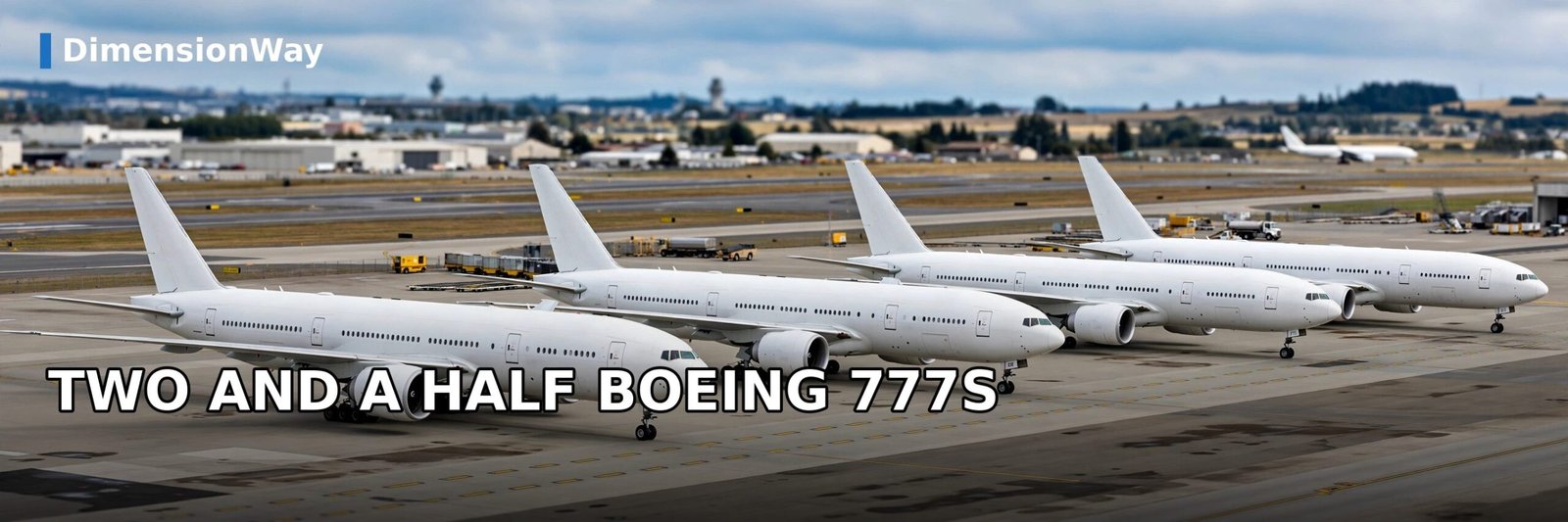
The Boeing 777-200 measures 209.1 feet from nose to tail. Multiply by 2.4 and you get about 502 feet, essentially our target. Picture two full airliners plus nearly half of a third parked wingtip to tail on the tarmac.
Airport ground crews work at this scale every day, guiding 200-foot jets into gates with only feet of clearance. Two and a half of them in a row is a parking job nobody wants.
The 777 family fills the gap between the 767 and the 747, and its length makes it one of the most common wide-body sights at international airports.
Seven Semi-Trailer Trucks

A standard semi-trailer is 53 feet long, and the tractor adds roughly 20 more, giving a total rig of about 70 to 75 feet. Seven rigs bumper to bumper stretch roughly 490 to 525 feet, bracketing our 500-foot mark almost exactly.
Highway rest stops are the perfect place to see this. Seven big rigs fill an entire parking lane, and standing at one end you can barely read the logo on the last trailer.
The 53-foot trailer became the industry standard under federal length regulations, which makes this one of the most consistent measuring sticks on this list.
Five NBA Basketball Courts

An NBA court is exactly 94 feet long. Five of them end to end measure 470 feet, just 30 feet short of our mark. Add the width of a free-throw lane and you are essentially at 500 feet.
School gyms hold a single court, so imagine five gyms in a row. The distance from the first baseline to the far baseline of the fifth court is your 500-foot stretch.
Court dimensions are standardized by the league down to the inch, which makes this one of the most exact comparisons here. It is only about 6 percent short.
A Little Under Half the Eiffel Tower

The Eiffel Tower stands 1,083 feet tall including its antennas. Half of that is about 541 feet, so 500 feet gets you a little under halfway up. Picture climbing to just below the middle of the tower and looking down.
This comparison gives you vertical intuition. Five hundred feet of height is enormous, roughly the elevation of a 50-story observation deck, yet it does not even reach the Eiffel Tower’s midpoint.
The tower was completed in 1889 and remains one of the most measured structures on earth, so its height is about as official as a number gets.
One and Two-Thirds Statues of Liberty

The Statue of Liberty measures 305 feet from the ground to the tip of her torch. Divide 500 by 305 and you get about 1.64, so picture Lady Liberty with another two-thirds of herself stacked on top.
Most visitors are surprised by how tall 305 feet really is. The statue’s nose alone is 4.5 feet long. Stacking one and two-thirds of her gives you a genuine sense of what half a thousand feet means.
The monument’s dimensions are maintained by the National Park Service, and the 305-foot figure includes the pedestal and foundation.
Just Under the Washington Monument

The Washington Monument rises 555 feet above the National Mall. Five hundred feet is about 90 percent of that height, so if you shaved just 55 feet off the top, you would have our distance standing upright.
This is a useful anchor because the monument is a clean, simple obelisk with no setbacks or spires to confuse the eye. Its height reads as one pure vertical line.
Completed in 1884, it was the tallest structure in the world for five years, and its 555-foot measurement is one of the most cited figures in American architecture.
How to Visualize 500 Feet Yourself
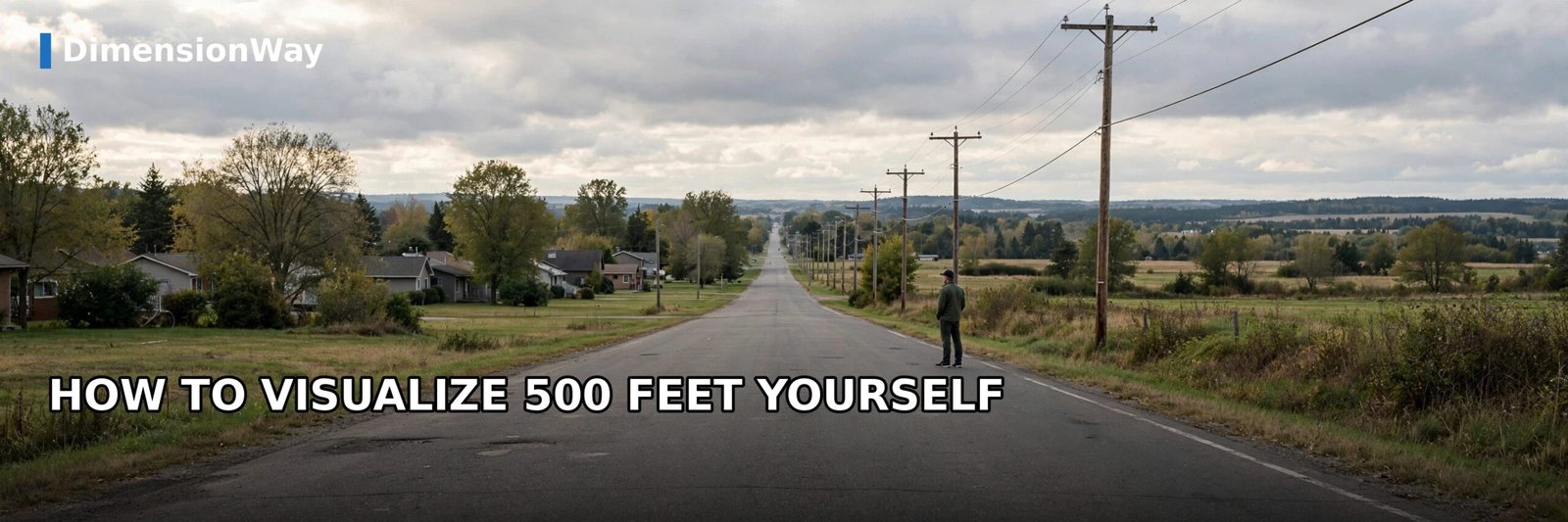
You do not need landmarks to learn this distance. Find a straight stretch of road with telephone poles, which sit about 100 to 150 feet apart. Walk four or five spans between poles and time yourself. You should land near 2 minutes at a normal pace.
A parking lot works too. Standard spaces run about 18 feet long, so 28 spaces in a row is roughly 500 feet. Walk the line, turn around, and study how far away your starting point looks.
Do it three or four times on different streets. Your eyes will start recognizing 500-foot stretches on their own, from the length of a running track straightaway to the far end of a big-box store parking lot.
FAQs
How many meters is 500 feet?
500 feet equals exactly 152.4 meters. For quick estimates, most people round it to 152 meters.
How many yards is 500 feet?
500 feet equals 166.67 yards, or one full football field plus two-thirds of another.
How long does it take to walk 500 feet?
At a normal pace of 3 miles per hour, walking 500 feet takes about 1 minute and 54 seconds, which most people round to 2 minutes. A brisk walk takes around 90 seconds.
How many steps are in 500 feet?
The average adult step is about 2.5 feet, so 500 feet works out to roughly 200 steps. Taller walkers with longer strides may need closer to 180.
Is 500 feet longer than a football field?
Yes. The playing area of a football field is 300 feet long, so 500 feet is about 1.67 football fields.
How many city blocks is 500 feet?
In Portland, Oregon, where downtown blocks are 200 feet square, 500 feet is two and a half blocks. In cities with longer blocks, it can be a single block.
How does 500 feet compare to the Eiffel Tower?
The Eiffel Tower is 1,083 feet tall, so 500 feet is a little under half its height.
Can you see clearly at 500 feet?
Yes. On a clear day you can easily spot a person or a car at 500 feet. Small details like facial features or license plate numbers blur out, but shapes, colors, and movement stay clear.
Is 500 feet a long home run in baseball?
A 500-foot home run is extremely rare and legendary. Most major league home runs travel 400 to 450 feet, so clearing 500 feet puts a hitter in historic company.
Conclusion
Five hundred feet is 152.4 meters, about a 2-minute walk, and roughly 200 steps. It is one and two-thirds football fields, a 50-story building on its side, five blue whales, or seven semi-trucks in a row.
The easiest way to remember it is to walk it. Count four or five spans between telephone poles or 28 parking spaces, pace it out, and look back. Once your eyes learn the distance, you will spot 500-foot stretches everywhere, from city blocks to airport tarmacs.
Related Reading
- How Far Is 200 Feet?: a shorter distance in the same series, with ten everyday comparisons.
- How Far Is 300 Feet?: the full football field distance for calibration.
- How Long Is 1000 Feet?: double this distance, with ten bigger comparisons.
Sources
- NFL Rulebook / Operations: football field dimensions, 300 feet goal line to goal line.
- NOAA Fisheries: blue whale size, large adults 80 to 100+ feet.
- Boeing Commercial Airplanes: 777-200 specifications, length 209.1 feet.
- NBA Official Rules: court dimensions, 94 by 50 feet.
- National Park Service: Statue of Liberty dimensions, 305 feet ground to torch.
- National Park Service: Washington Monument height, 555 feet.
- Societe d’Exploitation de la Tour Eiffel: tower height 330 meters (1,083 feet) including antennas.
- Portland Bureau of Transportation / city planning records: downtown blocks 200 feet square.
- U.S. Federal Highway Administration: standard 53-foot semi-trailer length regulations.
- Utility industry standards: typical pole spacing 100 to 150 feet apart.

James Carter is the founder and editor of DimensionWay, where he researches, measures, and verifies real-world dimensions — from everyday objects to world-famous landmarks. Every number published on DimensionWay is cross-checked against manufacturer specifications and official sources, so readers always get accurate, easy-to-visualize comparisons.

2 thoughts on “How Far Is 500 Feet? 10 Visual Comparisons”