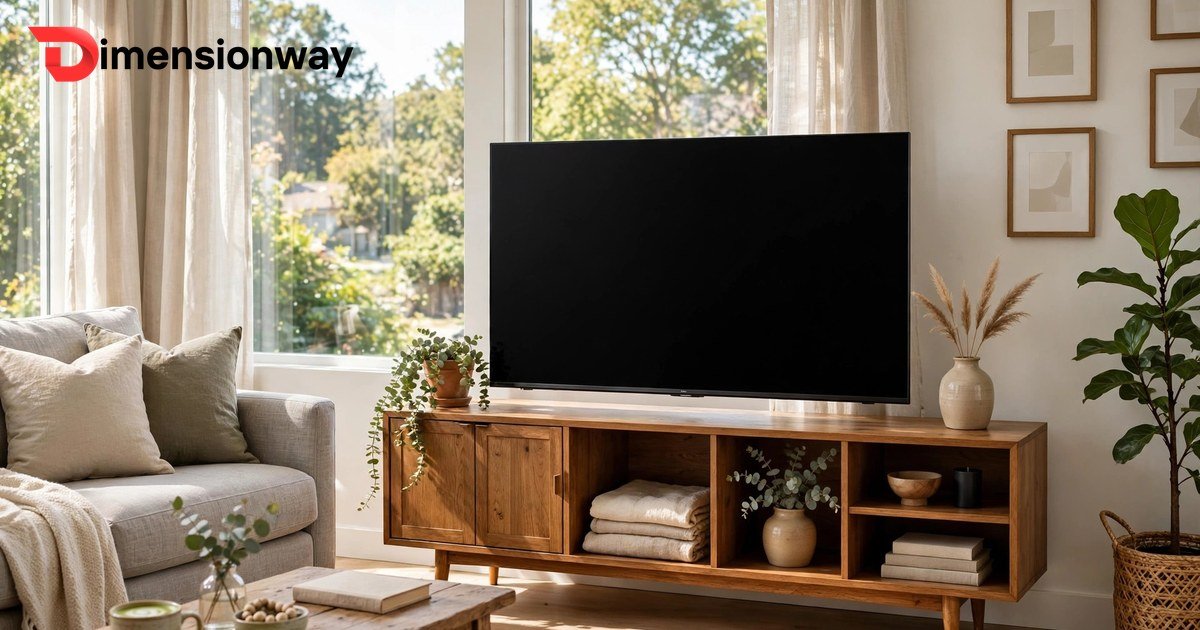
A 55 inch TV is about 48 inches wide and 28 inches tall without its stand, or about 30 inches tall on its feet. The “55 inch” label measures the screen corner to corner, not the width.
You have measured the wall and read the listing three times, but “55 inch class” still does not turn into a picture in your head. That is because the number on the box answers the wrong question. Nobody buys a TV and hangs the diagonal. You live with the width and the height, and those are the numbers that decide whether the TV fits on your console or swallows your wall.
A 55 inch TV is roughly four feet wide and a little over two feet tall, sitting on its stand at about the height of a dining table. Once you have those three pictures, the spec sheet stops being mysterious.
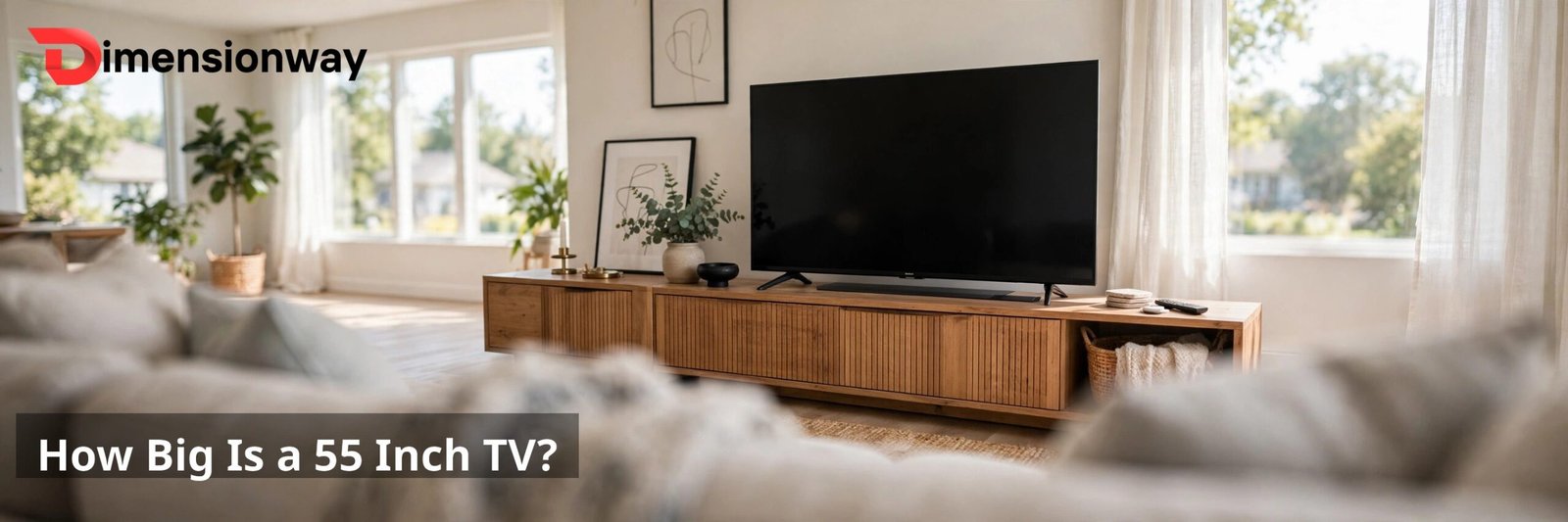
The Actual Dimensions of a 55 Inch TV
First, what the “55 inch” actually measures. Every TV size label refers to the diagonal of the screen, measured corner to corner across the display itself. It does not include the bezel, and it definitely does not include the stand. The label has worked this way for decades, back to the era of round picture tubes, and it persists partly because the diagonal is always the biggest number on the spec sheet.
Every modern 55 inch TV uses a 16:9 aspect ratio, so the screen geometry is fixed. A 55 inch diagonal on a 16:9 screen gives a viewable area 47.9 inches wide and 27.0 inches tall. That is the glass itself. The bezels on modern sets are slim, usually adding about half an inch to an inch all around, which is why the finished TV lands around 48.4 inches wide and 28 inches tall.
A database of 1,444 current 55 inch models (FullSpecs) puts the typical TV at 123.0 cm wide and 71.2 cm high without the stand, which converts to 48.4 by 28.0 inches, with a panel depth of about 2.5 inches. The same data set gives a typical height with the stand of 77.1 cm, or 30.4 inches. That half foot of stand is the part people forget to budget for, and it is the part that makes a TV taller than the console depth or the shelf it sits on.
Real models from the official spec sheets look like this. The differences come down to bezels, stand design, and how much glass the brand puts on the face.
| Model | Width (no stand) | Height (no stand) | Height (with stand) | Depth (with stand) | Weight (with stand) |
|---|---|---|---|---|---|
| Samsung QN55Q60D (2024, QLED) | 48.3 in | 28.0 in | 30.6 in | 9.6 in | 38.8 lb |
| LG OLED55C4 (2024, OLED) | 48.1 in | 28.2 in | 30.0 in | 9.1 in | 31.3 lb |
| Sony XR-55A80L (2023, OLED) | 48.4 in | 28.1 in | 28.9 in | 11.6 in | 41.0 lb |
| TCL 55QM751G (2024, QLED) | 48.2 in | 27.8 in | 30.3 in | 11.9 in | 32.4 lb |
The pattern to remember: 48 inches wide, 28 inches tall, 30 inches on its feet. Those three numbers survive across brands and years.
10 Comparisons That Make a 55 Inch TV Click
A 55 inch TV, 48.4 inches wide and about 30 inches tall on its stand. Here is what that looks like next to things you already know.
The Diagonal: About Four and a Half Feet Corner to Corner
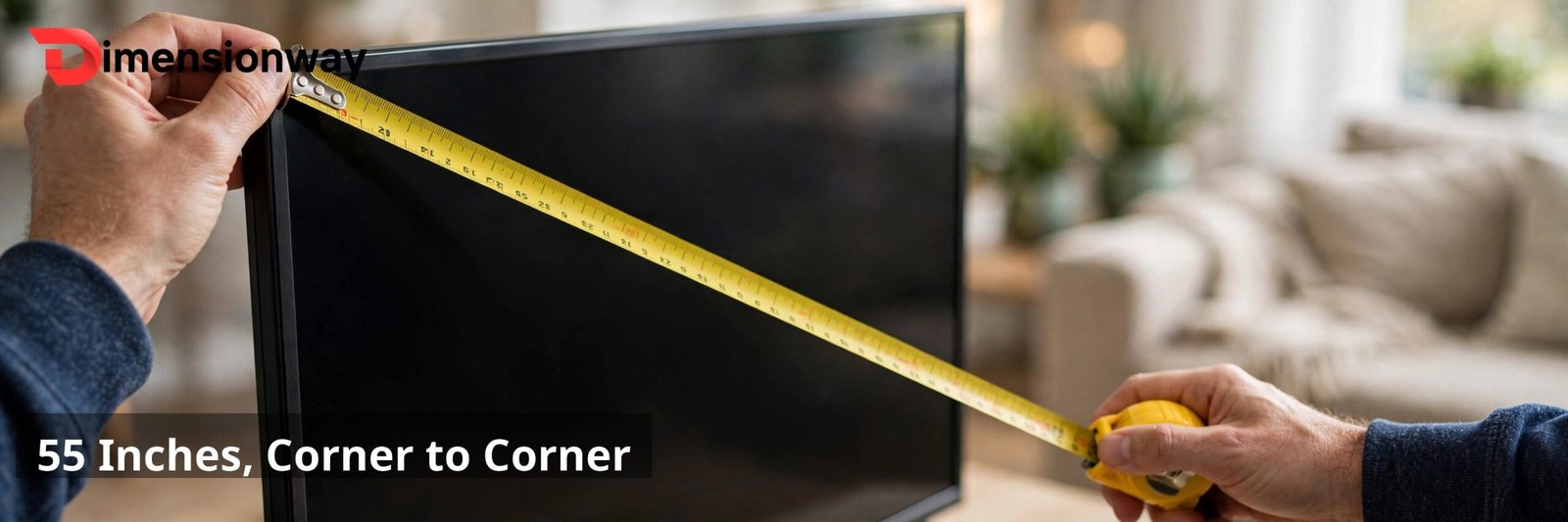
The 55 inch measurement runs from the bottom left corner of the screen to the top right corner. Stretched end to end, it spans 55 inches, which is four feet and seven inches. Hold your arms out wide. For an average adult, fingertip to fingertip is roughly your own height, so the TV’s diagonal is shorter than your wingspan by about a foot.
The diagonal is also the number that misleads people most. A 55 inch TV does not take up 55 inches of wall. It takes up 48 inches of wall, because width is what the wall sees.
A Queen Bed: The TV Is a Foot Narrower
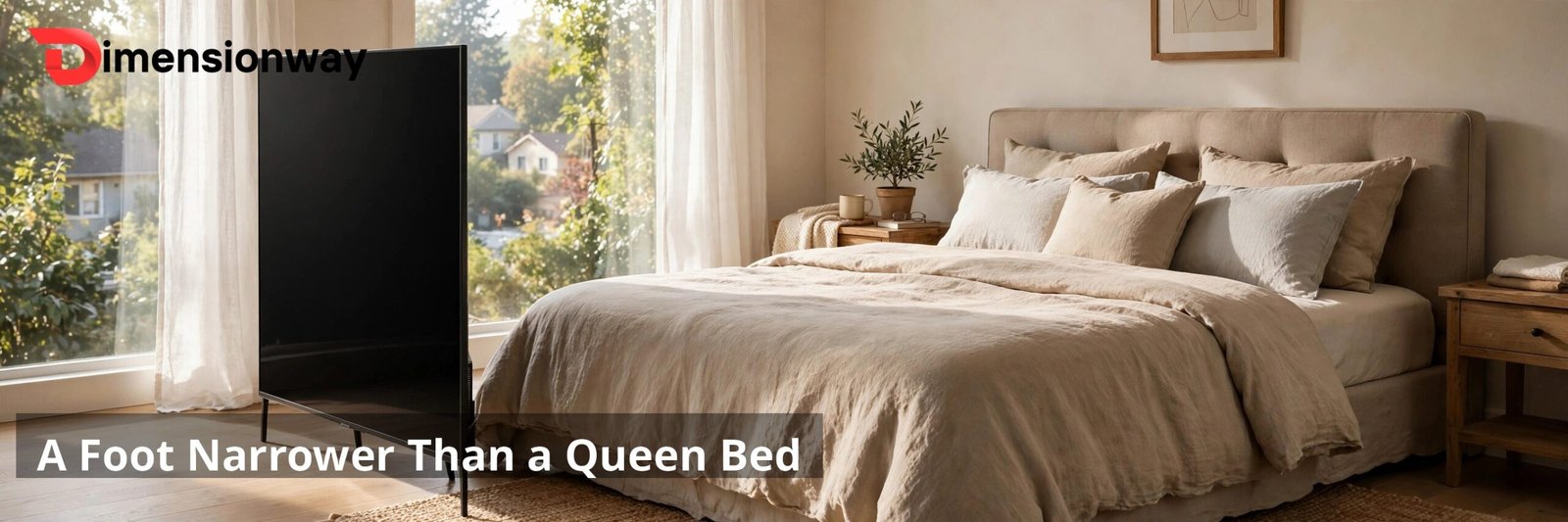
A queen bed measures 60 inches wide by 80 inches long. Set a 55 inch TV’s width against the bed’s width and the TV comes up 12 inches short, a full foot narrower than the mattress. The TV’s 48 inches are exactly four fifths of the queen’s 60.
This one helps because nearly everyone has slept in a queen. Picture the bed you woke up in this morning, then shave a foot off the width in your mind, and you are looking at the TV. Our guide to how big a king-size bed is covers the 80 inch length that shows up again in the viewing distance section.
A Kitchen Counter: The TV Stands Shorter
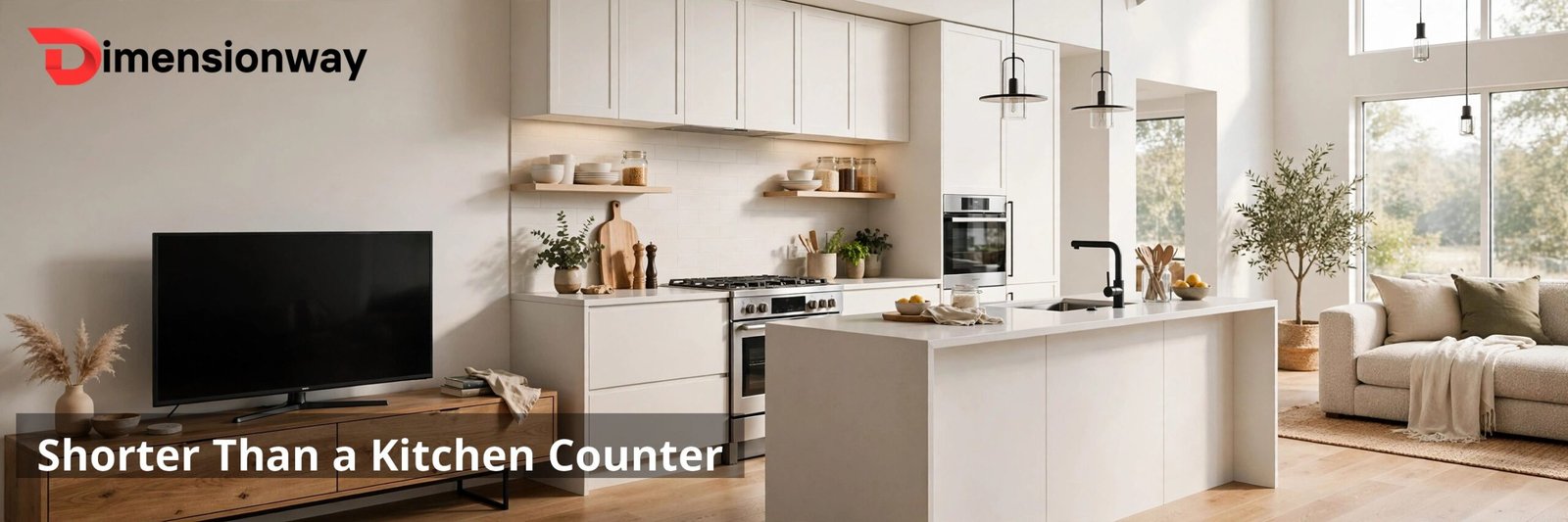
A standard kitchen counter is 36 inches tall. A 55 inch TV on its stand tops out around 30 inches, which means the whole TV is six inches shorter than your counter. It is a strange but useful fact. The biggest screen in your living room would hide completely behind the kitchen island.
The counter also anchors the TV’s panel depth. A counter is 24 to 25 inches deep, and a TV on its stand needs 9 to 12 inches of that depth. The TV claims less than half the counter’s depth, which is why a 16 inch deep console swallows a TV with room behind it for cables.
A Standard Bathtub: Twelve Inches Shorter

The classic alcove bathtub is 60 inches long. A 55 inch TV’s 48 inch width is a full foot shorter than the tub. If you could stand the TV on its end inside the tub (please do not), a foot of tub would stick out past it.
The tub works as a comparison because 60 inches is one of the few fixed lengths in a house. Tubs, interior doors at 80 inches, and counters at 36 inches are the constants. Measure your TV against the constants and you stop guessing.
A Dining Table: The Same Height on Its Stand
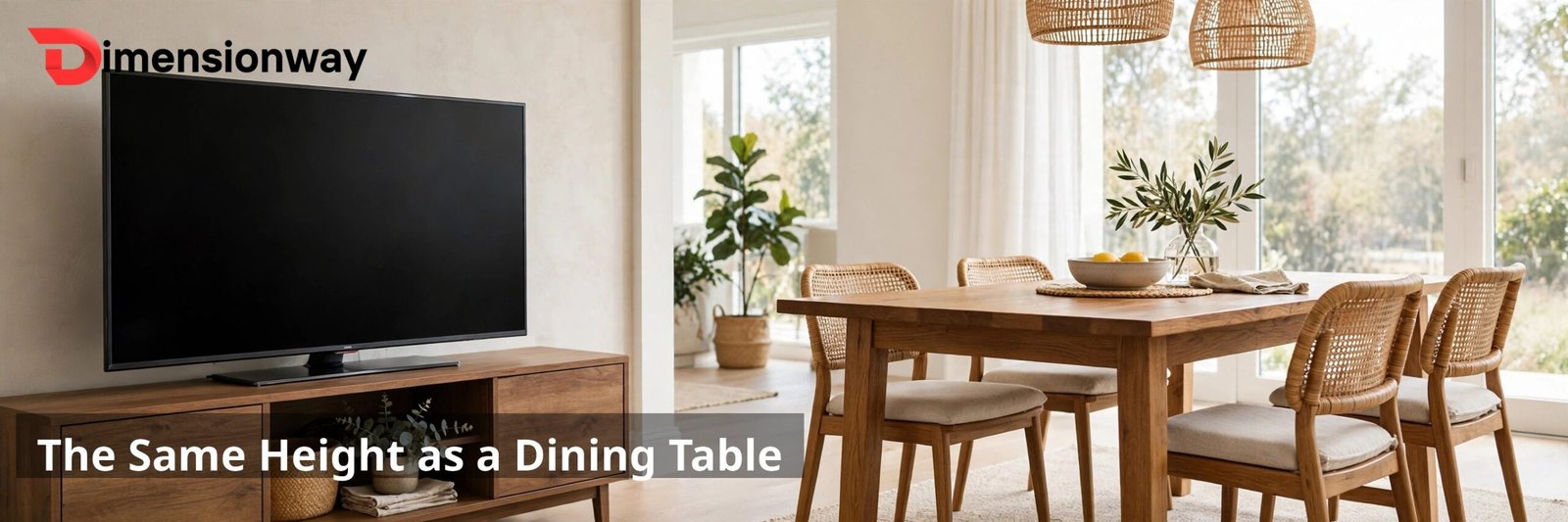
A standard dining table is 28 to 30 inches tall. A 55 inch TV on its stand is about 30 inches tall. The two are the same height, which is why a TV sitting on a console in the dining room looks perfectly natural. Its top edge lines up with the tabletop.
It also explains why TVs look so wide. We are used to seeing 30 inches of height in tables, where the mass spreads out low. The TV takes those same 30 inches and stretches them sideways across four feet. Same height, completely different silhouette. Our guide to what size a dining table is has the full 30 inch standard.
A Doorway: The TV Is a Foot Wider Than the Opening
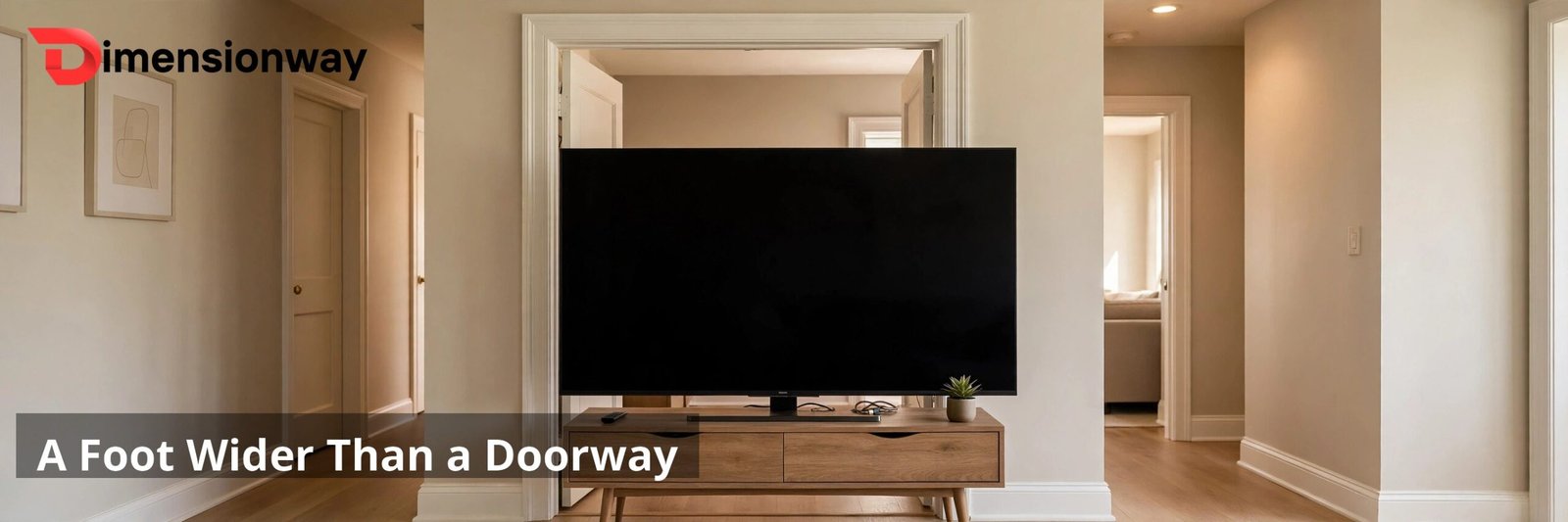
A standard interior doorway is 36 inches wide. A 55 inch TV is 48 inches wide, a full foot wider than the door opening. This is the delivery-day fact. The TV will not go through a doorway straight on. Delivery crews tilt it, because the width is the number that fights you, not the height. It also settles the wall question in most bedrooms: if the wall section between the door frame and the corner is 48 inches or more, the TV fits.
A King Bed Length Away: The Viewing Distance

The sweet spot for watching a 55 inch 4K TV is about 6 to 8 feet from the screen. A king-size bed is 80 inches long, which is 6 feet 8 inches. So the rule is simple: sit about one king bed length away.
The science is real. RTINGS, which has tested over 500 TVs, bases its guidance on angular resolution: the comfortable cinematic range is 30 to 40 degrees of your field of view, which lands most people 6 to 8 feet back. Gamers sit closer, around 5 to 6 feet.
An Acoustic Guitar: The TV Is Wider Than the Guitar Is Long
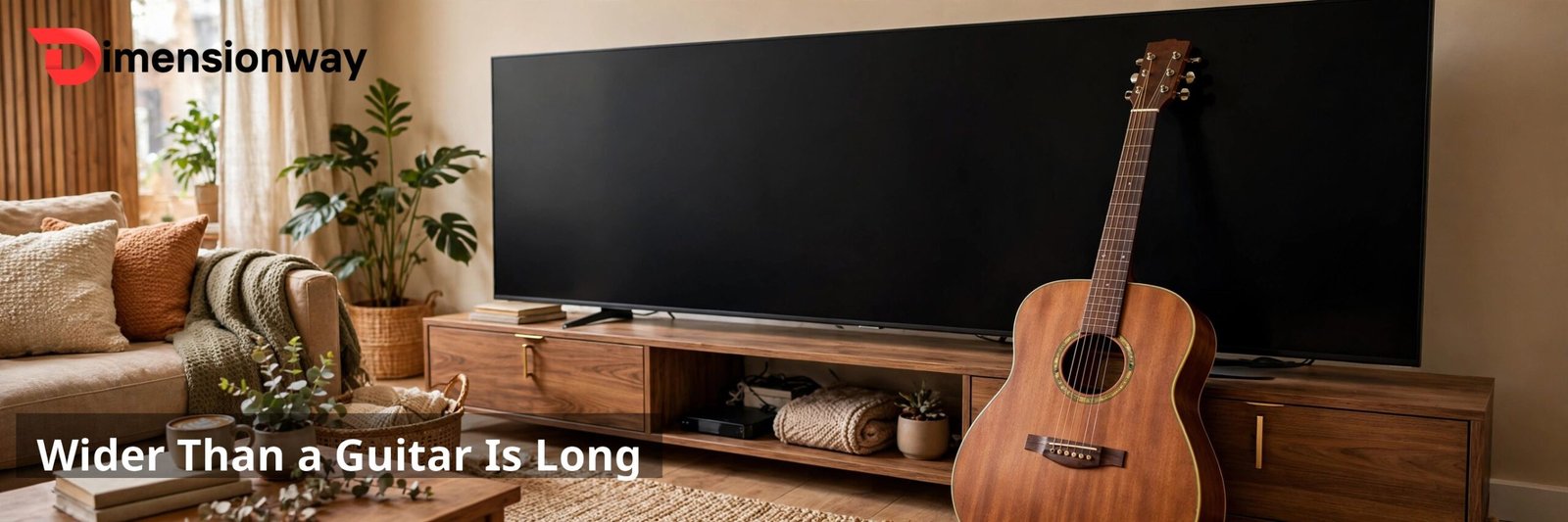
A full-size acoustic guitar is about 40 to 41 inches long. A 55 inch TV is 48 inches wide, so the TV is wider than the guitar is long, by about seven inches. Lean a guitar against the TV and the headstock stops well short of the TV’s far edge.
Musicians notice this one instantly. The guitar is the longest common object in many living rooms, and the TV beats it.
An Average Man: The Diagonal Reaches Four Fifths of His Height
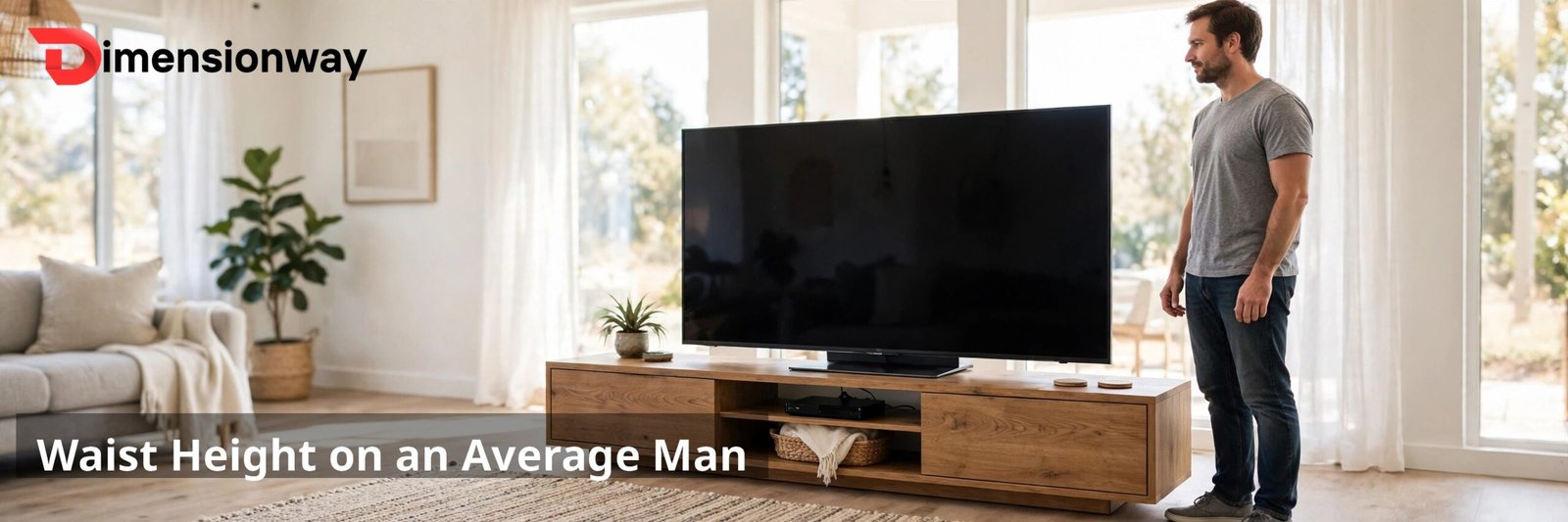
The average American man is about 69 inches tall (CDC measured data). The TV’s 55 inch diagonal is about 80 percent of his height. Stand the TV’s diagonal up vertically and it reaches roughly his chest.
More useful in practice: the TV on its stand, at 30 inches, tops out around his waist or belt line. That is why a TV on a low console looks right and a TV mounted too high looks wrong.
An Eight-Year-Old: As Tall as the TV Is Wide

The median eight-year-old stands about 50 inches tall (CDC growth charts). A 55 inch TV is 48 inches wide. Tip the TV on its side in your imagination and the child is two inches taller than the TV is wide.
Parents get this one immediately, because the kid is a walking ruler you see every day. A screen as wide as your third grader is tall is not a small screen.
How to Picture a 55 Inch TV Without One
Three tricks that stick.
First, use the door. A standard interior door is 80 inches tall and 36 inches wide. The TV’s width is a foot wider than the door opening, and the TV on its stand is a little over a third of the door’s height. If you can picture a door, you can picture the TV leaning against the wall next to it.
Second, use the console. Most TV consoles run 50 to 60 inches wide. The TV at 48 inches leaves an inch or two of breathing room on each end of a 50 inch console.
Third, use your waist. A 55 inch TV on its stand tops out around 30 inches, roughly belt height on an average man. Hold your hand at your waist. The top edge of the TV lives right there.
TV Size Chart: 43 to 85 Inches
TVs follow the 16:9 rectangle at every size, so the whole lineup scales predictably. These are the screen dimensions (glass only); add about an inch for bezels.
| Diagonal | Screen width | Screen height | Typical overall width | Best for |
|---|---|---|---|---|
| 43 in | 37.5 in | 21.1 in | 38.5 in | Bedrooms, kitchens, second rooms |
| 50 in | 43.6 in | 24.5 in | 44.5 in | Small living rooms, apartments |
| 55 in | 47.9 in | 27.0 in | 48.4 in | Main living rooms, the sweet spot |
| 65 in | 56.7 in | 31.9 in | 57.5 in | Large living rooms, home theaters |
| 75 in | 65.4 in | 36.8 in | 66.0 in | Dedicated media rooms |
| 85 in | 74.1 in | 41.7 in | 75.0 in | Projector replacement territory |
The jumps matter more than the labels. A 65 inch TV is about 9 inches wider than a 55, which is the difference between fitting on your current console and needing a new one.
Viewing Distance by Use
One distance does not fit all content. Here is the practical guidance, built from RTINGS testing data, THX and SMPTE viewing-angle standards, and manufacturer guides.
| Use | Recommended distance from a 55 in 4K TV | Why |
|---|---|---|
| Movies (cinematic) | 6 to 7.5 ft | Fills 30 to 36 degrees of your view, the THX/SMPTE zone |
| Sports and TV shows | 6 to 8 ft | Comfortable for mixed household viewing |
| Gaming | 5 to 6 ft | Closer for detail and reaction time |
| 1080p or broadcast content | 7 to 9 ft | Lower resolution needs more distance to stay sharp |
The one-line formula many guides use: for 4K, multiply the diagonal by 1.5 to get the distance in inches. 55 times 1.5 is 82.5 inches, or about 6.9 feet. Easy to do on your phone in the store.
Will It Fit? The Console, the Wall, and the Room
This is the section that saves delivery day and the return trip. Three checks, in order.
- Check the console width. The TV is 48.4 inches wide, and the rule of thumb is a console 3 to 6 inches wider than the TV. A 54 to 60 inch console is ideal; a 50 inch console works with an inch of margin on each side. Measure the stand feet too: they usually sit 35 to 45 inches apart, and they need to land on the console’s top, not hang over the edge.
- Check the console depth. The stand needs 9 to 12 inches of depth, and you want a couple of inches behind it for cables. Most media consoles are 16 to 20 inches deep, which is plenty. Glass-top and narrow consoles under 14 inches deep are the ones that cause trouble.
- Check the wall. For wall mounting, the TV is 48.4 by 28 inches and weighs 30 to 40 pounds. Almost every 55 inch TV uses a 200 by 200 mm or 300 by 300 mm VESA pattern, so a standard tilting bracket works. Mount it so the center of the screen sits at seated eye height, about 42 inches off the floor. Leave the TV a few inches off the wall for ventilation and cable access.
- Check the room. A 55 inch TV wants 6 to 8 feet of viewing distance, which means the sofa and the TV wall need at least 8 feet between them in a straight line. In a 10 by 12 foot room, that fits easily. In a 12 by 16 foot room, you have room to step up to a 65 later. Our guide to what 1,000 square feet looks like helps with the room math if you are planning a whole layout.
- Check the delivery path. The TV is a foot wider than a standard doorway, so it travels tilted. Measure the narrow hallways and stairwell turns, and keep the box: at 55 inches diagonal, the boxed TV is roughly 54 by 33 by 7 inches and needs a vehicle with a flat 5 foot cargo space.
One more scale note: a 55 inch TV on its stand is about 30 inches tall, less than half the 69 inches of a standard refrigerator. The TV is a wide object, not a tall one.
Inches to Centimeters for Common TV Sizes
| Diagonal | Inches | Centimeters | What it is |
|---|---|---|---|
| 43 | 43 | 109.2 | Bedroom size |
| 50 | 50 | 127.0 | Small living room size |
| 55 | 55 | 139.7 | The diagonal everyone quotes |
| 55 | 47.9 | 121.7 | The actual screen width |
| 55 | 28.0 | 71.1 | Typical overall height, no stand |
| 65 | 65 | 165.1 | The common step up |
| 75 | 75 | 190.5 | Media room size |
| 85 | 85 | 215.9 | Projector territory |
One inch equals exactly 2.54 centimeters. A 48.4 inch TV width is 122.9 cm, the number you will see on international spec sheets.
FAQs
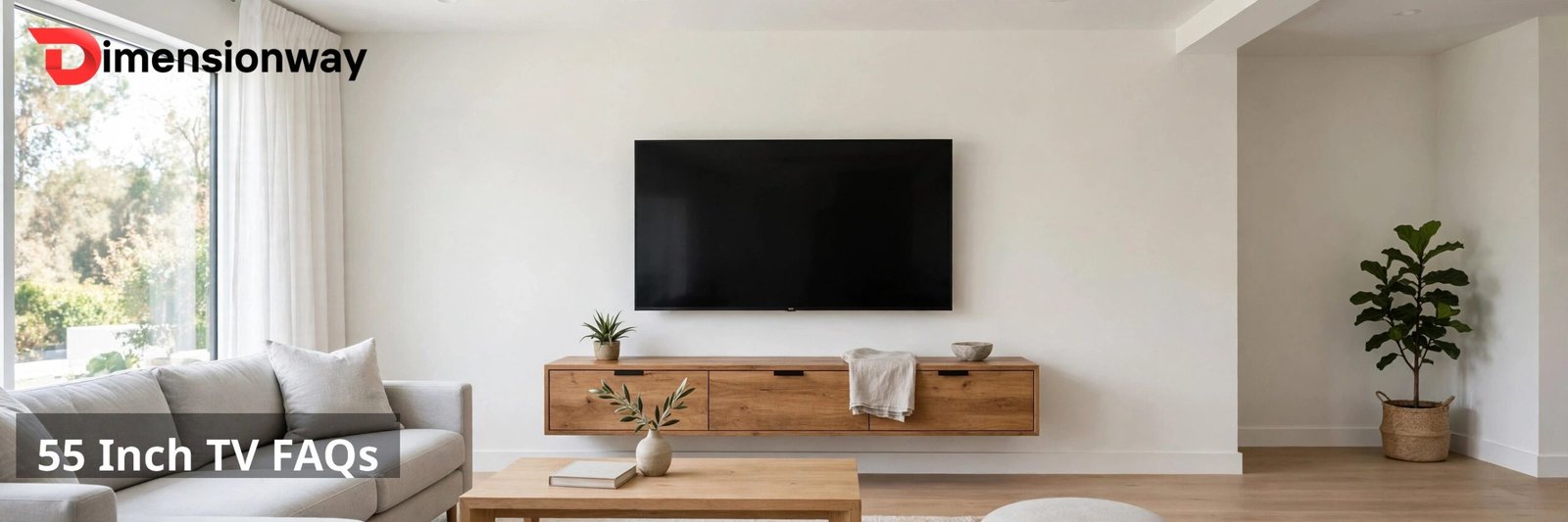
Is a 55 inch TV too big for a living room?
For most living rooms, no. A 55 inch TV is the most popular size in the world precisely because it fits the average living room. If your seating is 6 to 8 feet from the screen, a 55 is in the sweet spot. It only feels too big in small bedrooms or when the seating is under 5 feet away.
What are the actual dimensions of a 55 inch TV?
About 48 inches wide and 28 inches tall without the stand, or about 30 inches tall with the stand. Depth is 2 to 3 inches for the panel and 9 to 12 inches with the stand feet. The exact numbers vary slightly by model, so check the spec sheet before building furniture around it.
Will a 55 inch TV fit on a 50 inch TV stand?
Yes, with about an inch of margin on each side. A 55 inch TV is 48.4 inches wide, so it sits on a 50 inch console. Just confirm the stand feet, which usually span 35 to 45 inches, land fully on the console top.
How far should you sit from a 55 inch TV?
Six to eight feet for 4K content, which is roughly one king bed length. For the full cinematic effect with movies, 6 to 7.5 feet is ideal. Gamers often sit closer, around 5 to 6 feet. The old advice to sit 10 feet back comes from the low-resolution era and does not apply to 4K.
Should I get a 55 or 65 inch TV?
It comes down to distance and furniture. If your seating is 6 to 8 feet away and your console is 50 to 60 inches wide, a 55 fits perfectly. If you sit 8 to 10 feet away, a 65 fills your view better, but it is 9 inches wider, so budget for a bigger console or a wall mount.
Can you wall mount a 55 inch TV?
Yes. Nearly all 55 inch TVs use a 200 by 200 mm or 300 by 300 mm VESA mount pattern and weigh 30 to 40 pounds, so a standard tilting bracket rated for 55 inch screens works. Mount the center of the screen at seated eye height, about 42 inches off the floor.
How much does a 55 inch TV weigh?
Most modern 55 inch TVs weigh 30 to 40 pounds with the stand, or about 25 to 35 pounds for the panel alone. Older 2018-era models ran heavier, up to 45 pounds. One adult can usually lift and mount a modern 55, but two people make it much safer.
Is 55 inch good for gaming?
Yes, it is one of the most popular gaming sizes. At 5 to 6 feet away, a 55 inch 4K screen fills enough of your view for immersion without forcing your eyes to track across the screen. Look for 120 Hz refresh and HDMI 2.1 if you play on a current console.
What size TV stand do I need for a 55 inch TV?
A stand 54 to 60 inches wide is ideal, giving 3 to 6 inches of margin beyond the TV’s 48.4 inches. The stand should be at least 14 inches deep for the feet, and sturdy enough for 40 pounds. The most common mistake is a 48 inch stand that leaves zero margin.
Do 55 inch TVs come in 8K?
A handful do, but 4K is the standard at 55 inches. FullSpecs data shows about 97 percent of current 55 inch models are 4K. At typical viewing distances of 6 to 8 feet, most eyes cannot resolve 8K detail on a 55 inch screen anyway, so 4K is the sensible buy.
Conclusion
A 55 inch TV is 48 inches wide, 28 inches tall, and 30 inches tall on its feet. It is a foot narrower than a queen bed, the same height as your dining table on its stand, and a foot wider than your doorway. Sit a king bed length away and it fills your view exactly the way the standards say it should.
Keep the three pictures that matter. The console, minus a couple of inches on each side. Your waist, where the top edge lives. The king bed, stretched from your sofa to the wall. The next time a listing gives you one number, the diagonal, you will already know the other three.
Related Reading
– How Tall Is a Refrigerator? 10 Comparisons: the 69 inch giant your 30 inch TV is less than half as tall as. – How Big Is a King-Size Bed? 10 Things That Size, Visualized: the 80 inch length that defines your viewing distance. – What Size Is a Dining Table? 10 Things That Size, Visualized: the 30 inch table your TV matches on its stand. – What Does 1,000 Square Feet Look Like? 10 Comparisons: room math for planning the whole layout.
Sources
- FullSpecs
- TV Size Guide
- AEANET
- Gadgets 360
- Of Zen and Computing
- SlashGear
- CDC
- Standard Size References

James Carter is the founder and editor of DimensionWay, where he researches, measures, and verifies real-world dimensions, from everyday objects to world-famous landmarks. Every number published on DimensionWay is cross-checked against manufacturer specifications and official sources, so readers always get accurate, easy-to-visualize comparisons.
