2 feet is 24 inches (60.96 centimeters), about the length of two standard rulers laid end to end.
That one sentence is the whole answer, but 2 feet is a measurement that tricks your eyes. It sounds tiny, yet it shows up constantly in daily life: on desks, in kitchens, in airports, on lawns, and in hardware stores. You have held it, carried it, and walked past it hundreds of times without ever naming it.
This guide turns 2 feet into pictures you already carry in your memory. You will see it as rulers, a monitor, a game board, a ceiling tile, a dog crate, and a loaf of bread, with real numbers behind every comparison so you can trust what you are picturing.
Two feet also matters in practical places you may not have connected before. Furniture, luggage, pet supplies, and building materials are all sized around it. A standard ceiling tile is 2 feet on each side. A regulation cornhole board is 2 feet wide. Once you can picture the distance, you will start noticing it in every room of your home.
2 Feet in Plain Numbers
Before the comparisons, here are the exact conversions. Two feet is a small, friendly number in the imperial system, and it converts to equally tidy numbers in metric units.
| Unit | 2 Feet Equals |
|---|---|
| Inches | 24 in |
| Centimeters | 60.96 cm |
| Meters | 0.6096 m |
| Millimeters | 609.6 mm |
| Yards | 0.667 yd |
| Kilometers | 0.0006096 km |
| Miles | 0.000379 mi |
The centimeter conversion is the one worth remembering. Sixty centimeters is close enough to 2 feet for everyday estimating, and it is why so many products sold in metric countries come in 60-centimeter widths. If you ever shop for furniture or appliances abroad, 60 centimeters and 2 feet are practically the same thing.
10 Comparisons That Make 2 Feet Click
1. Two Standard Rulers End to End
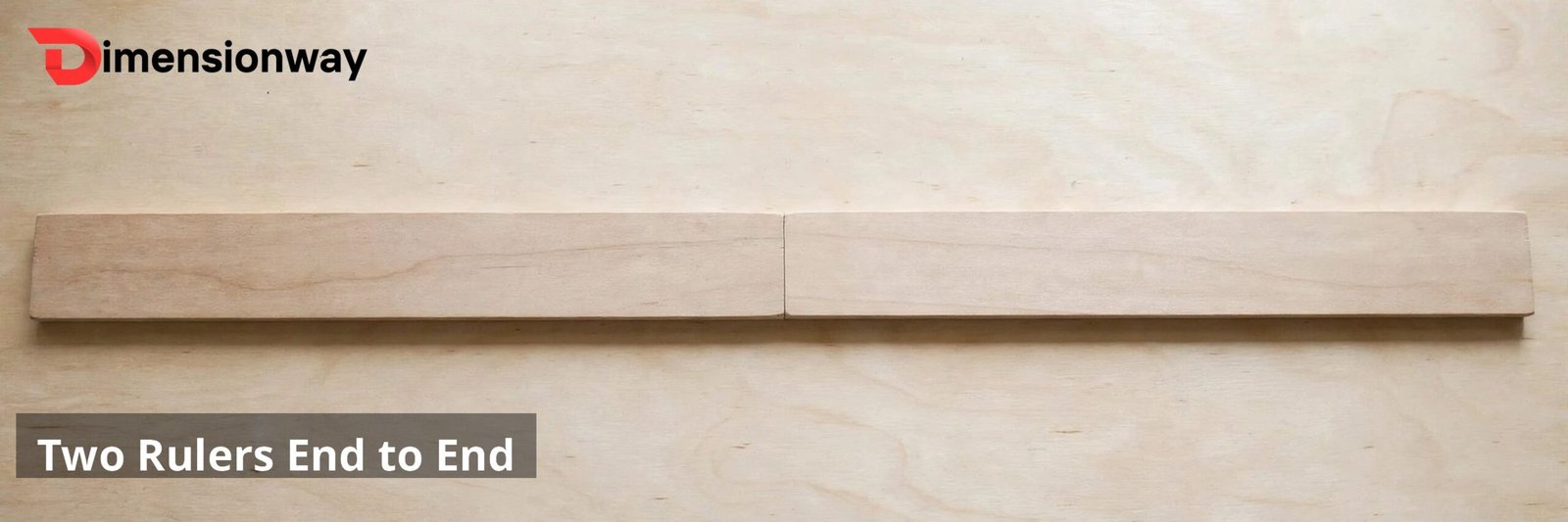
The simplest way to picture 2 feet is to grab two rulers. A standard school or office ruler is 12 inches long, which is exactly 1 foot. Lay two of them end to end on a desk and the pair stretches exactly 24 inches, which is 2 feet.
This is the comparison to use when you need to be exact. Rulers are everywhere: in desk drawers, in classrooms, in craft rooms, and in toolboxes. They cost almost nothing and they never change size. If you want to know whether something is about 2 feet long, hold two rulers against it. If the object lines up with the end of the second ruler, you have your answer.
It also explains why 2 feet feels so familiar. Most people have handled a ruler thousands of times, so two rulers is a distance your hands already know, even if your eyes have never measured it as a single span.
2. A 24-Inch Computer Monitor, Corner to Corner
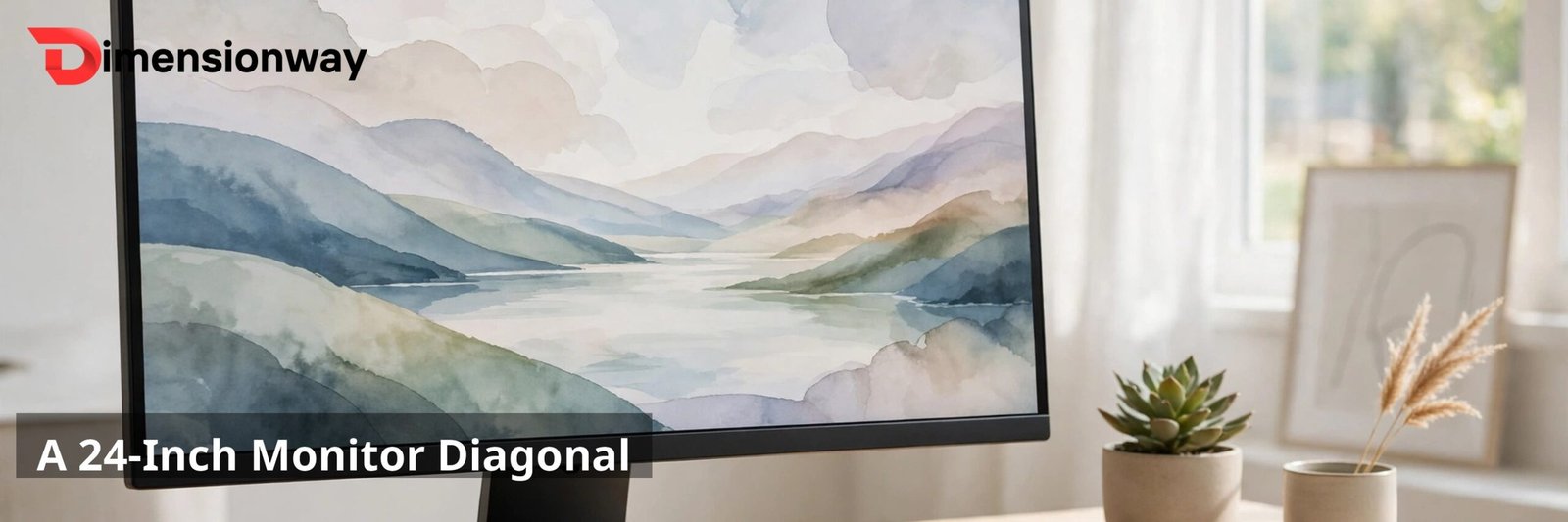
Here is a comparison with a twist that catches almost everyone. A monitor sold as “24-inch” is not 24 inches wide. Monitor sizes are measured diagonally, from one corner of the screen to the opposite corner. So the diagonal of a 24-inch monitor is exactly 24 inches, which is exactly 2 feet.
At the standard 16:9 widescreen ratio, that diagonal works out to a screen about 20.9 inches wide and 11.8 inches tall, plus a thin bezel around the edge. The full monitor with its stand is usually around 22 inches wide on your desk. But the diagonal itself, corner to corner, is a perfect 2-foot line.
That makes your desk monitor a built-in 2-foot reference. Next time you sit down at your computer, picture a line drawn from the bottom left corner of the screen to the top right corner. That line is 2 feet long. It is also a useful warning about how screen sizes are marketed: the number on the box is a diagonal, not a width, and knowing that saves you from buying a monitor that does not fit your desk.
3. The Width of a Regulation Cornhole Board
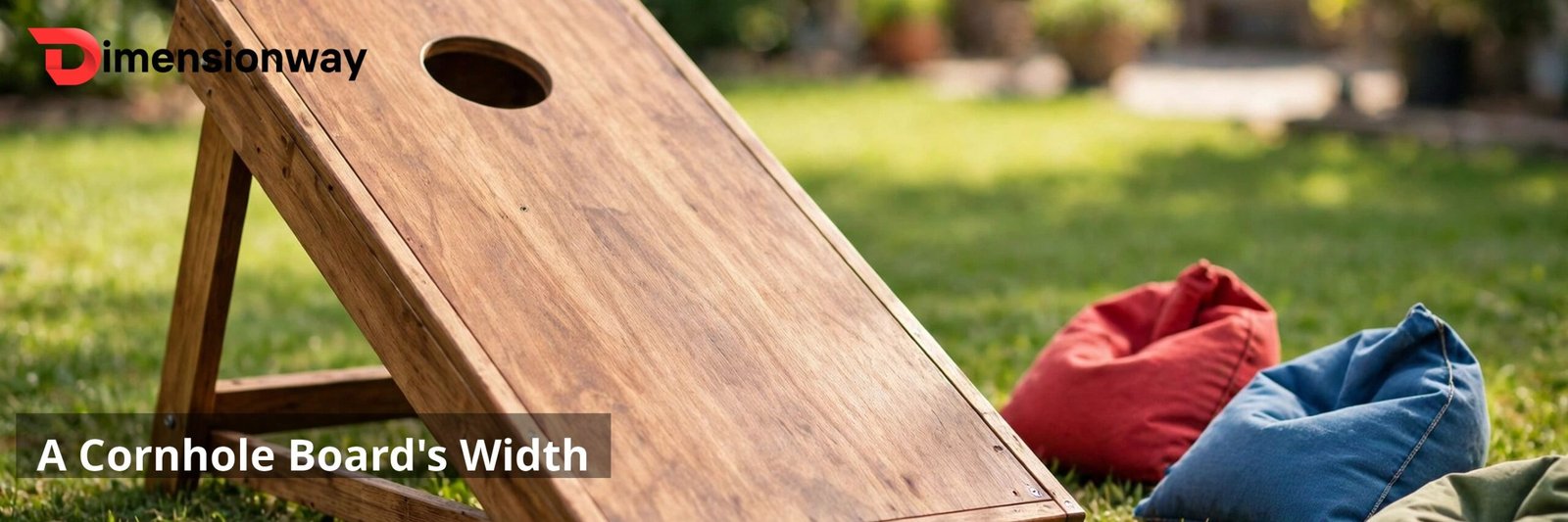
If you play lawn games, you already own a perfect 2-foot reference. A regulation cornhole board, the kind used in American Cornhole League events, measures 48 inches long by 24 inches wide. The width of the board, side to side, is exactly 2 feet.
The board is also a great way to feel how 2 feet relates to 4 feet, because the board is exactly twice as long as it is wide. Stand at the narrow end and look across the width: that is 2 feet. Then look down the full length: that is 4 feet, or two 2-foot sections back to back. The 6-inch hole in the board sits centered across the width, 12 inches from each side edge, which means the hole is exactly 1 foot from either side.
Cornhole boards show up at tailgates, backyard barbecues, and parks all summer, so this is a reference you can check in real life without buying anything.
4. A Standard Ceiling Tile
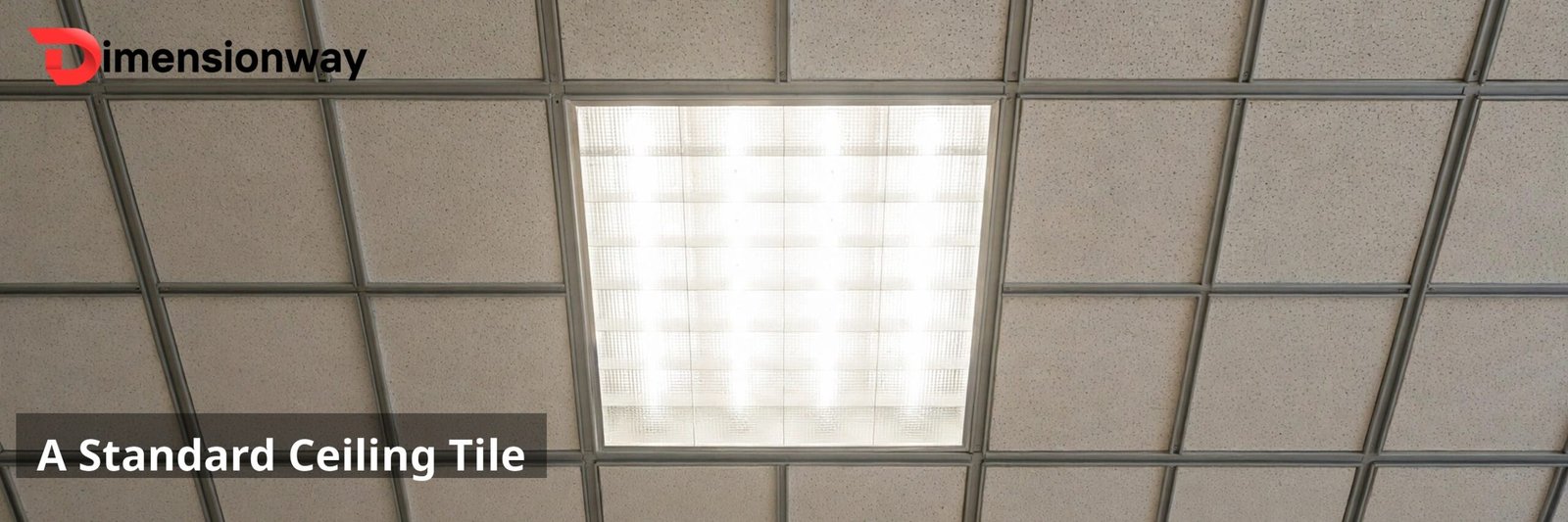
Look up in almost any office, school, or basement and you will see 2 feet built into the ceiling. Standard suspended ceiling tiles come in two sizes, and the most common square tile measures 24 inches by 24 inches, which is 2 feet by 2 feet. The rectangular version measures 24 by 48 inches, which is 2 feet by 4 feet.
Each square tile covers 4 square feet of ceiling. The tiles sit in a metal grid, and the grid itself is spaced in 2-foot modules, which is why dropped ceilings have that regular, repeating pattern. Counting tiles is a surprisingly accurate way to estimate a room: a ceiling that is 5 tiles wide is 10 feet across, and a ceiling that is 10 tiles long is 20 feet long.
This comparison is useful because it turns 2 feet into an area you can stand under. The next time you are in a classroom or an office, count the tiles above your head. Every single square is a 2-foot by 2-foot panel.
5. A 24-Inch Dog Crate
Pet owners get a very concrete 2-foot reference from the dog crate. A standard 24-inch dog crate, a common size for small breeds, measures 24 inches long, 18 inches wide, and 19 inches high. The length of the crate, front to back, is exactly 2 feet.
Crates are sold by their length, which is why the product name itself tells you the measurement. A 24-inch crate suits dogs up to about 25 pounds, including breeds like Dachshunds, Pugs, and small Beagles. The dog inside can stand up, turn around, and lie down stretched out, because 2 feet of length is roughly the body length of a small dog.
This is a handy comparison because crates are boxy and easy to picture. If you have ever folded a wire crate flat for storage, you have handled a panel that is 2 feet long. And if you are shopping for a crate, the size number on the box is doing your measuring for you: 24 inches on the label means 2 feet of crate.

6. A 24-Inch Kids’ Bike Wheel
Kids’ bicycles are sized by wheel diameter, and one of the most common sizes is a perfect 2-foot circle. A 24-inch bike wheel measures 24 inches across, from one edge of the tire through the hub to the opposite edge. That diameter is exactly 2 feet.
Bikes with 24-inch wheels are typically ridden by children aged about 7 to 11 years, roughly 4 feet 1 inch to 4 feet 9 inches tall. They are the last step before adult-sized bikes, which usually have 26-inch or larger wheels. So if you have a child in that age range, or you remember your own first “big kid” bike, its wheels were 2 feet across.
A wheel is a nice way to picture 2 feet because it is round. Most of the comparisons in this guide are straight lines, but a wheel turns 2 feet into a circle you can roll. Picture a bike wheel standing on the ground: the distance from the pavement up to the top of the tire is 2 feet.

7. A French Baguette
For a tastier comparison, head to the bakery. A traditional French baguette measures about 26 inches long, which is just 2 inches longer than 2 feet. Hold a full baguette in your hands and you are holding a loaf that is almost exactly 2 feet from end to end.
Baguettes are long and thin, usually about 2 to 2.5 inches in diameter, and they are sold in paper sleeves that make their length obvious. The classic baguette weighs about 250 grams and is defined by French baking tradition, but its length is what matters here: 26 inches is close enough to 24 inches that a baguette works as a quick kitchen estimate for 2 feet. If you need a little less than a baguette, you need about 2 feet.
This comparison is fun because it is edible and because it is slightly off. Not every comparison in this guide is exact, and knowing which ones run a little long is part of using them well. A baguette overshoots 2 feet by about the width of two fingers. If you picture a baguette and then shave a couple of inches off one end, you have 2 feet.

8. A Carry-On Suitcase
Air travelers carry a near-perfect 2-foot reference through every airport. Most airlines cap carry-on luggage at 22 inches tall, 14 inches wide, and 9 inches deep, including wheels and handles. That means a standard carry-on stands 22 inches tall, just 2 inches short of 2 feet.
Stand a carry-on upright next to your leg and the top of the bag, handle included, reaches just below the 2-foot mark. A bag that is 24 inches tall, which some stores still label as a carry-on, will be treated as a checked bag by most major airlines, because it breaks the 22-inch limit. That 2-inch gap is the difference between walking onto the plane with your bag and paying to check it.
This is a practical comparison because almost everyone has wrestled a carry-on into an overhead bin. The next time you pack, you can use your suitcase as a ruler: anything about as tall as your carry-on, plus a couple of inches, is about 2 feet.

9. A Skateboard Deck
Skateboarders ride a board that overshoots 2 feet by a comfortable margin. A standard adult skateboard deck measures about 31.5 inches long, which is 7.5 inches longer than 2 feet. Put another way, a skateboard is about one and a third times 2 feet.
That makes a skateboard a useful “a little more than 2 feet” reference. If you picture a skateboard lying on the ground and then chop roughly a quarter off one end, what is left is about 2 feet. Skateboard decks also vary less in length than in width: most full-size decks fall in the 31 to 32.5 inch range, so the length is stable across brands.
This comparison works well for younger readers and for anyone who has spent time at a skate park. A skateboard is also easy to picture in motion, which helps: 2 feet is a bit shorter than the board a skater stands on, so if you can picture the board, you can picture 2 feet by trimming the nose and tail in your head.

10. The Long Side of a Standard Poster
The last comparison is hanging on walls everywhere. A standard poster size is 18 inches by 24 inches, and the long side of that poster measures exactly 24 inches, which is 2 feet. Framed movie posters, classroom posters, and art prints in this size are extremely common.
This is a great indoor reference because posters are flat, rectangular, and easy to visualize. Hold your arms out to roughly the width of a movie poster on a bedroom wall and you are showing about 2 feet. The short side, 18 inches, is 1.5 feet, so a standard poster gives you two measurements at once: 2 feet one way and 1.5 feet the other.
It also pairs nicely with the ceiling tile comparison. A ceiling tile is a 2-foot square, and a standard poster is a 2-foot rectangle with one side trimmed to 18 inches. If you can picture either one, you can picture 2 feet.

The 10 Comparisons at a Glance
| Comparison | Measurement | How It Relates to 2 Feet |
|---|---|---|
| Two standard rulers | 12 in each | Exact, 2 rulers |
| 24-inch monitor diagonal | 24 in | Exact, corner to corner |
| Cornhole board width | 24 in | Exact |
| Ceiling tile | 24 by 24 in | Exact, both sides |
| Dog crate length | 24 in | Exact |
| Kids’ bike wheel | 24 in diameter | Exact |
| French baguette | About 26 in | About 2 in longer |
| Carry-on suitcase height | 22 in | 2 in shorter |
| Skateboard deck | About 31.5 in | About 7.5 in longer |
| Standard poster long side | 24 in | Exact |
2 Feet Compared to Nearby Lengths
Two feet sits in a busy neighborhood of measurements. It is double 1 foot, two thirds of a yard, and half of 4 feet. This table puts it in context so you can move between nearby sizes without a calculator.
| Object or Length | Measurement | Compared to 2 Feet |
|---|---|---|
| Standard ruler | 12 in | Half of 2 ft |
| Standard poster short side | 18 in | 6 in shorter than 2 ft |
| Carry-on suitcase height | 22 in | 2 in shorter than 2 ft |
| 2 feet | 24 in | The reference itself |
| French baguette | About 26 in | About 2 in longer than 2 ft |
| Skateboard deck | About 31.5 in | About 7.5 in longer than 2 ft |
| One yard | 36 in | 1.5 times 2 ft |
| Cornhole board length | 48 in | Exactly double 2 ft |
| Standard door height | 80 in | About 3.3 times 2 ft |
How to Picture 2 Feet Without a Tape
You do not need a tape measure to use 2 feet. Pick the anchor that matches where you are standing. In a classroom or office, look up at the ceiling tiles or across at a poster. At home, picture your dog’s crate or your computer monitor’s diagonal. In the kitchen, think of a baguette. At the airport, look at your suitcase.
For estimating a real distance, the ruler trick is the most practical. Everyone knows what a ruler looks like, and doubling it in your head is easy. If you have one ruler in hand, flip it end over end once along the distance you are measuring. Two ruler lengths is 2 feet.
Another practical trick is the poster trick. Standard posters are 2 feet on the long side, and they hang on walls in bedrooms, classrooms, and offices everywhere. If you can picture a poster, you can picture 2 feet anywhere indoors, because the poster’s long edge is the same length as two rulers laid end to end.
Try it as a worked example. Suppose you want to know whether a shelf is at least 2 feet wide before you buy a storage bin for it. Picture a standard poster laid across the shelf. If the shelf is about as wide as the poster’s long side, the bin needs to be about 2 feet wide or less. The same trick works with ceiling tiles in a basement or garage: one tile edge is 2 feet, so count tiles to estimate any wall or shelf.
2 Feet Around the House
Two feet shows up in every room, because builders and manufacturers settled on it as a convenient module long ago. This table collects the places you will meet it without leaving home.
| Room or Place | Where 2 Feet Shows Up | Measurement |
|---|---|---|
| Office or classroom | Ceiling tile edge | 24 in |
| Bedroom or dorm | Standard poster long side | 24 in |
| Desk | Monitor diagonal | 24 in |
| Living room | Dog crate length | 24 in |
| Garage | Cornhole board width | 24 in |
| Kitchen | Baguette length | About 26 in |
| Entryway | Carry-on suitcase height | 22 in |
| Kids’ room | Bike wheel diameter | 24 in |
Notice how many of these are exactly 24 inches. That is not a coincidence. Once an industry settles on a module, everything built for it follows: grid systems, crates, boards, and screens all land on 2 feet because it is a comfortable size to handle, carry, and install.
Common Questions About 2 Feet
How long is 2 feet in meters?
Two feet is 0.6096 meters. Multiply feet by 0.3048 to convert, so 2 times 0.3048 gives 0.6096 meters.
How many inches are in 2 feet?
There are 24 inches in 2 feet. Each foot holds 12 inches, and 2 times 12 is 24.
How many centimeters is 2 feet?
Two feet is 60.96 centimeters. Each inch is 2.54 centimeters, and 24 times 2.54 is 60.96.
How many yards is 2 feet?
Two feet is about 0.667 yards, or two thirds of a yard. Each yard holds 3 feet, and 2 divided by 3 is 0.667.
Is a 24-inch monitor 24 inches wide?
No. Monitor sizes are measured diagonally, corner to corner. A 24-inch monitor has a diagonal of 24 inches, which is exactly 2 feet, but its screen is only about 20.9 inches wide at the standard 16:9 ratio.
What dog crate size is 2 feet long?
A 24-inch dog crate is 2 feet long. It typically measures 24 inches long, 18 inches wide, and 19 inches high, and it suits small dogs up to about 25 pounds.
Is a baguette exactly 2 feet long?
Not quite. A traditional French baguette measures about 26 inches, which is about 2 inches longer than 2 feet. It is close enough to use as a kitchen estimate, but it overshoots by a couple of inches.
How can I picture 2 feet using rulers?
Lay two standard 12-inch rulers end to end. Each ruler is 1 foot long, so two rulers together stretch exactly 24 inches, which is 2 feet.
Is a carry-on suitcase 2 feet tall?
Almost. Most airlines cap carry-ons at 22 inches tall including wheels and handles, which is 2 inches short of 2 feet. A 24-inch suitcase is usually treated as a checked bag.
How does 2 feet compare to 3 feet?
Two feet is 24 inches and 3 feet is 36 inches, so 3 feet is 12 inches, or 50 percent, longer than 2 feet. A yardstick is 3 feet long, and 2 feet covers exactly two thirds of it.
Why 2 Feet Is Easy to Underestimate
Two feet sounds small on paper, yet it is bigger than most people picture, and there is a reason for that. Human beings judge length against their own bodies. Two feet is roughly the distance from your elbow to your fingertips, which is a span you use every day without thinking. Because it fits inside your personal space, your brain files it as small.
But set 2 feet against real objects and it grows. It is the width of a game board, the length of a dog crate, the diagonal of a monitor, and the edge of a ceiling tile. Those are all substantial, useful things, not tiny ones. Knowing the comparisons in this guide gives you a set of anchors that turn an abstract measurement into something your eyes already understand.
Related Reading
If this guide helped 2 feet click, these DimensionWay guides use the same visual approach for nearby sizes: How Long Is 3 Feet?, How Long Is 10 Feet?, How Long Is 20 Feet?, How Long Is 100 Feet?, How Long Is 1000 Feet?, How Tall Is 8 Feet?, How Tall Is 12 Feet?, How Tall Is 6 Feet?, How Tall Is 10 Feet?, and How Tall Is a Door?.
Sources
- American Cornhole League
- MidWest Homes for Pets
- Angi
- Wikipedia
- American Airlines
- Santa Cruz Skateboards
- Chef’s Pencil
- BikeExchange

James Carter is the founder and editor of DimensionWay, where he researches, measures, and verifies real-world dimensions, from everyday objects to world-famous landmarks. Every number published on DimensionWay is cross-checked against manufacturer specifications and official sources, so readers always get accurate, easy-to-visualize comparisons.
