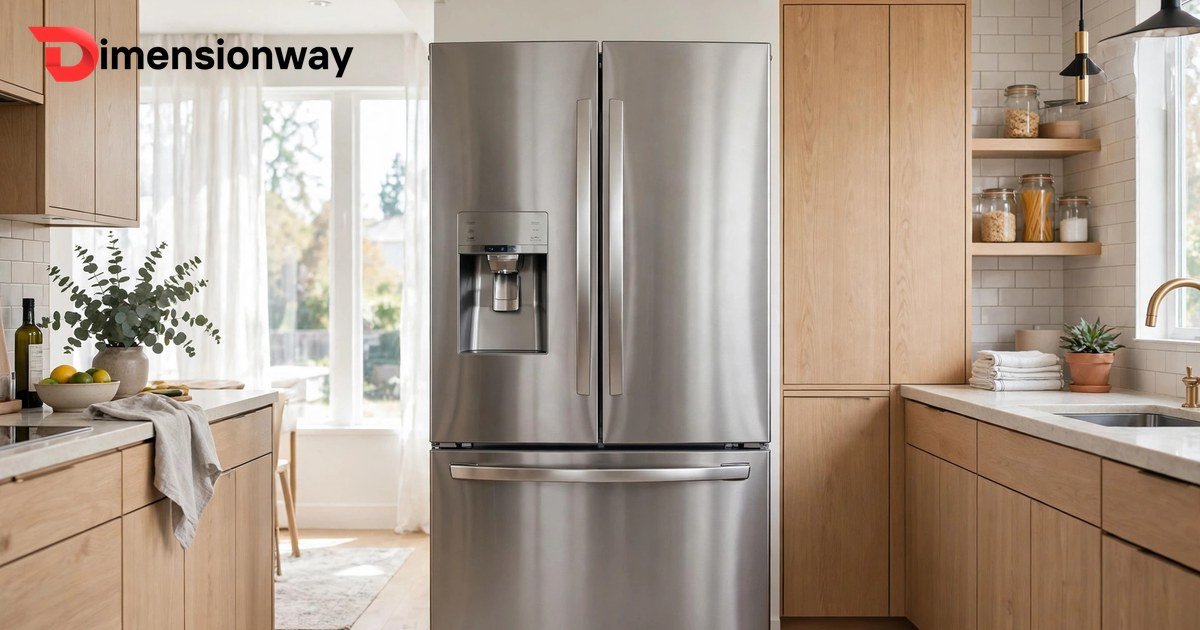
You are standing in the appliance aisle, or more likely scrolling through one on your phone at midnight, and every refrigerator listing gives you three numbers. Height, width, depth. The width and depth feel obvious. The height is the one that will ruin your week, because it decides whether the fridge slides under your cabinets or sits in your garage while you call the delivery crew back.
Here is what the listings never quite say plainly: a refrigerator is one of the few things in your home that is almost exactly as tall as you are. Most full-size models land within an inch or two of the average adult man. Once you carry that image in your head, the numbers stop being abstract.
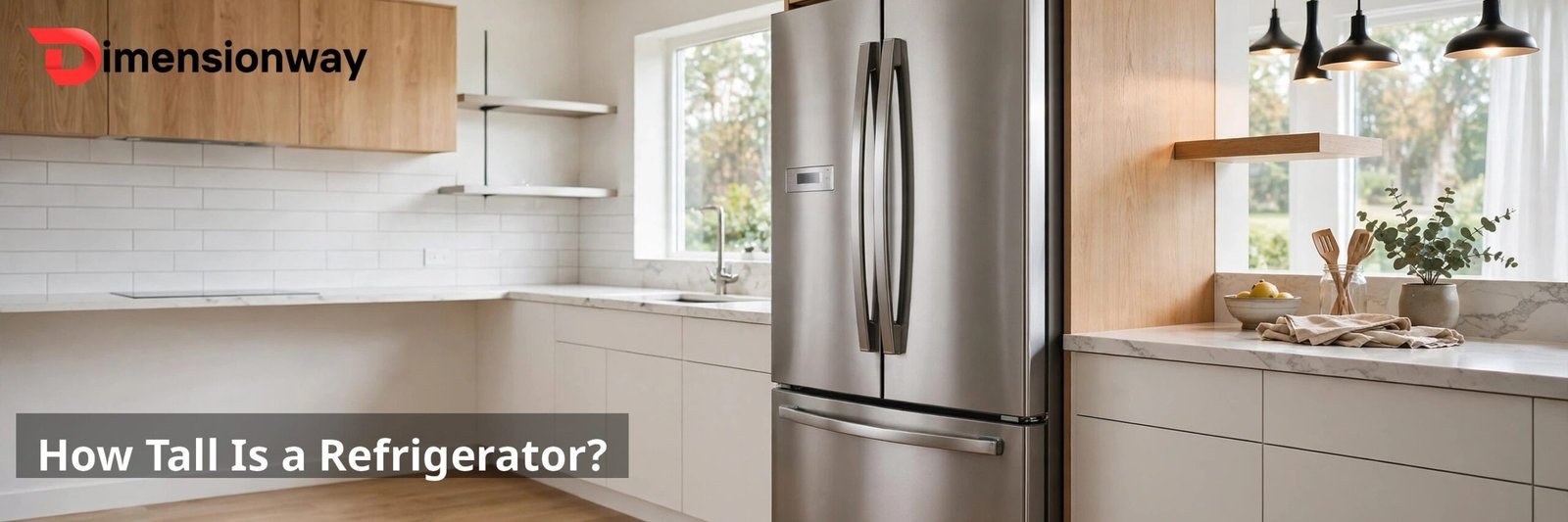
How Tall Is a Refrigerator?
A full-size refrigerator stands about 65 to 71 inches tall, with most French door and side-by-side models around 69 to 70 inches. Mini fridges run 18 to 34 inches. Built-in models can reach 84 inches.
The number that matters most is 69 inches. That is the height of the best-selling full-size refrigerators in the United States, the French door and side-by-side models that fill showroom floors. Your cabinets, your doorways, and your delivery route all revolve around that figure, plus a little breathing room.
The Standard Height, by Type
Not all fridges are built on the same scale. A dorm mini and a built-in column differ by more than four feet. The table below covers the full range, using the consensus of manufacturer dimension guides from Maytag, Whirlpool, Samsung, GE, and Lowe’s buying data.
| Type | Height | Width | Depth | Typical capacity |
|---|---|---|---|---|
| Top freezer | 61 to 69 in | 28 to 33 in | 28 to 35 in | 14 to 20 cu ft |
| Bottom freezer | 67 to 70 in | 29 to 33 in | 33 to 36 in | 18 to 25 cu ft |
| Side-by-side | 65 to 72 in | 32 to 40 in | 29 to 32 in | 20 to 28 cu ft |
| French door | 68 to 72 in | 29 to 36 in | 29 to 35 in | 22 to 28 cu ft |
| Counter depth | 68 to 72 in | 30 to 36 in | 24 to 28 in | 19 to 24 cu ft |
| Built-in | 80 to 84 in | 36 to 48 in | 24 to 28 in | 20 to 30 cu ft |
| Mini or dorm | 18 to 34 in | 18 to 24 in | 18 to 22 in | 1.7 to 4.5 cu ft |
A few notes on reading this table. Height is measured to the top of the cabinet, not counting the hinges, which can add an inch or more. Samsung’s own fit guides list a 28 cubic foot French door at 68 and seven-eighths inches without the hinge and a full 70 inches with it. That inch and change is exactly the kind of detail that turns a smooth delivery into a cabinet-trimming project.
Counter depth models are not shorter. They stand just as tall as standard-depth models. The difference is all in the depth, shaved down so the doors sit roughly flush with your counters. If height is your constraint, counter depth buys you nothing. If depth is your constraint, it buys you the built-in look for a fraction of the price.
Built-ins play a different game entirely. At 80 to 84 inches, they run from floor to ceiling in many kitchens, which is the whole point: a wall of refrigeration that looks like cabinetry. The classic Sub-Zero style built-in stands 84 inches tall, a full foot above a standard French door.
10 Comparisons That Make Fridge Height Click
A full-size refrigerator, about 69 inches tall. Here is what that looks like in the real world.
An Interior Doorway
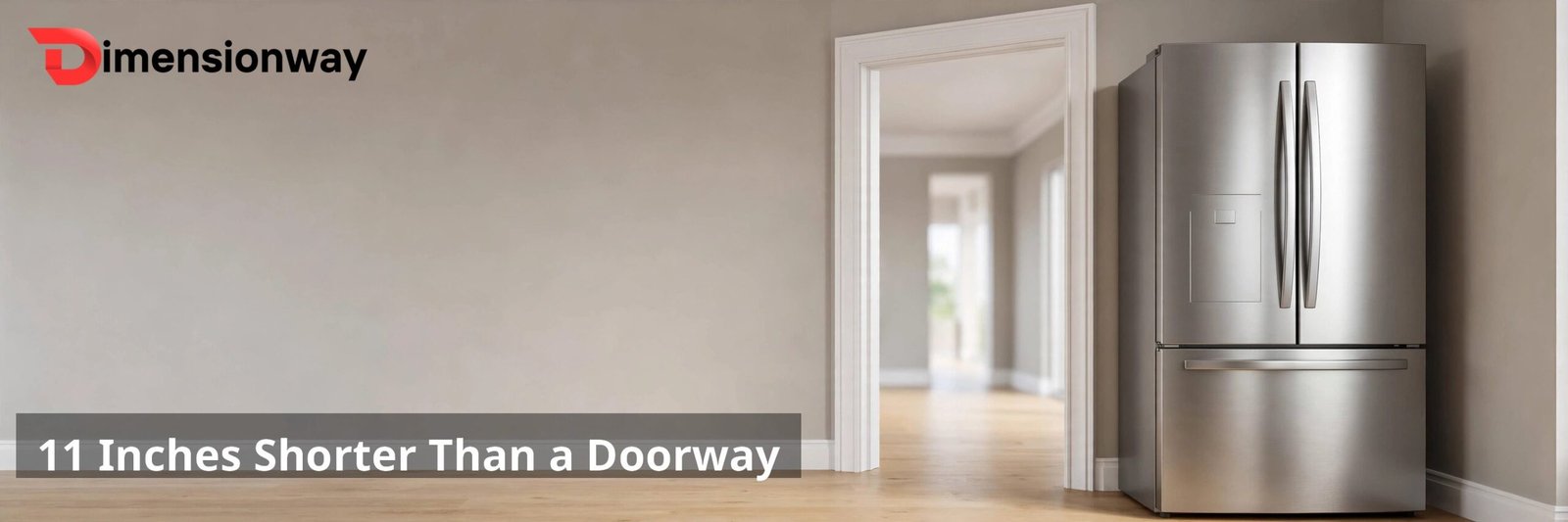
A standard interior door stands 80 inches tall. Set a 69-inch fridge beside one and the fridge comes up 11 inches short, roughly the length of a sheet of letter paper. The door frame towers over the fridge the way it towers over most people.
This is the most practical comparison in the guide, because it answers the delivery question directly. Your fridge is shorter than every door in your house, which means the height will clear. The width is the number that gets stuck in doorways, not the height. If the fridge is 36 inches wide or less, it will walk through a standard 36-inch doorway, height with room to spare.
An Average Adult Man
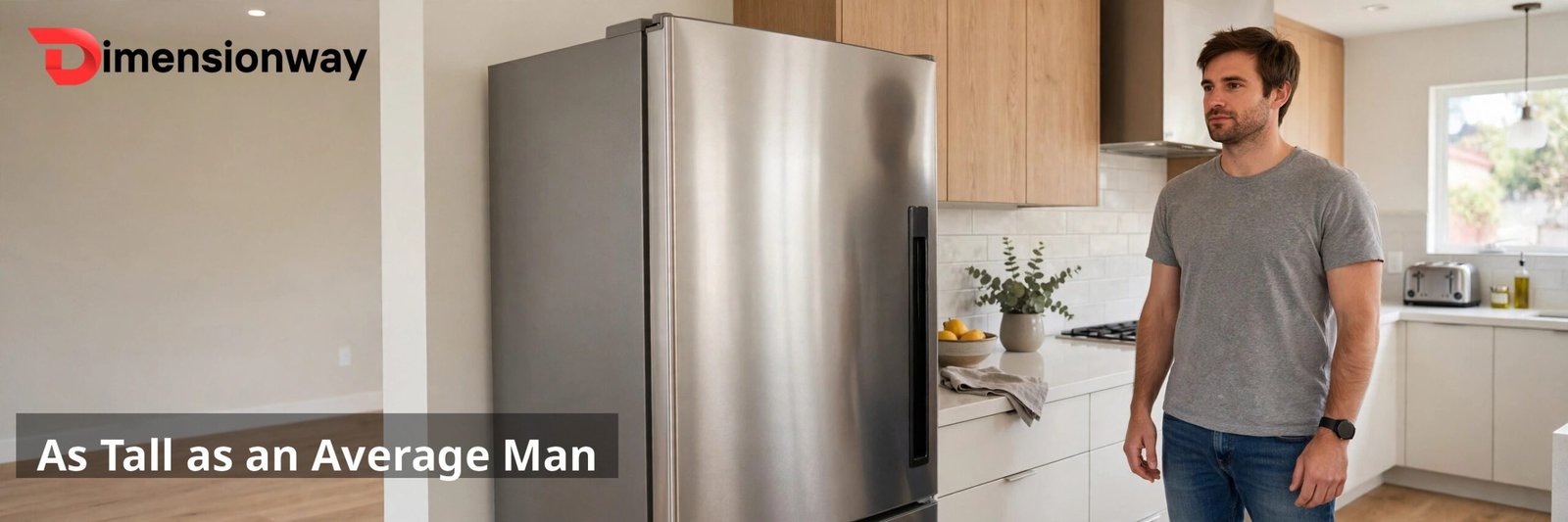
The average American man stands about 69 inches tall, according to the CDC’s measured body data. A full-size refrigerator at 69 inches is, quite literally, a man tall. Stand the two side by side and the top of the fridge lines up with the top of his head.
This is the image worth keeping. Every time you see a fridge listed at 68 or 70 inches, picture a man standing next to it. If you are an average-height man yourself, you do not need a tape measure to estimate a fridge. Stand next to it. Your eyes tell you the rest.
An Average Adult Woman

The average American woman stands about 64 inches tall, also per the CDC’s measured data. A 69-inch fridge rises about five inches above her head, roughly the height of a coffee mug stacked on her crown.
The practical upshot matters in daily life. For an average-height woman, the top shelf of a full-size fridge is a reach, not a view. That is why the most-used items migrate to the door bins and middle shelves. The fridge’s height is designed around the middle of the population, which means half the population stretches for the top.
A Kitchen Counter
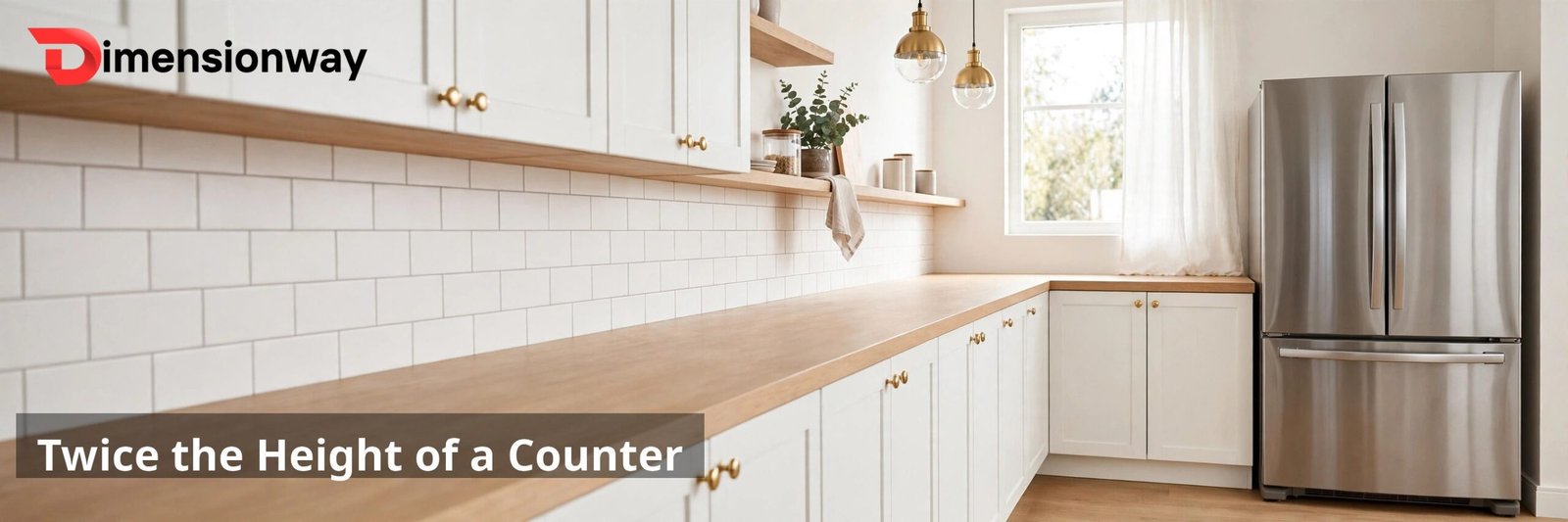
A standard kitchen counter stands 36 inches tall. Stack two of them and you get 72 inches, within three inches of a full-size fridge. The fridge is almost exactly twice counter height, a proportion you can check in any kitchen in America.
The counter is also the anchor for understanding the mini fridge. A dorm mini at 30 to 34 inches tops out just under counter height, which is why the classic setup tucks it beneath a counter or a desk. Same 36-inch line, two completely different machines.
A 6-Foot Person

A person who is 6 feet tall measures 72 inches, three inches taller than the typical full-size fridge. Stand them side by side and the person sees just over the top, about the length of a finger. Our guide to how tall 6 feet is walks through that human scale in more detail.
This comparison is useful at the store. Salespeople quote the cabinet height, the number in the table above. The hinges, the door swing, and the delivery tilt all push the effective height higher. A 6-foot person standing next to the floor model tells you the honest truth faster than the spec sheet.
A Dining Table
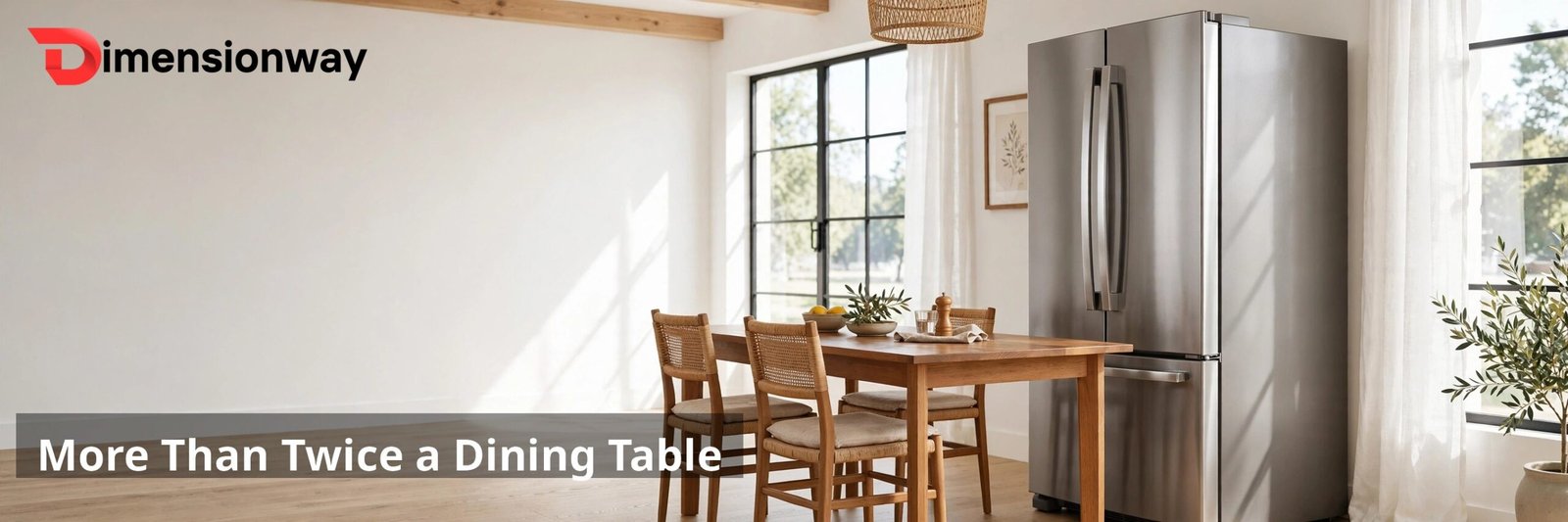
A standard dining table stands about 28 to 30 inches tall. A 69-inch fridge is more than twice that, 2.3 times the table height. Stack two dining tables and the fridge still clears them by the length of a paperback book. Our guide to what size a dining table is covers that 30-inch standard in full.
The table comparison also explains why fridges feel so dominant in open kitchens. Almost nothing else in the room breaks four feet. The fridge, the doorway, and the ceiling are the three tall things, and the fridge is the only one you move.
A King-Size Bed

A king-size bed measures 76 by 80 inches. Tip a 69-inch fridge onto its back and it would be 11 inches shorter than the bed is long. The bed wins by a hand’s length. Our guide to how big a king-size bed is breaks down those 80 inches.
This one lands because of the shared scale. Both objects are built for the same human body, one for storing food at standing height, one for sleeping lying down. They converged on nearly the same length from opposite directions.
A Gallon of Milk
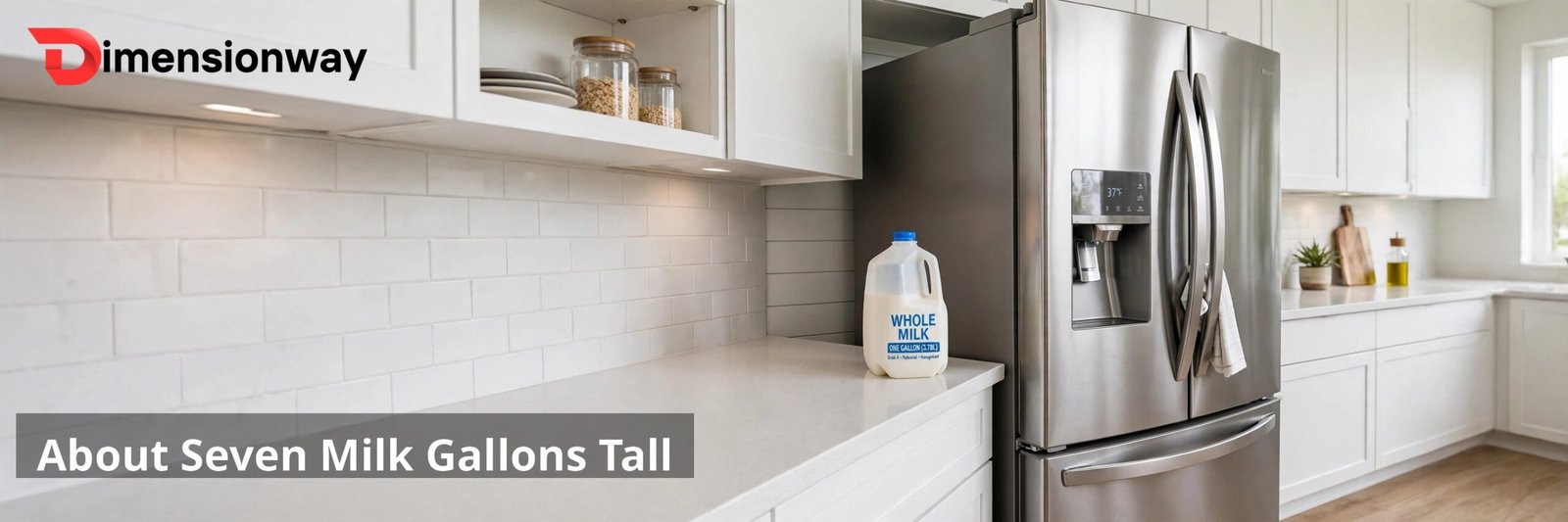
A gallon milk jug stands about 10 inches tall. A 69-inch fridge is about seven milk jugs tall, stacked cap to base. Line up seven gallons on the floor and the top of the stack grazes the top of the fridge.
Seven is a fun number because it is also roughly a week’s worth of milk for a thirsty family. The fridge and the weekly grocery run share the same vertical rhythm, which makes sense: the fridge exists to hold exactly that kind of stack.
A Basketball Hoop
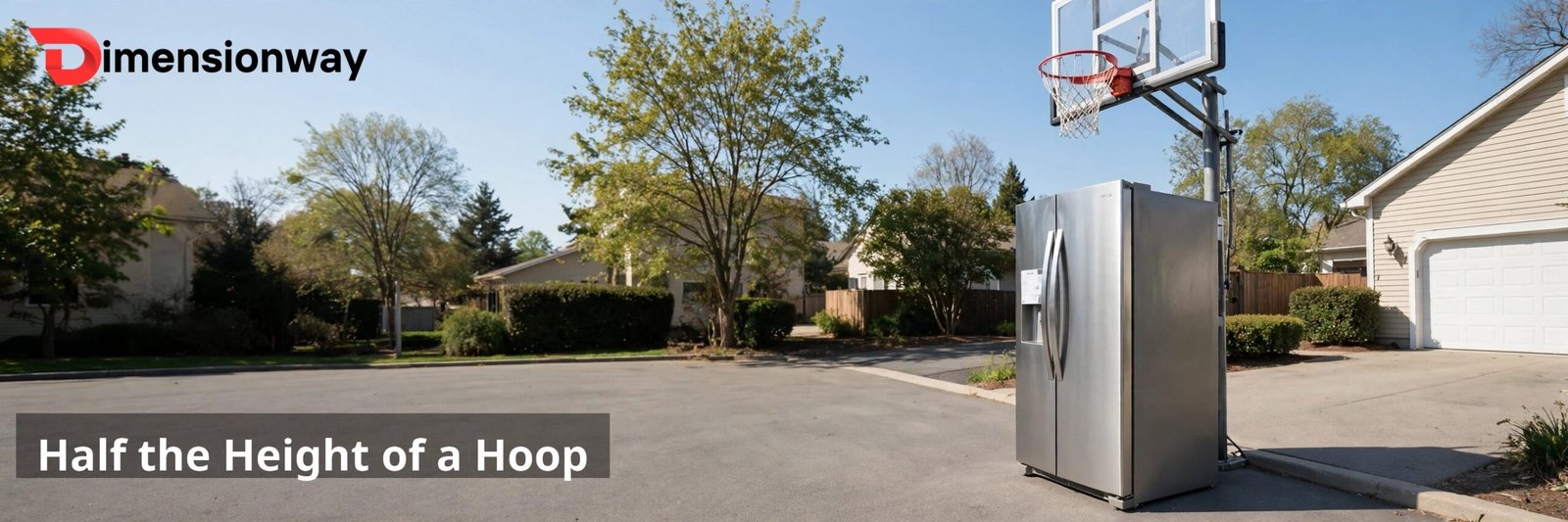
A regulation basketball hoop sits 10 feet off the ground, 120 inches. A 69-inch fridge reaches a little over halfway there, about 58 percent of the way to the rim. The rim is the only familiar object that clearly dwarfs the fridge.
This comparison works because hoops are everywhere and their height is sacred. Every driveway hoop is 10 feet. Once you know the fridge is a bit more than half a hoop, you can estimate fridge height from the street.
A Mini Fridge
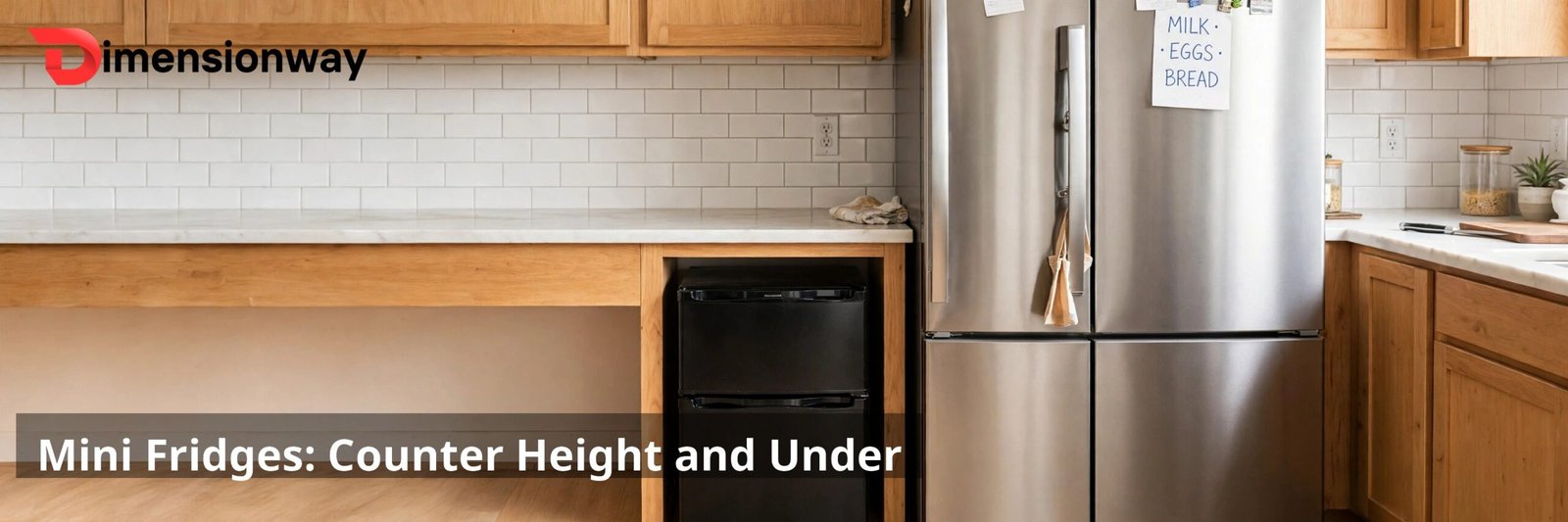
A dorm mini fridge stands about 28 to 34 inches tall, roughly counter height. Next to a 69-inch full-size model, the mini reaches just below the halfway mark. The difference between the two is the difference between a dorm room and a family kitchen.
The mini earns its spot because it is the fridge most people picture first. Ask someone to draw a fridge and they draw a box a little taller than a desk. That box is real. It is just not the box in your kitchen. The kitchen box is twice as tall and holds ten times the food.
How to Picture Fridge Height Without a Fridge
Three tricks that stick.
First, use the door. A standard interior door is 80 inches. A full-size fridge tops out about a hand’s length below the top of the door frame. If you can picture a door, you can picture a fridge.
Second, use yourself. If you are an average-height man, a full-size fridge matches your height. If you are an average-height woman, the fridge rises about five inches above you. Your own body is the most portable measuring tape you own.
Third, use the counter. A kitchen counter is 36 inches, half a fridge. Two counters, one fridge. The mini fridge is the counter’s little sibling, topping out just below that 36-inch line.
Fridge Capacity vs Height
Bigger fridges are taller fridges, but not in a straight line. Manufacturers stretch the tall ones first because kitchen footprints are fixed.
| Capacity | Typical height | Best for |
|---|---|---|
| 14 to 18 cu ft | 60 to 66 in | Couples, small kitchens, second fridges |
| 19 to 23 cu ft | 66 to 70 in | Average families, the most common range |
| 24 to 28 cu ft | 70 to 73 in | Large families, wide French door models |
| 29 cu ft and up | 73 in and up | Big households, wide and deep models |
The sweet spot for most families sits in the 19 to 23 cubic foot band, which is exactly where the 69-inch standard lives. Go bigger and the height creeps past 70 inches, which is where cabinet problems start. That is no accident: kitchen cabinet openings were standardized around the fridges people actually buy.
Will It Fit? Measuring Your Space
This is the section that saves delivery day. Follow it in order, with a tape measure in your hand.
- Measure the opening. Height from the floor to the underside of the overhead cabinet, width wall to wall, depth from the back wall to the front edge of the counters. Write all three down. Measure twice, because a quarter inch at the cabinet line decides everything.
- Subtract the clearances. Manufacturers publish minimum air gaps, and they are not suggestions. The table below combines guidance from Whirlpool and Samsung installation documents.
| Where | Allow | Why |
|---|---|---|
| Top | 1/2 to 1 in | Ventilation, and the door hinges swing near the top |
| Each side | 1/2 to 1 in | Airflow, and room to slide the unit into place |
| Behind | 1 to 2 in | Coils, air circulation, and the water line |
| Hinge side next to a wall | 3 3/4 in | The door needs a full 90-degree swing |
| Overhead cabinet | 1 in above the hinge tops | Hinges sit proud of the cabinet and swing upward |
- Walk the delivery route. Measure every doorway, hallway, and turn between the street and the fridge’s final spot. The narrowest opening rules. A 36-inch-wide fridge needs a true 36 inches of clear passage at every point, and stairs add a tilt that steals height. Our guide to estimating distance without a tape measure has household-object tricks if the tape measure goes missing mid-route.
- Check the exact model, not the type. Two French doors can differ by two inches. The spec sheet lists height with and without hinges, and the with-hinge number is the one that meets your cabinets. Samsung’s fit sheets, for example, list 70 inches with the hinge against 68 and seven-eighths without. Buy by the hinge number.
- Remember the floor. Tile, hardwood, and a thick rug change the height by fractions of an inch. If your opening is tight to the quarter inch, measure from the finished floor the fridge will actually stand on.
The single most common failure, judging by the forums, is the 69-inch opening meeting a 69-inch fridge. The numbers match and the fridge still does not fit, because the hinges need that last half inch. Give the top a full inch and the problem disappears.
Inches to Centimeters for Common Fridge Heights
| Inches | Centimeters | What it is |
|---|---|---|
| 36 | 91.4 | Standard counter height |
| 61 | 154.9 | Short top-freezer models |
| 65 | 165.1 | Short side-by-side models |
| 66 | 167.6 | Small capacity full-size |
| 67 | 170.2 | Bottom-freezer low end |
| 68 | 172.7 | French door low end |
| 69 | 175.3 | The most common full-size height |
| 70 | 177.8 | Most French door and side-by-side models |
| 71 | 180.3 | Tall side-by-side models |
| 72 | 182.9 | Six feet, taller models |
| 84 | 213.4 | Built-in models |
One inch equals exactly 2.54 centimeters, so any height multiplies straight across. A 69-inch fridge at 175.3 cm is the figure you will see on international spec sheets, and it matches the 69-inch domestic number to the fraction.
FAQs
What is the standard height of a refrigerator?
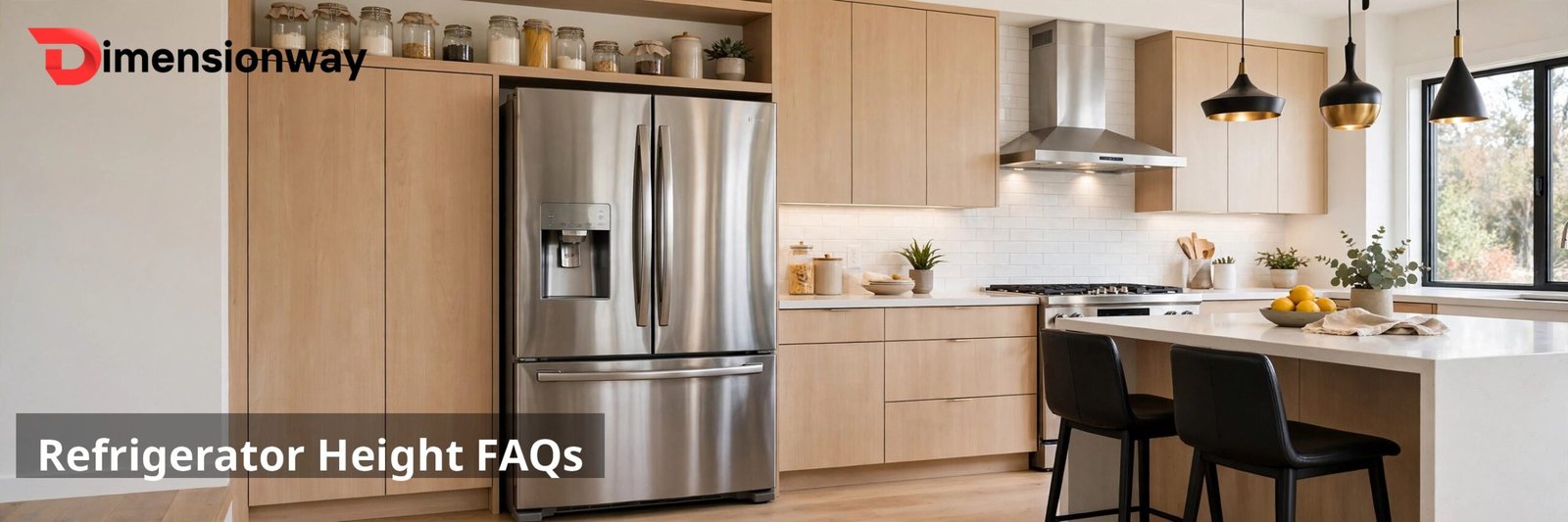
A full-size refrigerator is 65 to 71 inches tall. The most common height on showroom floors is about 69 to 70 inches, which covers most French door, side-by-side, and bottom-freezer models. Top freezers run shorter, 61 to 69 inches, and mini fridges run 18 to 34 inches.
How tall are French door refrigerators?
French door models are 68 to 72 inches tall, with the great majority landing at 69 to 70 inches. Samsung’s fit guides, for example, list a 28 cubic foot French door at 70 inches with the hinge and 68 and seven-eighths without. Always use the with-hinge number when checking your cabinets.
Will a new fridge fit under my cabinets?
Measure your opening from the floor to the underside of the cabinet, then compare against the fridge’s height with hinges plus at least half an inch of clearance, ideally a full inch. Most kitchen fridge alcoves are 70 to 72 inches, which fits a 69-inch fridge comfortably. If your opening is exactly 69 inches, look for a shorter model or plan on cabinet work.
How much clearance should I leave on top of my fridge?
Leave half an inch to one inch above the fridge, following your model’s installation guide. Whirlpool asks for half an inch at the top and Samsung for three-eighths as a minimum, but a full inch is the safer real-world number under a cabinet. The top hinges sit above the cabinet line and need that room to swing.
How tall is a counter depth refrigerator?
Counter depth refrigerators are 68 to 72 inches tall, the same height as standard-depth models. Counter depth refers to the depth only, shaved to about 24 to 28 inches so the doors sit close to flush with your counters. If height is your problem, counter depth does not help. If depth is your problem, it helps a lot.
What is the standard cabinet opening for a refrigerator?
There is no single standard, which is why you must measure. Common rough openings are 36 inches wide and 70 to 72 inches tall, sized for the 69-inch fridge that dominates sales. Older kitchens were built around shorter top-freezer models and can run 66 to 68 inches, which is where most fit problems begin.
Do mini fridges fit under a kitchen counter?
Usually yes. Dorm mini fridges run 18 to 34 inches tall, and a standard counter is 36 inches, so most slide underneath with room to spare. Dedicated undercounter models are built at 34 to 36 inches to sit flush. Check the depth too, because a mini that is too deep will stick out past the counter edge.
How tall are built-in refrigerators?
Built-in models run 80 to 84 inches tall, floor to ceiling in most kitchens. The classic built-in, like the Sub-Zero style column, stands 84 inches. They are designed to look like cabinetry, which is why they cost several times a freestanding fridge and need professional installation.
Will a refrigerator fit through my front door?
A standard front door is 36 inches wide and 80 inches tall, and most full-size fridges are 36 inches wide or less and under 72 inches tall, so yes, with the doors removed if needed. The trouble spots are interior doorways, tight turns, and stairs, not the front door. Walk the whole delivery route and measure the narrowest point.
How do I measure for a refrigerator before buying?
Measure the alcove height, width, and depth, then subtract the manufacturer’s clearances for the top, sides, back, and hinge swing. Then walk the delivery route and measure every doorway and turn. Finally, check the exact model’s spec sheet for the with-hinge height, which is the number that has to clear your cabinets.
Conclusion
A full-size refrigerator stands about 69 inches tall, as tall as an average man, twice a kitchen counter, and eleven inches shorter than your doorway. Mini fridges live at counter height and under. Built-ins climb to 84 inches and pretend to be cabinets.
Keep the three pictures that matter. The door minus a hand’s length. Yourself, plus five inches if you are a woman. The counter, doubled. The next time a listing gives you three numbers, the height will be the one you already understand.
Related Reading
– How Tall Is 6 Feet? 10 Everyday Comparisons: the human yardstick that a fridge is three inches short of. – What Size Is a Dining Table? 10 Things That Size, Visualized: the 30-inch table your fridge is more than twice as tall as. – How Big Is a King-Size Bed? 10 Things That Size, Visualized: the 80-inch bed that beats a tipped fridge by a hand’s length. – How to Estimate Distance Without a Tape Measure: household objects that double as rulers when the tape measure goes missing.
Sources
- Wayfair
- Maytag
- Lowe's
- Fridge.com
- Samsung
- Whirlpool
- CDC
- Appliances First

James Carter is the founder and editor of DimensionWay, where he researches, measures, and verifies real-world dimensions, from everyday objects to world-famous landmarks. Every number published on DimensionWay is cross-checked against manufacturer specifications and official sources, so readers always get accurate, easy-to-visualize comparisons.
