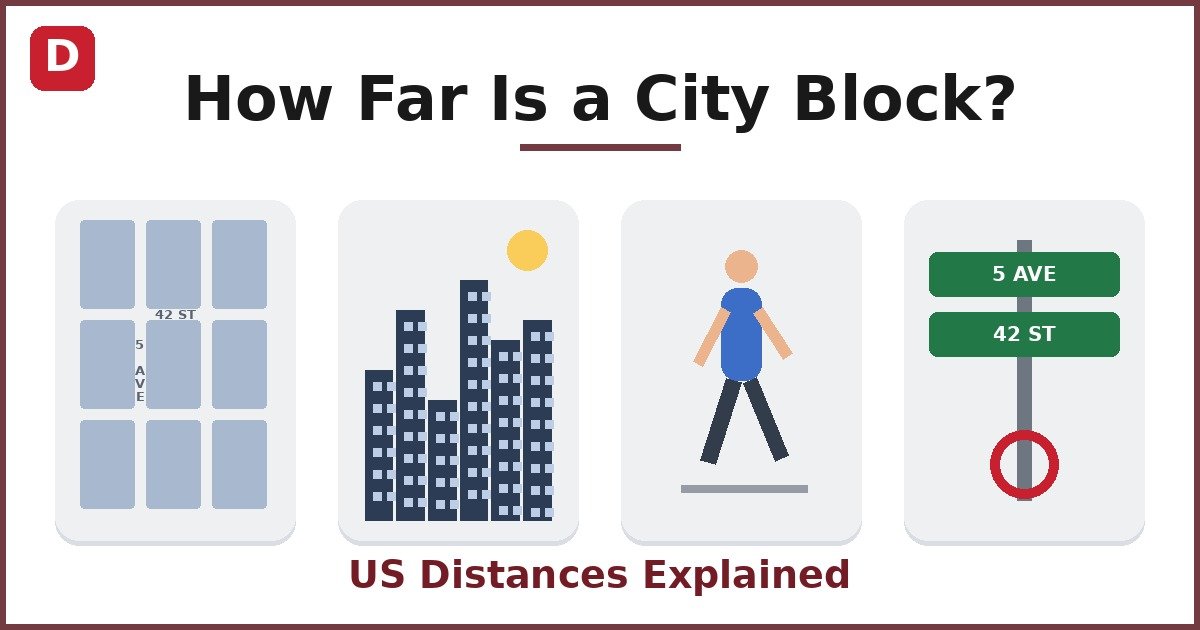
Someone tells you the coffee shop is three blocks away, and you nod like that means something precise. Then you start walking, and three blocks in Manhattan feels nothing like three blocks in Chicago. So how far is a city block, really? The honest answer is that it depends on the city, but there is a standard most Americans picture: about 264 feet, or 80 meters, which is exactly one-twentieth of a mile. That number comes from the Manhattan street grid, the most famous grid in the country. This guide gives you the exact conversions, shows how block sizes differ across US cities, and walks you through 10 everyday things that measure about one city block, so the next “three blocks away” actually means something to you.
How Long Is a City Block?
A city block is the stretch of street between two intersections, and its length changes from city to city. In Manhattan, the standard block runs 264 feet on its short side and 900 feet on its long side, a layout set by the Commissioners' Plan of 1811. Twenty of those short blocks make a mile.
The exact numbers for a standard 264-foot block: 264 feet equals 3,168 inches, 88 yards, 80.47 meters, and 8,046.72 centimeters. In miles, it is exactly 0.05 miles, or one-twentieth of a mile.
This matters because “blocks” are how Americans give walking directions. When someone says “five blocks,” they usually mean about a quarter mile, or roughly a five-minute walk. Knowing the real number behind the word turns vague directions into a distance you can feel.
City Block Conversion Tables
City Blocks to Inches
City Blocks
Inches
0.5
1,584
1
3,168
2
6,336
5
15,840
10
31,680
City Blocks to Meters
City Blocks
Meters
0.5
40.23
1
80.47
2
160.93
5
402.34
10
804.67
City Blocks to Centimeters
City Blocks
Centimeters
0.5
4,023.36
1
8,046.72
2
16,093.44
5
40,233.60
10
80,467.20
City Block Sizes Across the US
Not every city copied Manhattan. Here is how the standard block compares in a few major US cities, so you can see why “a block” is not one fixed distance.
City
Block Dimensions
Blocks per Mile
Manhattan, New York
264 x 900 feet
20 short blocks
Chicago
330 x 660 feet
8 long / 16 short blocks
Portland, Oregon
200 x 200 feet
About 26 blocks
Philadelphia
About 528 feet
About 10 blocks
Chicago's grid is the reason some people say “eight blocks to a mile.” That is true only for Chicago's 660-foot long side. In Manhattan it takes 20. Anyone who gives you one universal number is only describing their own city.
10 Things About as Long as a City Block
A Manhattan Avenue Block
This is the definition itself, and it is exact. The short side of a standard Manhattan block measures 264 feet from one cross street to the next. The 1811 Commissioners' Plan laid out the island's grid this way, and the pattern has barely changed in two centuries.
Walk from one numbered street to the next anywhere in Midtown and you have walked the distance. New Yorkers even have a rule of thumb for it: one short block takes about one minute on foot. The long side, between avenues, runs 900 feet and takes closer to three minutes.
The useful detail: this 264-foot standard is why Americans treat “a block” as one-twentieth of a mile in everyday speech, even in cities with different grids.
Two Boeing 737s, Nose to Tail
A Boeing 737-800, the most common version of the world's best-selling jetliner, measures 129 feet 6 inches long. Park two of them nose to tail and they stretch 259 feet, just 5 feet short of a city block.
Stand at one end of the pair and the far nose looks surprisingly distant for just two airplanes. Most travelers only ever see one 737 at a gate, so doubling it is what makes the length click.
One thing people get wrong: the 737 looks small next to a jumbo jet, but it still carries up to 189 passengers. Two of them hold a small neighborhood's worth of people across a single city block.
A 26-Story Building Laid on Its Side
Using the common rule of thumb of 10 feet per story, a 26-story building stands about 260 feet tall. Tip it onto its side and it covers a city block almost exactly.
This is the vertical version of the distance, and it is the one hiding on every downtown street. Look at a mid-rise apartment tower, count roughly 26 floors of windows, and you are looking at a city block standing upright.
The honest caveat: real floor heights vary, with residential floors often closer to 9 feet. A 26-story residential tower might measure closer to 240 feet. The 10-feet-per-story figure is a mental anchor, not an architectural survey.
An American Football Field
Here is the comparison that surprises people. A football field measures 100 yards, or 300 feet, from goal line to goal line. That is 36 feet longer than a city block, so the field overshoots by about 12 percent.
The reason this works as a reference is that almost every American has stood on or watched a football field. Picture the field, then shave a little off each end, and you have a block.
Competitors often write that a block “is about the length of a football field,” which is close but not exact. The block is the shorter of the two, and now you know by how much.
The Statue of Liberty
The Statue of Liberty measures 305 feet 1 inch from the ground to the tip of her torch. Laid flat, she would stretch 41 feet past a city block.
Most visitors experience her height by craning their necks upward from the base, which makes 300-plus feet hard to judge. Thinking of her length as “one city block, plus a little extra” turns the abstract number into a street you could walk.
She was dedicated in 1886 as a gift from France, and her copper skin was once as shiny as a new penny before decades of oxidation turned it green.
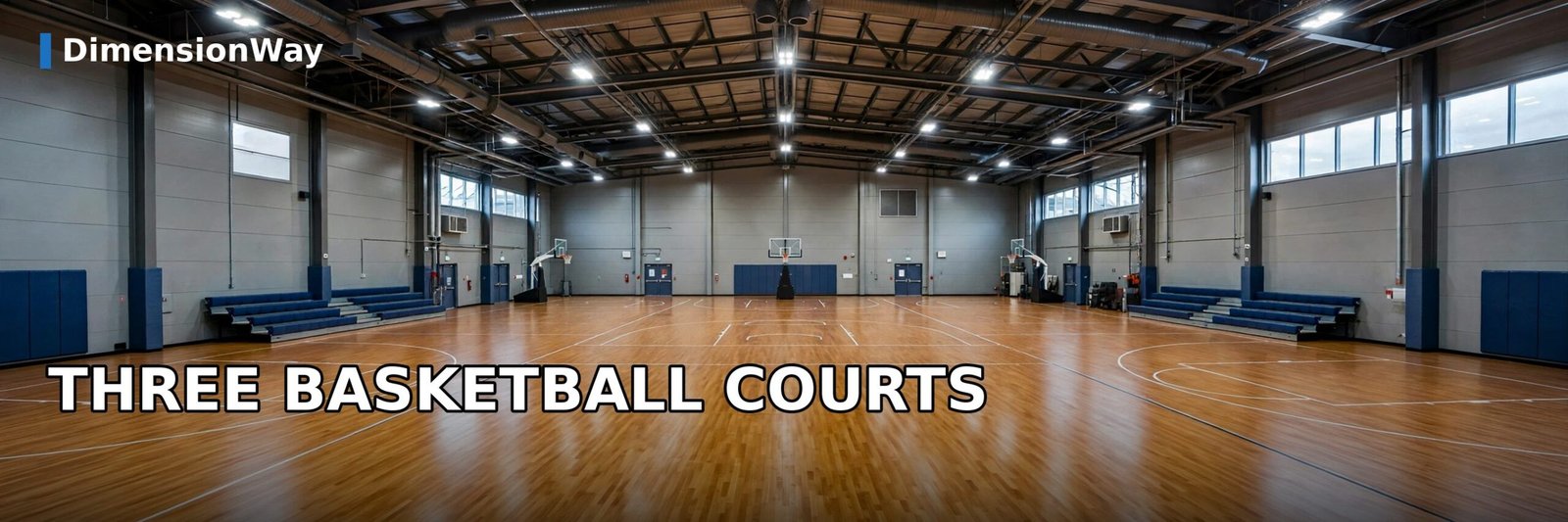
Three Basketball Courts End to End
An NBA court is 94 feet long. Three of them end to end measure 282 feet, which overshoots a city block by 18 feet.
Anyone who has played pickup ball knows the tired-legs feeling of running one full court. Stretch that across three courts and you are walking a Manhattan block.
International courts run slightly shorter under FIBA rules, at about 91.9 feet. Three of those total about 276 feet, which lands even closer to the 264-foot mark.
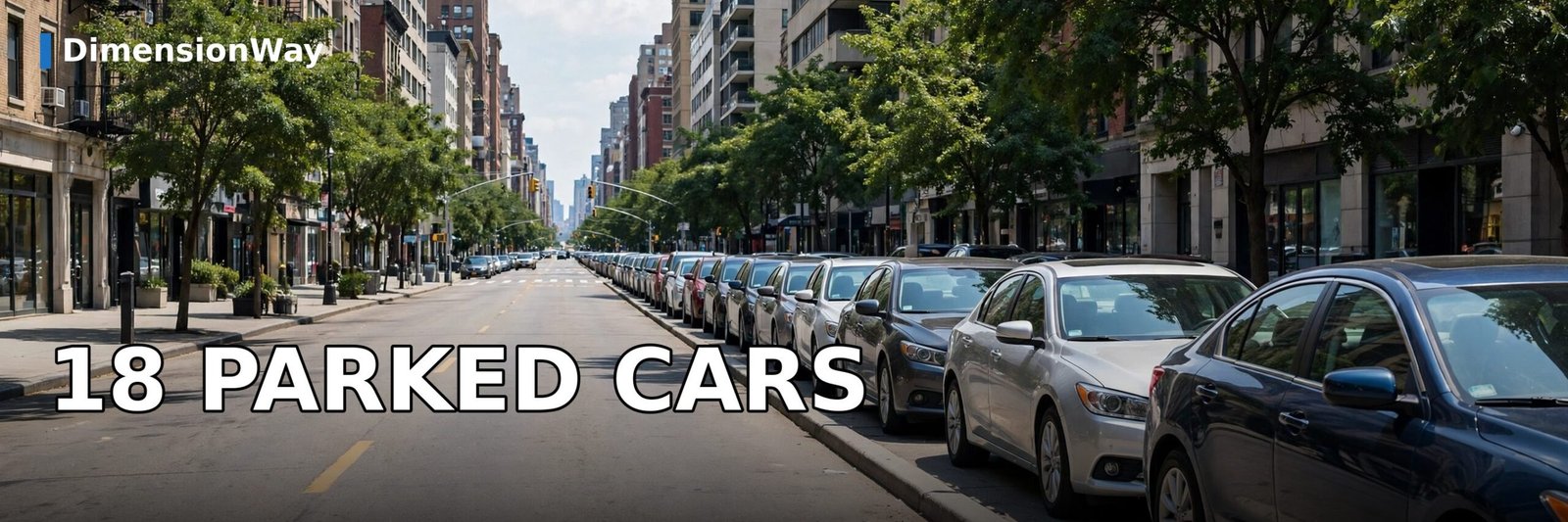
About 18 Parked Cars, Bumper to Bumper
A typical sedan is about 15 feet long. Line up 18 of them bumper to bumper and they span 270 feet, just 6 feet more than a city block.
This is the most useful street-level reference on the list because you can verify it anywhere. Next time you walk a block, count the parked cars along the curb. If you count around 18, the block is running true to the Manhattan standard.
The number shifts with vehicle mix, since SUVs and trucks run longer than sedans. A curb full of crew-cab pickups will hit the block's length in fewer vehicles.
Six and a Half School Buses
A full-size school bus runs about 40 feet long. Six and a half of them nose to tail cover 260 feet, just 4 feet short of a city block.
Picture the morning drop-off line at an elementary school. If six or seven buses are queued with their stop signs out, that line is your city block reference, painted yellow.
The familiar color has an official name, National School Bus Glossy Yellow, chosen because the human eye picks it out faster than any other color at dawn and dusk.
About Three and a Half Tennis Courts
A regulation tennis court is 78 feet long from baseline to baseline. Three and a half courts end to end measure 273 feet, just 9 feet more than a city block.
Public tennis parks usually line up several courts in a row, so this reference is easy to check in person. Walk the length of three full courts plus half of a fourth, and you have walked a block.
The 78-foot length is fixed by the International Tennis Federation for every official match, from Wimbledon to the neighborhood park down your street.
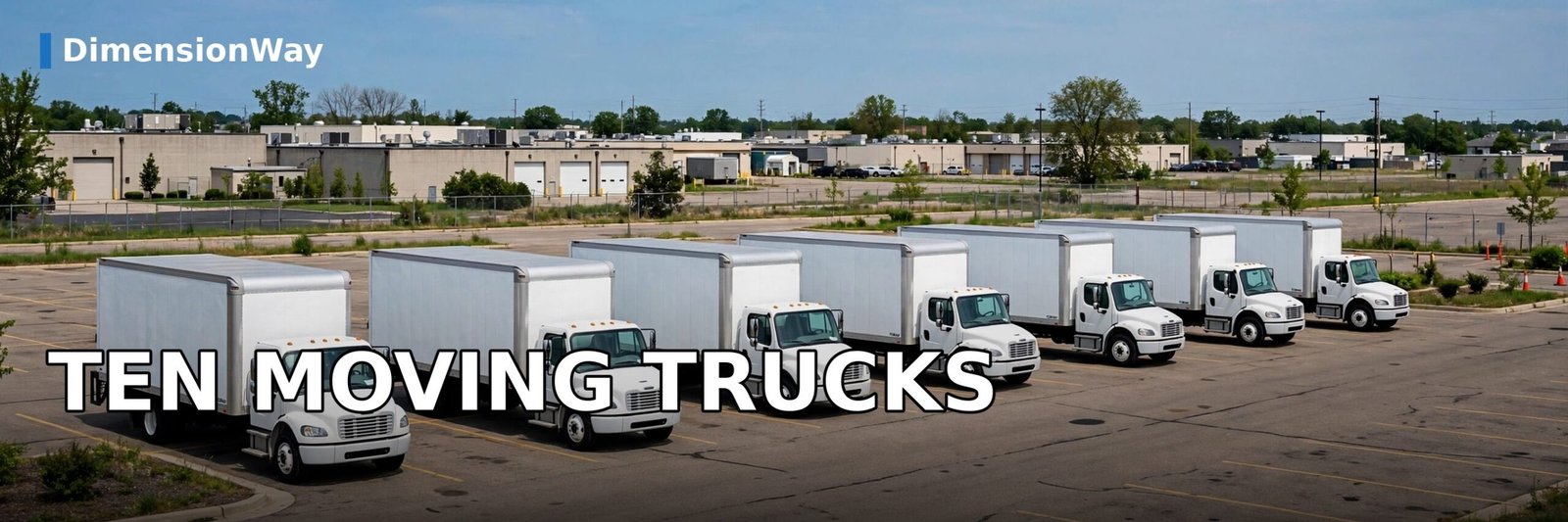
Ten 26-Foot Moving Trucks
The 26-foot box truck is the largest standard rental truck, the one people hire for a full-house move. Ten of them in a row measure exactly 260 feet, 4 feet short of a city block.
Rental lots often park these trucks in long rows, which makes the image easy to picture. Each truck is about the length of a city bus and a half, and ten of them quietly add up to a Manhattan block.
The 26 feet is the cargo box length, the number that matters when you are estimating how much furniture fits. The cab adds a few more feet, which would nudge the ten-truck line right onto the 264-foot mark.
How Long Does It Take to Walk a City Block?
Walk time is how most people actually experience a city block. New Yorkers live by a simple rule: one short block takes about one minute on foot. Here is how the math works at common paces, based on a 264-foot block:
Pace
Speed
Time for One Block
Slow stroll
2 mph
About 1 min 30 sec
Casual walk
3 mph
About 1 min
Normal walk
3 mph
About 1 min
Brisk walk
3.5 mph
About 52 sec
Your stride decides the step count. At an average stride of about 2.5 feet, a city block costs you roughly 105 steps. Taller walkers with longer strides will do it in closer to 90.
The long side of a Manhattan block, the 900-foot avenue stretch, is a different story. At a normal pace that takes about 3 minutes and 25 seconds, which is why locals treat avenue blocks as a separate unit of distance.
How to Visualize a City Block Yourself
Start with the clock, because time is the easiest ruler. Walk at your normal pace for one minute and check how far you went. That distance is about one city block, and your body now owns the measurement.
Next, use the car trick. Parked cars are everywhere, and each sedan is about 15 feet. Count 18 car lengths along any curb and you have traced a block without a tape measure.
Finally, borrow the Manhattan grid even if you do not live there. Twenty short blocks make a mile, so five blocks make a quarter mile. Any walk you can time in minutes converts directly: one minute per block at a normal pace. Run any of these once and “three blocks away” stops being a guess.
FAQs
How many feet is a city block?
A standard city block is about 264 feet long, which is one-twentieth of a mile. That figure comes from the Manhattan street grid. Other cities differ: Chicago blocks run 330 to 660 feet, and Portland's are about 200 feet.
How many city blocks are in a mile?
In Manhattan, 20 short blocks make a mile. In Chicago, 8 long blocks or 16 short blocks make a mile. The common mistake is treating one city's answer as universal, so check which city you are in.
How long does it take to walk a city block?
At a normal walking pace of 3 miles per hour, one 264-foot block takes about one minute. A long avenue block in Manhattan, at 900 feet, takes about three and a half minutes.
How many meters is a city block?
A standard 264-foot city block is 80.47 meters, usually rounded to about 80 meters. A Chicago long block at 660 feet is about 201 meters.
Is a city block the same distance everywhere?
No. Block sizes are set by each city's street plan. Manhattan uses 264 by 900 feet, Chicago uses 330 by 660 feet, and Portland uses 200-foot squares. Always confirm the city before converting blocks to feet.
How many steps are in a city block?
Most adults take about 100 to 110 steps to walk a 264-foot block, assuming an average stride of about 2.5 feet. Taller people with longer strides may need closer to 90 steps.
Is a city block longer than a football field?
No, slightly shorter. A football field is 300 feet from goal line to goal line, while a standard city block is 264 feet. The field overshoots the block by 36 feet.
How far is 5 city blocks?
Five standard blocks measure 1,320 feet, which is exactly a quarter mile. At a normal walking pace, that takes about five minutes.
Why are Manhattan blocks so long and narrow?
The 1811 Commissioners' Plan laid out Manhattan's grid with short 264-foot blocks between cross streets and long 900-foot blocks between avenues. The shape fit more buildings per block and kept cross-town traffic moving.
How many acres is a city block?
A Manhattan block covers 264 times 900 feet, or 237,600 square feet, which is about 5.45 acres. A Chicago block at 330 by 660 feet covers about 5 acres.
Conclusion
So how far is a city block? In the standard most Americans mean, it is 264 feet, or about 80 meters, exactly one-twentieth of a mile. Picture two Boeing 737s nose to tail, 18 parked cars along a curb, or a one-minute walk, and you have it. Just remember that Chicago, Portland, and Philadelphia all play by different numbers, so the city sets the ruler. The next time someone says “three blocks away,” you will know whether to expect a three-minute stroll or a ten-minute hike.
Related Reading
How Far Is 100 Yards?: a bit longer than a city block, with ten everyday comparisons.
How Long Is 100 Feet?: about a third of a city block, visualized with familiar objects.
Commissioners' Plan of 1811: established Manhattan's street grid with the 264-foot standard block.
Wikipedia, “City block”: Manhattan blocks about 264 by 900 feet; Chicago blocks 330 by 660 feet; 20 blocks to a mile in Manhattan, 8 north-south blocks to a mile in Chicago.
James Carter is the founder and editor of DimensionWay, where he researches, measures, and verifies real-world dimensions — from everyday objects to world-famous landmarks. Every number published on DimensionWay is cross-checked against manufacturer specifications and official sources, so readers always get accurate, easy-to-visualize comparisons.