
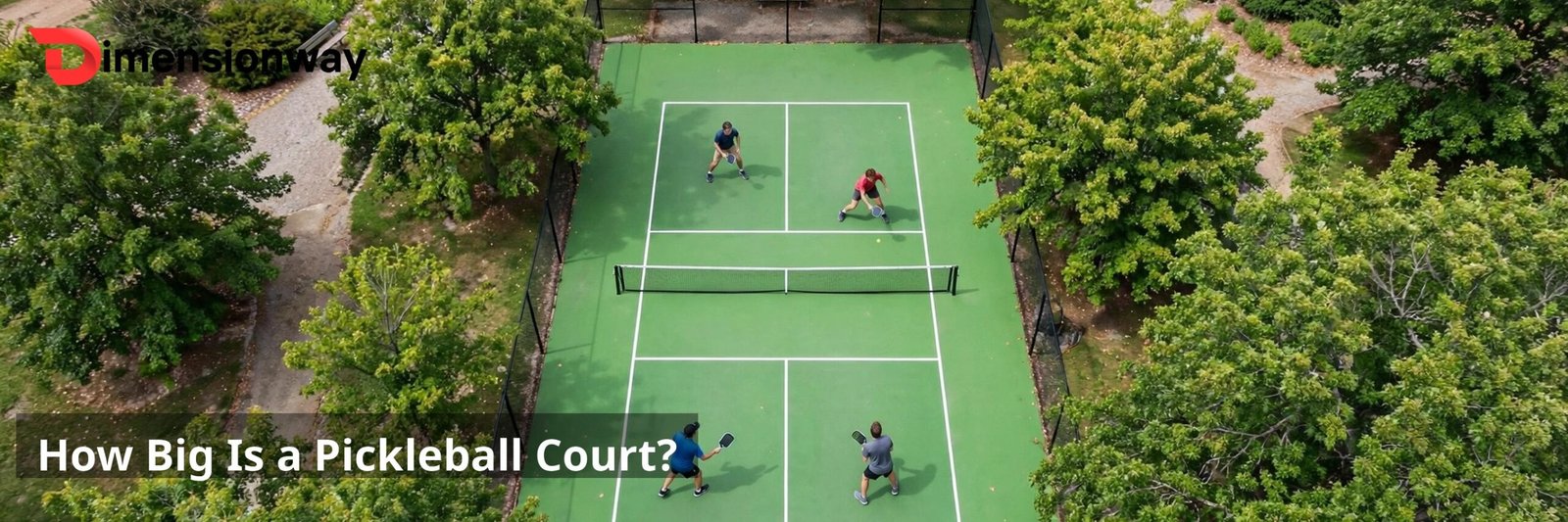
A pickleball court measures 20 feet by 44 feet, which is 880 square feet. The recommended total playing space is 30 by 60 feet, and singles and doubles use the same court.
You have seen them appear everywhere. The tennis courts at the park now carry a second set of lines in a brighter color. The Y has a waiting list for its new indoor courts. Your neighbor painted lines on the driveway last summer and has been playing ever since. Pickleball is the fastest growing sport in the country, and at the center of all of it sits a very small rectangle.
The question everyone asks next is the same one: how big is that rectangle, really? The official numbers are simple, 20 by 44 feet, but numbers do not picture anything. You have probably never stood on a measured pickleball court either. You have stood on a tennis court, you have parked in a driveway, you have swum in a backyard pool. This guide translates the court into all of those.
There is a number pair to hold onto. Twenty by forty-four. Eight hundred eighty square feet of playing surface, eighteen hundred with the safety space around it. Once you carry those two numbers, every comparison in this guide snaps into place.
The Official Pickleball Court Dimensions
Pickleball’s governing body, USA Pickleball, spells out the court in its official rulebook, and every reputable guide agrees on the same figures. The playing lines form a rectangle 20 feet wide and 44 feet long. That size is identical for singles and doubles, which is unusual among racket sports and part of why the game spread so fast. One court serves every format.
The court is divided by a net into zones. Here is the complete specification.
| Measurement | Size | Notes |
|---|---|---|
| Playing area | 20 x 44 ft | Same for singles and doubles |
| Court area | 880 sq ft | About a small studio apartment |
| Kitchen (non-volley zone) | 7 x 20 ft | Each side of the net |
| Service boxes | 15 x 10 ft | Two on each side of the net |
| Net height at sidelines | 36 in | Same as a kitchen counter |
| Net height at center | 34 in | Slight dip in the middle |
| Minimum total space | 30 x 60 ft | 5 ft clearance each side |
| Preferred total space | 34 x 64 ft | USA Pickleball preferred |
The 20 by 44 foot court is the part inside the lines. The 30 by 60 foot figure is the minimum area with room to play around it, and USA Pickleball prefers 34 by 64 feet when space allows. The difference between those two numbers is the space where the real game happens, the steps back from the baseline, the lunges past the sidelines, the out-of-bounds balls you chase down.
10 Comparisons That Make a Pickleball Court Click
A pickleball court is 20 feet wide, 44 feet long, 880 square feet inside the lines. Here is what that looks like next to things you already know.
Four Courts Fit on One Tennis Court

A regulation doubles tennis court is 78 feet long and 36 feet wide, which is 2,808 square feet, about 3.2 times the area of a pickleball court. That size gap is the reason your local park looks the way it does now: one tennis court can be re-striped to hold four pickleball courts, two on each half, and many facilities have done exactly that.
The visual is striking. Stand at the baseline of a tennis court and picture the four smaller rectangles inside it. Each pickleball court is barely longer than half the tennis court, and two sit side by side across its width. The tennis net comes down, four portable pickleball nets go up, and the participation per hour quadruples. This is the single biggest reason pickleball spread through public parks faster than any sport in decades.
A Badminton Court: The Exact Same 44 x 20 Footprint

Here is the twist nobody expects. A doubles badminton court is also 44 feet long and 20 feet wide. The two sports share the identical playing rectangle, 880 square feet, line for line at the outer boundary. When pickleball’s inventors were laying out the first court on a badminton court in 1965, they kept the dimensions and just lowered the net.
The differences live inside the rectangle. Badminton’s net stands 5 feet high at center, nearly two feet taller than pickleball’s 36 inch net. Badminton’s short service line sits 6.5 feet from the net, close to pickleball’s 7 foot kitchen line, which is why the two games feel like cousins on the same court. Many backyard players have painted pickleball lines over a badminton court’s footprint, or vice versa, and both games work fine.
A Basketball Court: 5.3 Times the Area

A regulation basketball court is 94 feet long and 50 feet wide, which is 4,700 square feet. Divide that by the pickleball court’s 880 and you get 5.3. More than five pickleball courts tile across one basketball court.
The length comparison is the one that lands. A basketball court is more than twice as long as a pickleball court, 94 feet against 44. The pickleball court is about the length of a basketball court from one free throw line to the opposite baseline. If you have ever played full-court basketball, the pickleball court is roughly the quarter of the court you defended in a half-court game.
A Two-Car Driveway: The Exact Same Width

A standard two-car driveway is about 20 feet wide. The pickleball court is exactly 20 feet wide. That match is no coincidence in the story of the sport’s backyard boom: the width people needed was the width they already had.
The length is the part that stretches the driveway. At 44 feet, a court needs a driveway nearly twice as deep as a typical 20 to 25 foot one, which is why full driveway courts usually run onto the sidewalk apron or the street-adjacent slab. The common compromise is the mini court, 18 by 40 feet or even 12 to 15 feet wide by 30 to 35 feet long, which fits a standard driveway with room to move. For casual family games, the shrunken court plays surprisingly well.
A School Bus: Nearly the Court’s Length
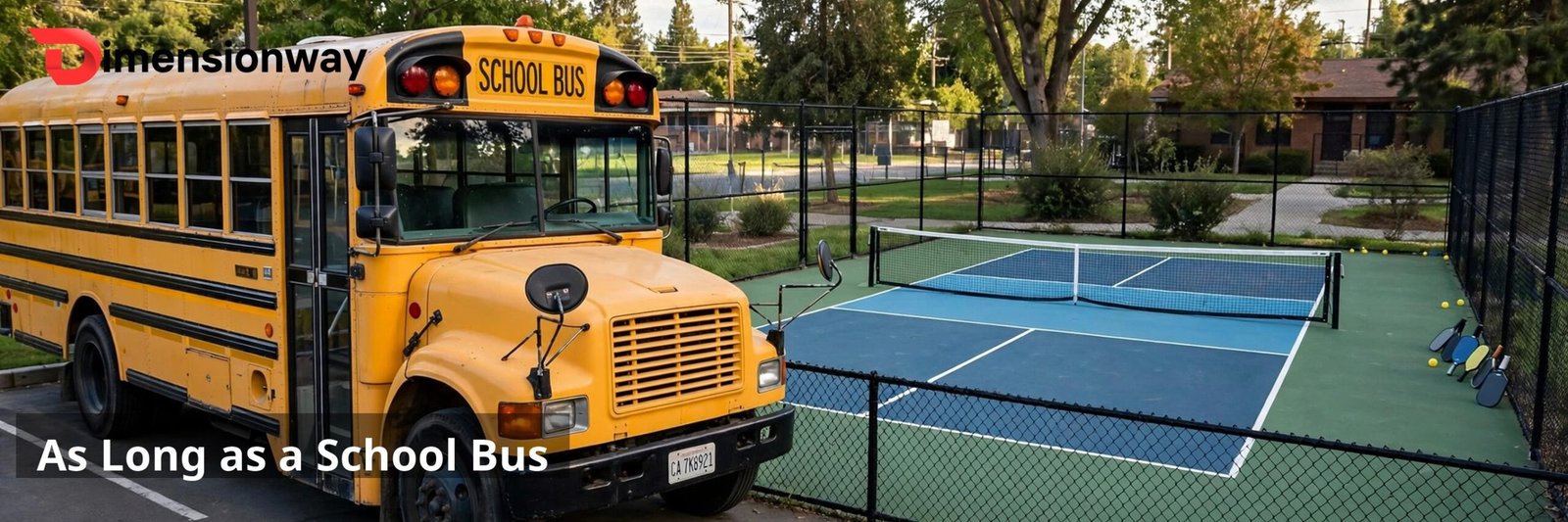
A full-size school bus runs about 35 to 45 feet long, with the classic Type C bus landing around 40 feet. The pickleball court at 44 feet is just a touch longer than the bus. Picture the bus parked alongside the court: the court stretches from the front bumper past the back door.
This is the comparison for anyone who has waited behind a school bus. The court is the length of that bus plus a fender. It is a big object, but it is a familiar one, and it makes the 44 foot number stop feeling abstract.
About Five and a Half Parking Spaces

A standard parking space is 9 feet by 18 feet, which is 162 square feet. Divide the court’s 880 square feet by that and you get about 5.4. One pickleball court covers the same ground as five and a half parking spaces. Our guide to how big a parking space is breaks down the space math in full.
The line picture helps too. A parking space is 18 feet long, and the court is 44 feet, so the court runs about two and a half spaces deep. Five and a half spaces wide in a lot is a short row. If you can picture a row of six parked cars, you are picturing the footprint of a pickleball court, minus a little.
Bigger Than a Backyard Pool
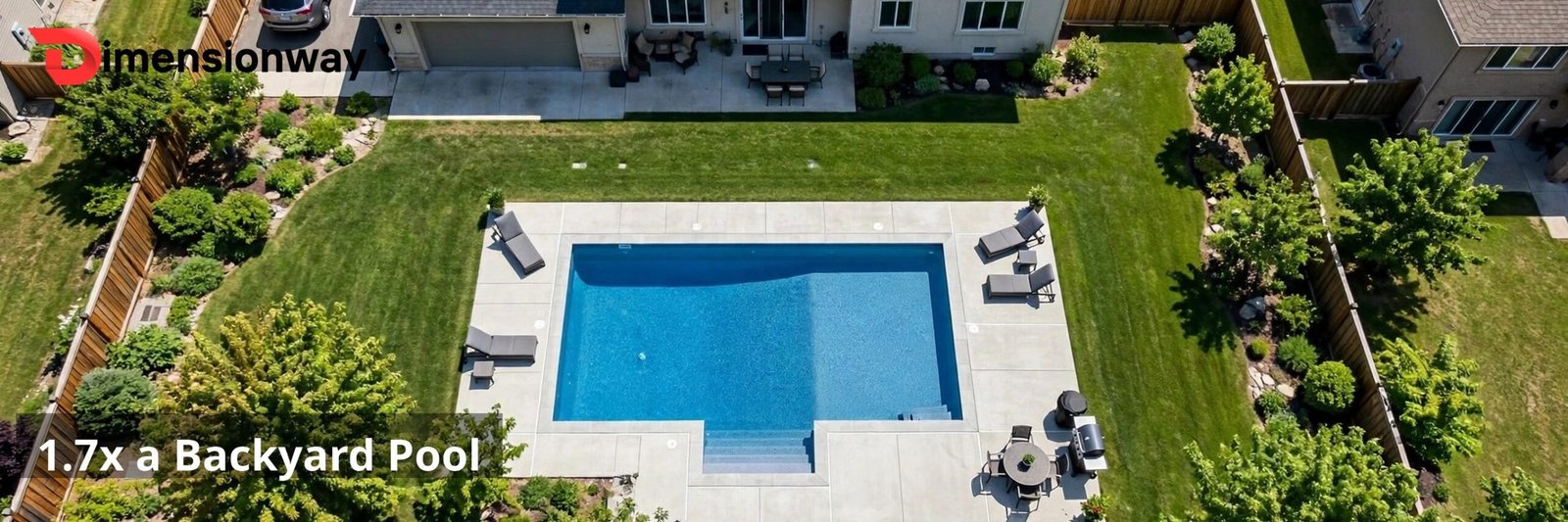
A common backyard swimming pool is 16 feet by 32 feet, which is 512 square feet. The pickleball court at 880 square feet is about 1.7 times that. The court is wider than the pool by 4 feet and longer by 12.
This comparison matters because the pool and the court compete for the same backyard. Many homeowners have done the math and found the court wins: it costs a fraction of a pool to build, needs almost no maintenance, and four to eight people play at once instead of two. The recommended 30 by 60 foot total space is 1,800 square feet, which fits comfortably in most suburban backyards that have a pool-sized open area.
The Kitchen: 7 Feet, About a Twin Bed Long
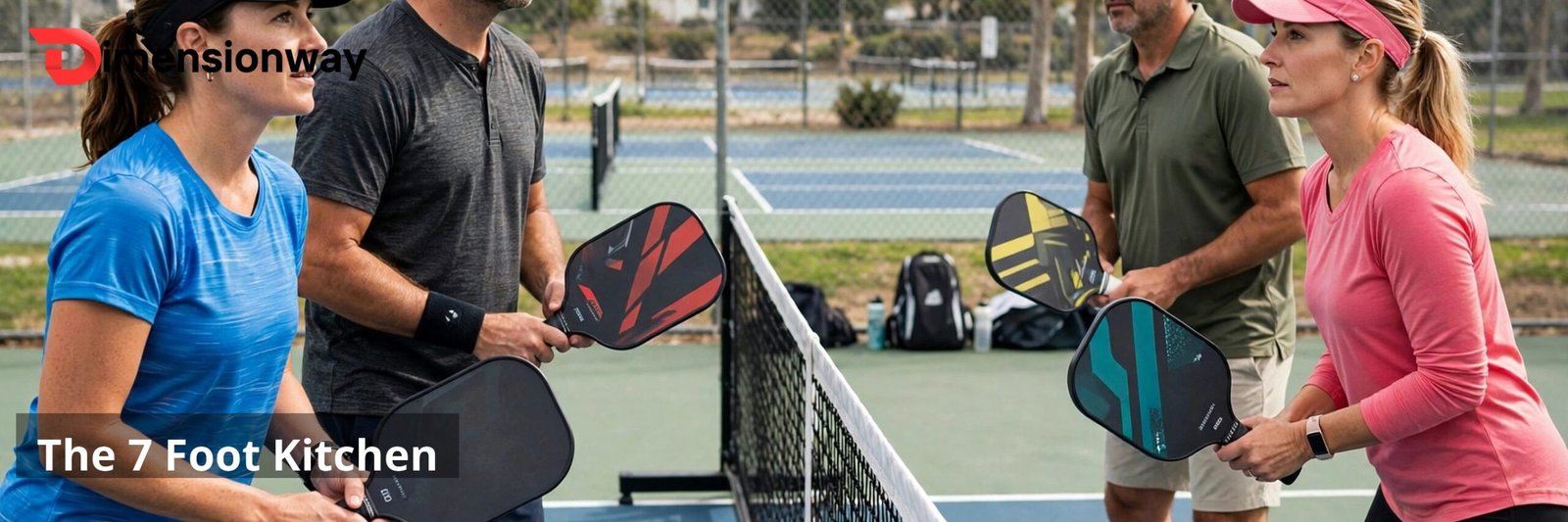
The non-volley zone, the kitchen, extends 7 feet from the net on each side. Seven feet is a hard number to picture until you anchor it: a twin bed is 75 inches long, which is 6.25 feet. The kitchen is a twin bed plus nine inches. Lay a twin bed sideways across each half of the court and you have drawn the kitchen.
The kitchen eats a real share of the court. Two 7 foot zones make 14 feet of the court’s 44 foot length, which is nearly a third of the playing area. That 14 foot band in the middle is where the game’s famous dink rallies happen, the soft exchanges that decide most points. A third of the court, a twin bed per side, and the most important real estate in the game.
Half the Size of a Volleyball Court
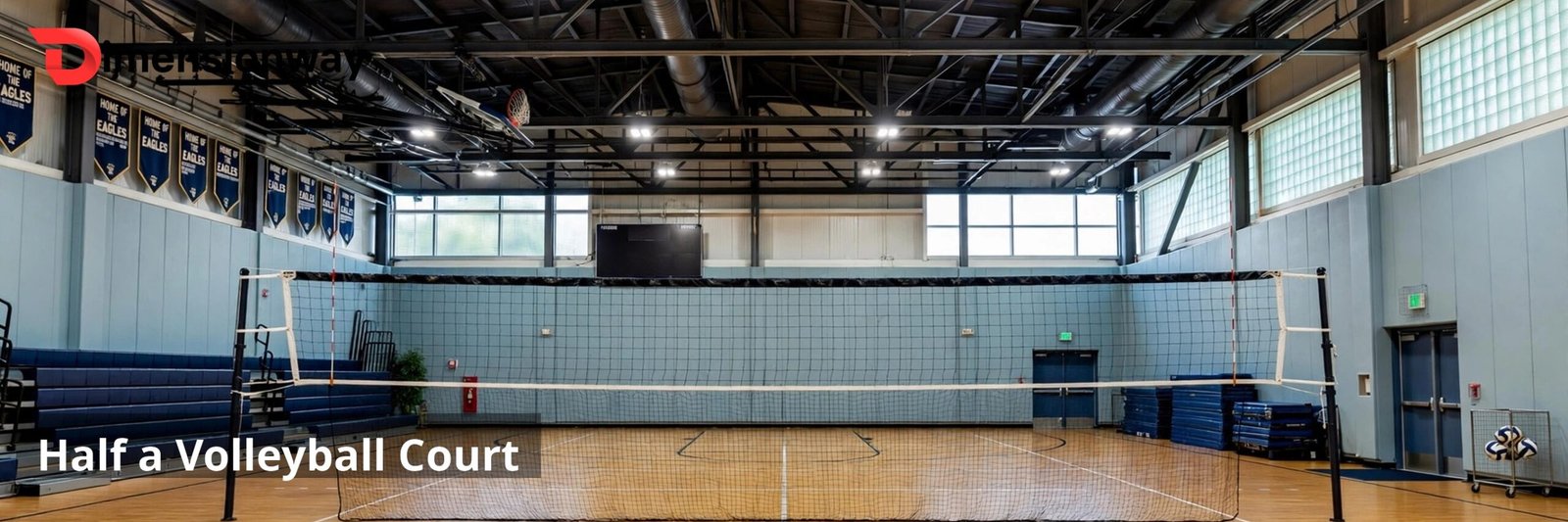
A regulation volleyball court is 29.5 feet by 59 feet, which is about 1,741 square feet. The pickleball court’s 880 square feet is almost exactly half of that. Two pickleball courts tile across one volleyball court with room to spare.
The volleyball net gives the comparison its punch. A men’s volleyball net stands 7 feet 11 inches high, more than double the pickleball net’s 36 inches. The two courts are close cousins in area but built for completely different games: one for jumping over a tall net, the other for dinking over a low one. Many school gyms run both sports on the same floor, with the lines painted in different colors.
The Net Is Kitchen Counter Height

The pickleball net stands 36 inches high at the sidelines and dips to 34 inches at center. Thirty-six inches is exactly the standard height of a kitchen counter. Walk into any kitchen and put your hand on the countertop: that is the height of the pickleball net where it meets the posts.
This is the most useful everyday measure in the guide. A kitchen counter is something you touch every day. The net is counter height, the center sags two inches below that, and the ball you are hitting over it is about 3 inches across. Suddenly the geometry of the dink shot makes physical sense: you are dropping a ball just over a counter-height net from 14 feet away.
The Badminton Connection: Same Footprint, Different Game
The pickleball court and the doubles badminton court are the same 44 by 20 foot rectangle. That is not a rough equivalence. It is the identical footprint, 880 square feet each, and it is the reason the two sports share facilities, backyard setups, and even line paint in different colors.
Everything else about the two courts diverges. Here is the full picture.
| Feature | Pickleball | Badminton (doubles) |
|---|---|---|
| Court size | 44 x 20 ft | 44 x 20 ft |
| Net height | 36 in sidelines, 34 in center | 5 ft 1 in posts, 5 ft center |
| Front zone | 7 ft kitchen | 6.5 ft to short service line |
| Service boxes | 15 x 10 ft | Defined by service lines |
| Played | Mostly outdoors | Mostly indoors |
| Ball | Plastic, 3 in | Shuttlecock |
The 6.5 foot short service line in badminton sits almost exactly where pickleball’s 7 foot kitchen line sits, which means the two games put their most important lines within six inches of each other on the same court. Players who switch between the sports report the same thing: the court feels like home, the net feels wrong. Badminton’s 5 foot net forces a completely different shot shape than pickleball’s counter-height one.
The shared footprint also explains a practical fact. Schools and rec centers with badminton courts can host pickleball with nothing more than a lower portable net and different line tape. The floor space is already correct. That compatibility is a quiet driver of pickleball’s growth, and it is why the two sports show up together in so many facility schedules.
How Many Pickleball Courts Fit?
The court’s small size is its superpower. Here is what it means in real spaces.
| Space | Size | Pickleball courts that fit |
|---|---|---|
| Tennis court | 2,808 sq ft | 4 in practice (re-striped) |
| Basketball court | 4,700 sq ft | 5 by area |
| Football field | 57,600 sq ft | 65 by area |
| 10 acres | 435,600 sq ft | 495 by area |
The tennis court number is the one that changed the country’s parks. Four pickleball courts on the footprint of one tennis court means a facility can serve eight to sixteen players where it once served two to four. Park departments did this math years ago, and the lines on the ground followed.
The 10 acre number puts the backyard in perspective. Our guide to how big 10 acres is works through the full picture, but the short version is this: one pickleball court, with its recommended 30 by 60 foot total space, is 1,800 square feet, which is about 4 percent of a single acre. A dedicated player could fit a court on a generous suburban lot and still have room for the house.
Pickleball Court Measurements in Meters
The court is defined in feet, but the game is global. Here are the official measurements converted.
| Feet | Meters | What it is |
|---|---|---|
| 44 ft | 13.41 m | Court length |
| 20 ft | 6.10 m | Court width |
| 7 ft | 2.13 m | Kitchen depth |
| 36 in | 0.91 m | Net height at sidelines |
| 34 in | 0.86 m | Net height at center |
| 30 ft | 9.14 m | Minimum total width |
| 60 ft | 18.29 m | Minimum total length |
FAQs
What are the official dimensions of a pickleball court?
The official court is 20 feet wide and 44 feet long, 880 square feet, and the size is the same for singles and doubles. Those dimensions come straight from the USA Pickleball Official Rulebook, which also specifies the 7 foot non-volley zone on each side of the net and the 36 inch net at the sidelines dipping to 34 inches at center.
How much space do you need for a pickleball court?
The minimum total space is 30 feet by 60 feet, which gives 5 feet of clearance on each side of the 20 by 44 foot court. USA Pickleball prefers 34 by 64 feet when you have the room, and calls 40 by 64 feet ideal. For a backyard build, measure your open space against the 30 by 60 minimum first, then add what you can.
What is the kitchen in pickleball?
The kitchen is the non-volley zone, a 7 foot by 20 foot area on each side of the net. You cannot hit the ball out of the air while standing in it or on its lines. The rule exists to prevent players from camping at the net and smashing everything, which is why the soft dink game developed in the first place.
Can you play pickleball on a tennis court?
Yes, and it happens constantly. Temporary court lines can be taped or chalked inside a tennis court, and a portable net goes up in minutes. Four pickleball courts fit on one tennis court, which is why parks with converted courts see so much more play. The surfaces are similar enough that the ball behaves the same on both.
Is a pickleball court the same size as a badminton court?
The playing rectangles are identical: a doubles badminton court is also 44 by 20 feet. The nets are completely different, though, with badminton’s at 5 feet center against pickleball’s 34 inches. You can play either game on the other’s footprint, but you need the right net height for each.
How tall is a pickleball net?
Thirty-six inches at the sidelines and 34 inches at the center, with a small tolerance allowed. The 36 inch height is exactly standard kitchen counter height, which makes it easy to picture. The net is the same height as a tennis net, interestingly, on a court that is one third the area.
Can I fit a pickleball court in my driveway?
A full 20 by 44 foot court needs a very large driveway, but smaller versions work well. A common driveway setup is about 18 by 40 feet, and very compact practice courts run 12 to 15 feet wide by 30 to 35 feet long. All you need is a flat surface, a portable net, and tape or chalk for lines.
How much does it cost to build a pickleball court?
It depends on what you build. A tape-and-portable-net setup on an existing driveway or slab can cost a few hundred dollars. A purpose-built backyard court is commonly quoted around 20,000 dollars for an entry-level build, according to USA Pickleball’s facilities staff, with fencing and lighting adding several thousand more. Resurfacing an existing concrete pad falls somewhere between the two.
Are indoor and outdoor pickleball courts the same size?
The court dimensions are identical, 20 by 44 feet with the same kitchen and net heights. The differences are the surface and the ceiling: indoor courts need at least 20 feet of overhead clearance, outdoor courts need proper drainage and a north-south orientation to keep the sun out of players’ eyes.
How many pickleball courts fit on a tennis court?
Four. One tennis court is 78 by 36 feet, and four 20 by 44 foot pickleball courts tile neatly inside it, two on each side of the old tennis net line. This conversion is one of the most common facility upgrades in the country and the main reason public court counts have exploded.
Conclusion
A pickleball court is 20 feet by 44 feet, 880 square feet inside the lines, 1,800 square feet with the recommended space around it. It is four of them to a tennis court, the exact twin of a badminton court, a two-car driveway wide, a school bus long, and five and a half parking spaces in area. The net is kitchen counter height and the kitchen is a twin bed long.
Keep the three pictures that matter. The tennis court with four rectangles painted inside it. The badminton court wearing the same footprint with a taller net. The driveway that is already the right width. The next time you drive past a park and see those bright new lines, you will know exactly how much court you are looking at.
Related Reading
– How Big Is a Parking Space? 10 Things That Size, Visualized: the 9 by 18 foot space that five and a half of fit on a pickleball court. – How Big Is 10 Acres? Visualized in Football Fields + More: the land parcel that holds 495 pickleball courts. – What Does 1,000 Square Feet Look Like? 10 Comparisons: the apartment floor plan the court nearly matches at 880 square feet.
Sources
- USA Pickleball Official Rulebook
- PickleballDimensions.com
- ND Insider
- Realtor.com
- SlipDoctors
- PaceCourt
- BadmintonConnect
- LetsGoTennis

James Carter is the founder and editor of DimensionWay, where he researches, measures, and verifies real-world dimensions, from everyday objects to world-famous landmarks. Every number published on DimensionWay is cross-checked against manufacturer specifications and official sources, so readers always get accurate, easy-to-visualize comparisons.
