
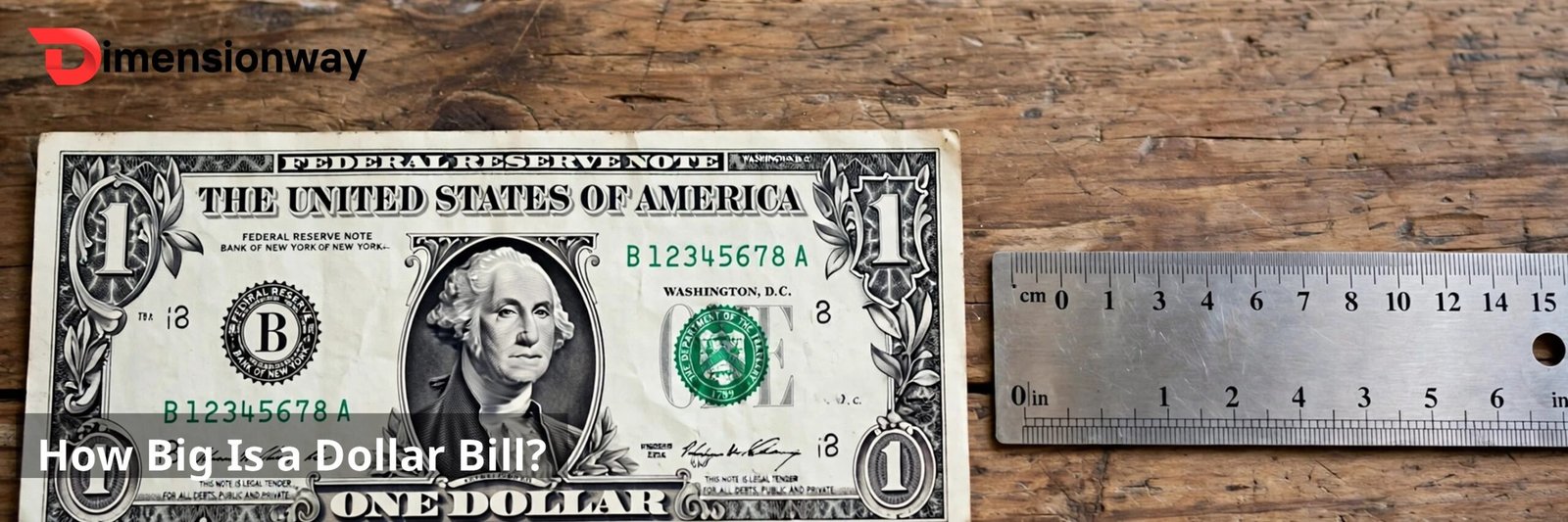
A US dollar bill is 6.14 inches long and 2.61 inches wide, about the size of a modern smartphone. Every denomination shares these dimensions, and a single bill is 0.0043 inches thick and weighs about 1 gram.
You have probably held a dollar bill thousands of times without ever really looking at it. It comes out of the wallet, it goes into the vending machine, and it never gets a second thought. But that little rectangle of cotton and linen is one of the most precisely standardized objects in your life. Its size has not changed in nearly a century, it is identical on every denomination, and it turns out to be one of the best everyday measuring tools you own.
A dollar bill is 6.14 inches long. That number is more useful than it looks. Fold the bill in half and you have about 3 inches. Lay two end to end and you have a foot, with a quarter inch to spare. Keep the bill in your wallet and you carry a ruler that never needs batteries.
The Exact Dimensions of a Dollar Bill
The Bureau of Engraving and Printing, the federal agency that prints all US paper currency, sets the size of a dollar bill at 6.14 inches long by 2.61 inches wide. In metric terms, that is 156.06 millimeters by 66.29 millimeters. Every denomination, from the $1 to the $100, is printed to exactly the same dimensions.
The full spec sheet goes further. Here are the official numbers:
| Measurement | Inches | Metric |
|---|---|---|
| Length | 6.14 in | 156.06 mm |
| Width | 2.61 in | 66.29 mm |
| Thickness | 0.0043 in | 0.109 mm |
| Weight | 0.035 oz | about 1 gram |
| Surface area | 16.02 sq in | 103.4 sq cm |
| Perimeter | 17.5 in | 44.45 cm |
Those figures describe a freshly printed note. A bill that has been folded, crumpled, washed, and passed through a hundred wallets measures a touch thinner and a little softer at the edges. The BEP builds in a small manufacturing tolerance for exactly this reason, so currency counters and ATM sensors accept normal wear without flagging a genuine bill as suspect.
The paper is not really paper at all. US currency is printed on a blend of 75 percent cotton and 25 percent linen, a fiber mix chosen because it resists tearing and survives the washing machine far better than wood-pulp paper. That is why a dollar can go through a full laundry cycle and come out crumpled but intact.
Every denomination sharing one size is deliberate. It makes counting machines simple, it makes cash registers and vending machines universal, and it keeps counterfeiting harder, since a forged bill that is even slightly off-size gets flagged fast. Before 1929, US paper money was about 30 percent larger, roughly 7.375 by 3.125 inches, and collectors call those oversized notes “horse blanket” currency because they barely fit in a wallet. In 1929 the Treasury cut the size by nearly a third to save on printing costs, and the dimensions have not moved since.
10 Comparisons That Make a Dollar Bill Click
A US dollar bill, 6.14 inches long and 2.61 inches wide. Here is what that actually looks like next to things you already know.
A Credit Card: The Bill Is Nearly Twice as Long

A standard credit card measures 3.375 inches by 2.125 inches. Set it next to a dollar bill and the bill stretches nearly twice as long, about 1.8 times the card’s length, and about 1.2 times its height. The two objects belong to the same wallet, and the bill is the bigger one by a comfortable margin.
Lay two credit cards end to end and you get 6.75 inches. The dollar bill comes up 0.61 inches short of that, about the width of your fingertip. So the mental picture is simple: a bill is two credit cards long, minus a fingertip. Our guide to how big a credit card is covers that 3.375 inch standard in full.
A Smartphone: About the Same Height, the Bill a Touch Longer

A modern smartphone is about 5.8 to 6.1 inches tall. An iPhone 16, for example, stands 5.81 inches tall and 2.82 inches wide. Lay a dollar bill alongside it and the bill is a touch longer, roughly a third of an inch beyond the phone’s top edge.
This is one of the most practical comparisons in the guide because your phone is always with you. If you need to estimate 6 inches on a package, a wall, or a piece of furniture, picture the phone in your pocket and add a fingertip. That is the length of a dollar bill, and it is close enough for most everyday measuring.
Your Palm: The Bill Spans Wrist to Mid-Finger

Hold out your hand and lay a dollar bill on your open palm. For most adults, the bill spans from the wrist to the middle of the fingers, with a little overhang at each end. The bill’s 2.61 inch width sits comfortably inside the palm’s roughly 3.3 to 3.5 inch breadth across the knuckles.
Your hand is the measuring tool you can never forget, and the bill calibrates it. Once you know that a bill covers your palm from wrist to mid-finger, you can estimate 6 inches anywhere, no wallet required, just the memory of the fit.
A Coffee Mug: A Thousand Bills Stack to Mug Height

One bill is 0.0043 inches thick, so a stack of 1,000 bills stands 4.3 inches tall. That is roughly the height of a standard coffee mug, which typically runs 3.5 to 4.5 inches tall. Picture a thousand dollars in singles piled on the table and it reaches about as high as your morning coffee.
The stack math is what makes this one fun. Ten bills are 0.043 inches, a whisper. A hundred bills are 0.43 inches, less than half an inch. Then the thousands arrive and suddenly money has a height you can see. Our guide to how big a coffee mug is has the full breakdown of standard mug sizes.
A Men’s Shoe: The Bill Covers a Bit More Than Half

A US men’s size 10 shoe has an outsole about 11.5 inches long. Lay a dollar bill along it and the bill covers a bit more than half the shoe, with about 5.4 inches of sole left over. Two bills end to end would overshoot the shoe by less than an inch.
Shoes are everywhere and their sizes are standardized, which makes them a surprisingly good field reference. If you wear a size 10, half your shoe is the length of a dollar bill. Our guide to how long a shoe is walks through shoe sizing in inches.
Two Sticky Notes: An Eighth of an Inch Short

The classic square sticky note measures 3 by 3 inches. Put two of them side by side and you get exactly 6 inches. A dollar bill at 6.14 inches is about an eighth of an inch longer, a difference you would need a ruler to notice.
The width comparison is fun too. A sticky note is 3 inches wide and the bill is 2.61, so the bill is a touch narrower than the little square that lives on every office desk. The bill is the sticky note stretched out, same family, different proportions.
A Ruler: Two Bills Are Just Over a Foot
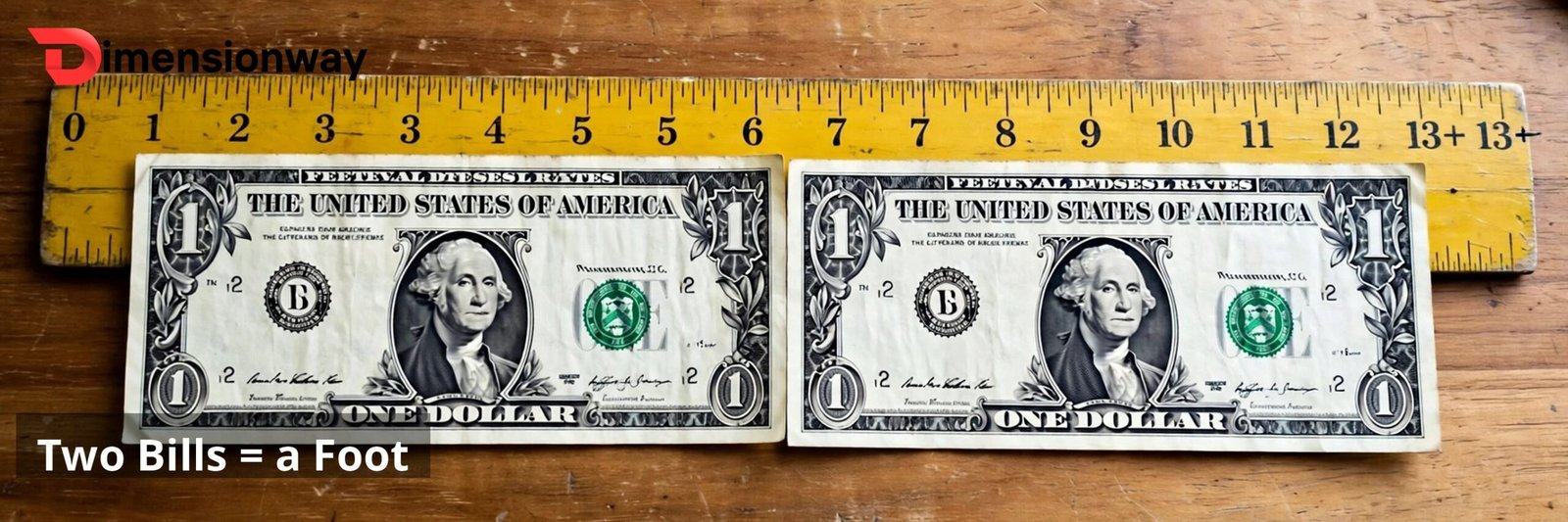
This is the trick that turns your wallet into a tape measure. One bill is 6.14 inches. Two bills laid end to end are 12.28 inches, which is one foot plus about a quarter inch. For estimating purposes, two bills equal a foot.
Fold a single bill in half lengthwise and you get 3.07 inches, close enough to 3 inches for any rough measure. That gives you a whole toolkit: a bill for 6 inches, a folded bill for 3 inches, and two bills for a foot. Our guide to estimating distance without a tape measure has more household-object tricks in the same spirit.
A Dime: Ten Bills Are Thinner Than It

Ten bills stacked are 0.043 inches thick. A US dime is 0.053 inches thick. So a stack of ten fresh bills is just a hair thinner than a dime, a difference of about a hundredth of an inch.
It is hard to picture four thousandths of an inch, and that is the point. One bill is essentially invisible edge-on. But the math scales perfectly: every bill adds the same 0.0043 inches, so 233 bills make almost exactly one inch of stack.
A Deck of Playing Cards: A Hundred Bills Weigh the Same

Each bill weighs about 1 gram, so a hundred bills weigh 100 grams. A standard deck of playing cards weighs roughly 94 to 100 grams. Hold a deck of cards in one hand and a hundred singles in the other and the scale would barely tip.
This one matters for the feel of money. A hundred dollars in singles feels like a deck of cards in your hand, light and floppy. A thousand bills weigh a kilogram, about 2.2 pounds, roughly the weight of a small laptop. Suddenly “a million dollars in cash” stops being an abstraction and becomes a very heavy duffel bag.
The Statue of Liberty: A Million Dollars Stacks Taller

A million dollars in one-dollar bills is a stack of a million notes, and a million times 0.0043 inches is about 358 feet. The Statue of Liberty stands 305 feet from ground to torch. Stacked up, a million singles would rise more than 50 feet above her torch.
The same million in hundred-dollar bills is only 10,000 notes, a stack 43 inches tall, about the height of a kitchen counter. The denomination changes nothing about the bill and everything about the fantasy.
How to Use a Dollar Bill as a Ruler
The bill’s dimensions were not designed for measuring, but they are too convenient to ignore. Here is the full wallet toolkit, in one place.
- One bill, long side, is 6.14 inches. Round it to 6 inches for rough work and you are within a seventh of an inch.
- One bill folded in half lengthwise is 3.07 inches. Round to 3 inches.
- Two bills end to end are 12.28 inches. Round to a foot; the extra quarter inch rarely matters.
- The bill’s width is 2.61 inches. Round to 2.5 inches when you need a short measure.
- Two bills laid side by side are 5.22 inches across, handy for measuring the width of a book or a small box.
- A bill is 156 millimeters long, a number worth knowing if you work in metric.
Stack Math: From One Bill to a Million
Every bill adds exactly 0.0043 inches of thickness and 1 gram of weight, so the numbers scale with perfect linearity. The table below walks the whole ladder.
| Stack | Thickness | Weight | Everyday equivalent |
|---|---|---|---|
| 1 bill | 0.0043 in | 1 g | A paperclip weighs about the same |
| 10 bills | 0.043 in | 10 g | Just thinner than a dime (0.053 in) |
| 100 bills | 0.43 in | 100 g | About a deck of playing cards |
| 233 bills | about 1 in | 233 g | One inch of money |
| 1,000 bills | 4.3 in | 1 kg (2.2 lb) | About a standard coffee mug |
| 10,000 bills | 43 in | 10 kg (22 lb) | About the height of a kitchen counter |
| $1 million in $1 bills | 358 ft | 1,000 kg (1 metric ton) | Taller than the Statue of Liberty (305 ft) |
| $1 million in $100 bills | 3.58 ft | 10 kg (22 lb) | Fits in a large briefcase |
The weight column is the one people underestimate. A single bill feels like nothing, but a thousand of them weigh a kilogram. A million dollars in singles weighs a metric ton, which is why bank heists in movies always switch to hundreds. In hundreds, the same million is 22 pounds, heavy but carryable.
How the Dollar Compares to World Currency
The US dollar is the odd one out in world currency. Most countries vary their note sizes by denomination, with bigger values printed on bigger paper. The euro, for example, grows with value: a 5 euro note is 120 by 62 millimeters, while a 500 euro note stretches to 160 by 82. American money keeps one size for everything, which makes it longer and narrower than most of its counterparts.
| Currency | Note size | In inches | vs US dollar |
|---|---|---|---|
| US dollar (all) | 156 x 66 mm | 6.14 x 2.61 in | The reference |
| Euro 5 | 120 x 62 mm | 4.72 x 2.44 in | Shorter and narrower |
| British 5 pound (polymer) | 125 x 65 mm | 4.92 x 2.56 in | Shorter, similar width |
| Canadian 5 dollar (polymer) | 152.4 x 69.85 mm | 6.00 x 2.75 in | Nearly as long, a bit wider |
| Australian 5 dollar | 130 x 65 mm | 5.12 x 2.56 in | Clearly smaller |
| Japanese 1,000 yen | 150 x 76 mm | 5.91 x 2.99 in | Shorter, noticeably wider |
The American bill’s 2.35 to 1 length-to-width ratio gives it that distinctive slim look. The euro’s smaller notes sit closer to 1.9 to 1, which is why European money feels squarer in the hand.
Inches to Centimeters for Common Bill Measurements
One inch equals exactly 2.54 centimeters. Every bill measurement converts straight across.
| Inches | Centimeters | What it is |
|---|---|---|
| 6.14 | 15.60 | Bill length |
| 2.61 | 6.63 | Bill width |
| 0.0043 | 0.0109 | Bill thickness |
| 16.02 sq in | 103.4 sq cm | Bill surface area |
| 12.28 | 31.19 | Two bills end to end |
| 3.07 | 7.80 | Bill folded in half |
| 4.3 | 10.9 | Stack of 1,000 bills |
| 43 | 109.2 | Stack of 10,000 bills |
FAQs

What are the exact dimensions of a dollar bill?
A US dollar bill measures 6.14 inches long by 2.61 inches wide, or 156.06 by 66.29 millimeters. The thickness is 0.0043 inches and the weight is about 1 gram. These are official Bureau of Engraving and Printing specifications.
Are all US bills the same size?
Yes. Every denomination, from the $1 to the $100, is printed at exactly 6.14 by 2.61 inches. Only the designs, colors, and security features change with value. This has been true since 1929, when the Treasury standardized the size.
How thick is a dollar bill?
A single bill is 0.0043 inches thick, about 0.11 millimeters. A stack of 100 bills is 0.43 inches, less than half an inch. It takes about 233 bills to make a one-inch stack.
How much does a dollar bill weigh?
About 1 gram, or 0.035 ounces. A hundred bills weigh 100 grams, roughly the same as a deck of playing cards. A thousand bills weigh a kilogram, about 2.2 pounds.
What is a dollar bill made of?
US currency is printed on a blend of 75 percent cotton and 25 percent linen, not wood-pulp paper. The cotton-linen fiber mix resists tearing and survives washing far better than ordinary paper, which is why a bill can go through the laundry and come out crumpled but intact.
Why are all US bills the same size?
Standardization. One size simplifies counting machines, cash registers, ATMs, and vending machines, and it makes counterfeits easier to spot, since an off-size bill gets flagged fast. Most other countries vary note size by denomination, but the US has kept a single size since 1929.
Can I really use a dollar bill as a ruler?
Yes, and it is surprisingly accurate. One bill is 6.14 inches long, so round to 6 inches for rough work. Fold it in half for 3 inches. Two bills end to end give you 12.28 inches, just over a foot. The Bureau’s tolerances are tight enough that a fresh bill is a genuinely reliable reference.
How big is a stack of a million dollars?
In one-dollar bills, a million dollars stacks about 358 feet high, taller than the Statue of Liberty at 305 feet. In hundred-dollar bills it is only 10,000 notes, a stack 43 inches tall, about the height of a kitchen counter.
Were dollar bills ever bigger?
Yes. From the Civil War era until 1929, US notes were about 7.375 by 3.125 inches, roughly 30 percent larger than today. Collectors call them “horse blanket” notes because they barely fit in a wallet. The Treasury shrank them in 1929 mainly to cut printing costs.
Are old large-size bills still legal tender?
Yes. Every note the United States has ever issued remains legal tender at its face value, including the large pre-1929 sizes and even the rare $500 and $1,000 bills. You could spend a horse blanket note at face value, though selling it to a collector would be far smarter.
Conclusion
A US dollar bill is 6.14 inches long, 2.61 inches wide, 0.0043 inches thick, and about 1 gram in weight. It is two credit cards long minus a fingertip, as tall as your smartphone plus a touch, two sticky notes plus an eighth of an inch, and half of a size 10 shoe.
Keep the three pictures that matter. The bill for 6 inches, the folded bill for 3, and the pair for a foot. The next time the tape measure is in the other room, the ruler in your wallet has you covered.
Related Reading
– How Big Is a Credit Card? 10 Things That Size, Visualized: the 3.375 inch card your dollar bill is nearly twice as long as. – How Big Is a Coffee Mug? 10 Things That Size, Visualized: the 4.5 inch mug a thousand-bill stack matches. – How Long Is a Shoe? 10 Comparisons: the 11.5 inch outsole your bill covers half of. – How to Estimate Distance Without a Tape Measure: more household-object measuring tricks, including the dollar bill ruler.
Sources
- U.S. Bureau of Engraving and Printing
- U.S. Department of the Treasury
- Federal Reserve
- SizesVisualizer
- Candimension
- European Central Bank
- Bank of England
- Bank of Canada

James Carter is the founder and editor of DimensionWay, where he researches, measures, and verifies real-world dimensions, from everyday objects to world-famous landmarks. Every number published on DimensionWay is cross-checked against manufacturer specifications and official sources, so readers always get accurate, easy-to-visualize comparisons.
