You are staring at a shoe size chart on your phone, trying to buy sneakers for someone else, and the numbers might as well be in code. Size 10. Size 10.5. Size 11 in the UK, 44 in the EU, 28 in Japan. You measure your foot with a ruler, get 10 and three-quarter inches, and the chart confidently tells you nothing you understand.
Here is the part nobody tells you: those numbers do not measure the shoe. They measure your foot, in steps of one-third of an inch, using a unit named after a grain of barley. Once you know that, the whole system clicks into place.
This guide gives you the real numbers behind the most common sizes, explains where the strange numbering came from, and hands you ten everyday things that make shoe size easy to picture.
How Long Is a Shoe?
A shoe is about 11.5 to 12 inches long in men’s US size 10, built around a foot that measures about 10.5 inches from heel to toe.
The numbers: in men’s US size 10, the foot measures 10 9/16 inches (26.8 cm) on the standard Brannock scale. The shoe runs about an inch longer, roughly 11.5 to 12 inches (29 to 30.5 cm) heel to toe, because your toes need breathing room. Women’s sizes follow the same steps on a shifted scale, and every full size moves the length by exactly one-third of an inch.
Why does this matter? Nearly every shoe purchase happens online now, and guessing between a 10 and a 10.5 is a coin flip with shipping costs. Know your foot’s length in inches and the chart stops being code. It becomes simple addition.
Foot Length vs Shoe Length: Two Numbers, One Box
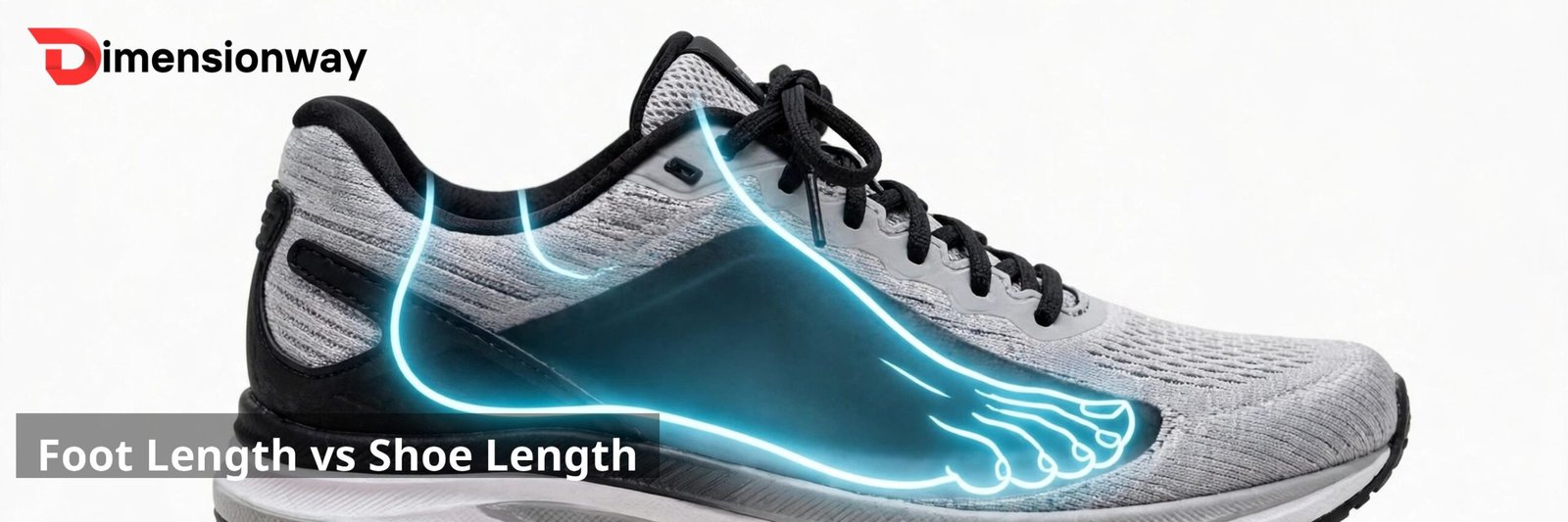
Here is the confusion that trips up almost everyone. A shoe size number describes your foot, not your shoe. Shoe companies build each shoe around a wooden or plastic form called a last, which is shaped like a foot but made about an inch longer. Your toes get a margin of space, the shoe gets its length, and the number on the box refers to the foot that goes inside.
That is why a “10-inch shoe” does not exist in the way people imagine it. A men’s US size 10 fits a foot of about 10.5 inches, and the shoe itself stretches to about 11.5 to 12 inches. Measure the shoe and you will always get a bigger number than the chart promised. Measure your foot and the chart makes sense.
| US men’s | Foot length | Foot length | Typical shoe outsole |
|---|---|---|---|
| 9 | 10.25 in | 26.0 cm | about 11.2 in |
| 10 | 10.56 in | 26.8 cm | about 11.6 in |
| 10.5 | 10.73 in | 27.3 cm | about 11.7 in |
| 11 | 10.90 in | 27.7 cm | about 11.9 in |
| 12 | 11.23 in | 28.5 cm | about 12.3 in |
The gap is the toe margin, roughly an inch, and it is remarkably consistent. Brands fudge it a little, but the pattern holds. Remember it and you will never wonder why the tape measure disagrees with the box.
US Men’s Shoe Sizes and Foot Length
| US men’s | Foot length (in) | Foot length (cm) |
|---|---|---|
| 6 | 9.23 | 23.4 |
| 7 | 9.56 | 24.3 |
| 8 | 9.90 | 25.2 |
| 9 | 10.23 | 26.0 |
| 10 | 10.56 | 26.8 |
| 10.5 | 10.73 | 27.3 |
| 11 | 10.90 | 27.7 |
| 12 | 11.23 | 28.5 |
| 13 | 11.56 | 29.4 |
| 14 | 11.90 | 30.2 |
The rule is simple: each full size adds one-third of an inch, each half size one-sixth. Go up two sizes and you have added two-thirds of an inch, two barleycorns. The average American man wears about a 10.5, which puts the most common foot in the country at roughly 10.7 inches long.
US Women’s Shoe Sizes and Foot Length
| US women’s | Foot length (in) | Foot length (cm) |
|---|---|---|
| 5 | 8.7 | 22.1 |
| 6 | 9.0 | 22.9 |
| 7 | 9.3 | 23.7 |
| 8 | 9.7 | 24.6 |
| 9 | 10.0 | 25.4 |
| 10 | 10.3 | 26.2 |
| 11 | 10.7 | 27.1 |
| 12 | 11.0 | 27.9 |
Women’s numbering runs about 1.5 sizes above men’s for the same foot: a woman measuring 9.7 inches wears a US women’s 8, a man with the same foot about a 6.5. The average American woman wears roughly an 8.5 to 9. Same barleycorn steps, same rule, different starting line.
US to UK to EU Shoe Size Conversion
| US men’s | UK | EU | Foot length (in) |
|---|---|---|---|
| 8 | 7 | 41 | 10.0 |
| 9 | 8 | 42.5 | 10.25 |
| 10 | 9 | 44 | 10.56 |
| 11 | 10 | 45 | 10.90 |
| 12 | 11 | 46 | 11.23 |
| 13 | 12 | 47.5 | 11.56 |
Two conversions are worth memorizing. US men’s sizes run one full size above UK sizes: an American 10 is a British 9. EU sizes use Paris points, each step two-thirds of a centimeter, about a quarter inch. One warning: the centimeter number on Nike boxes is not your foot length. Nike’s own guides say the box CM is a separate scale, so read the foot-length column, not the box.
How Shoe Sizing Works: Barleycorns and the “Foot” in Footwear
Your shoe size is counted in barleycorns. A barleycorn is one-third of an inch, named for an actual grain of barley. In 1324, under Edward II, English law set three barleycorns laid end to end as one inch, and shoemakers gradually agreed that each full shoe size would grow by exactly one barleycorn. Every size chart on earth still runs on that medieval grain.
The starting line is stranger still. Shoemakers began counting at 4 inches, the width of a man’s hand across the knuckles, which is also the unit used to measure horses. Children’s sizes run from 0 to 13 in barleycorn steps, then adult sizes restart at 1, as if the counter ran out of room. Size 13 sits at 8 and one-third inches; adult size 1 picks up one barleycorn later. Nobody designed this to be intuitive. It grew, like the foot itself.
America got its own version in the 1880s, when New York businessman Edwin Simpson published the first detailed US sizing system. About a decade later the National Association of Shoe Retailers adopted it, and by the 1920s stores were measuring feet with standardized tools: the Ritz stick and the Brannock device. Charles Brannock patented his famous metal foot measurer in 1928 and 1929, and it is still the free, correct way to find your size in most shoe stores. It measures length in barleycorn steps and width in letters from AAA (narrowest) to EEE (widest).
So why is it called a “foot”? Because the whole system grew out of measuring feet with the inch, and the inch itself was defined through the foot: three barleycorns to the inch, twelve inches to the foot. Our guide to how long 3 feet is walks through that yard-long history. Your shoe size is, quite literally, your foot expressed in ancient grain.
How to Measure Your Foot at Home
You need a wall, a sheet of paper, and a pen. No special tools.
- Place the paper on a hard floor with one short edge flat against the wall.
- Stand on the paper with your heel touching the wall, putting your full weight on the foot.
- Mark the paper at the tip of your longest toe. For many people that is the second toe, not the big one.
- Step off and measure from the wall edge of the paper to the mark. That is your foot length.
- Repeat with the other foot and use the longer measurement.
Two tips. Measure in the evening, when feet are at their largest. If your measurement lands between sizes, size up: extra room beats a cramped toe box every time. Our guide to estimating distance without a tape measure has more tricks for turning household objects into rulers.
Kids’ Sizes, Briefly
Children’s sizes live on the same barleycorn scale, just an earlier stretch: they start at 0, which equals 4 inches, and climb to 13 at 8 and one-third inches. Then adult sizing restarts at 1, one barleycorn later. That restart is why a kids’ 13 and an adult 1 are nearly the same length. Their foot is not changing systems. The numbering is.
10 Comparisons That Make Shoe Size Click
A men’s US size 10 shoe, about 11.5 to 12 inches long. Here is what that looks like in the real world.
A 12-Inch Ruler
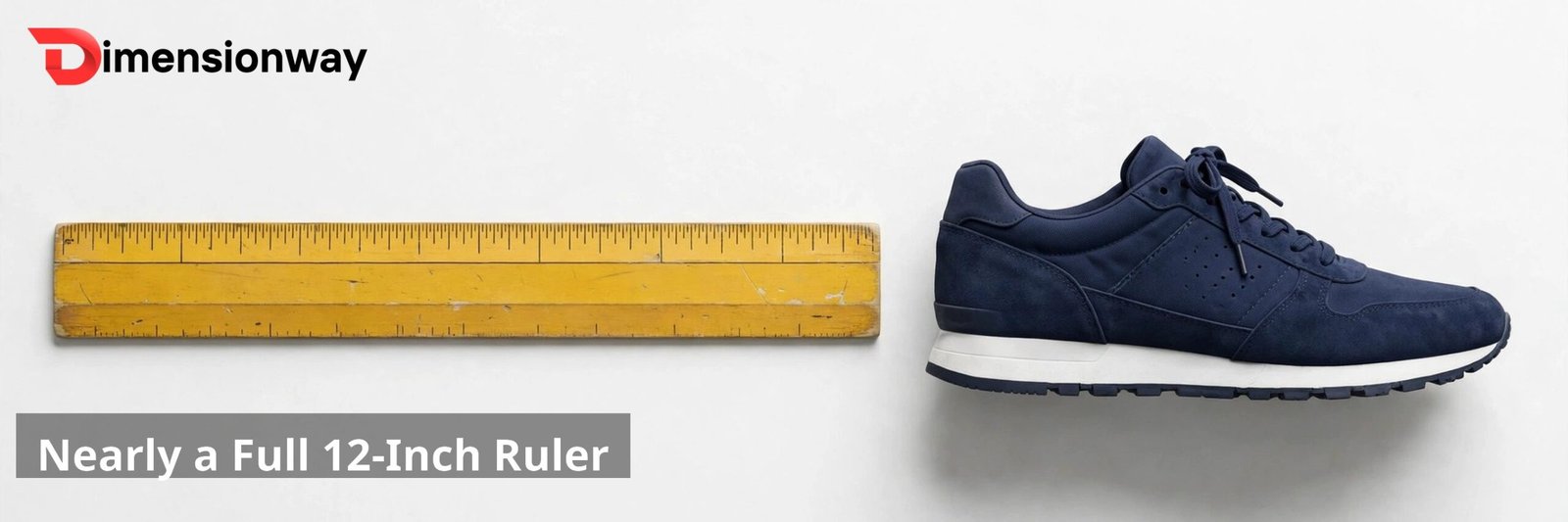
Lay a standard 12-inch school ruler next to a men’s size-10 sneaker and the shoe covers nearly the whole thing, leaving about half an inch peeking out past the heel. The outsole of a typical sneaker runs about 11.6 inches, 97 percent of a ruler.
This is the most useful comparison in the guide. A size-10 shoe is a ruler minus a fingertip. Hold that image and you can estimate shoe length anywhere: in a store, in a closet, in a photo.
A Foot-Long Sub
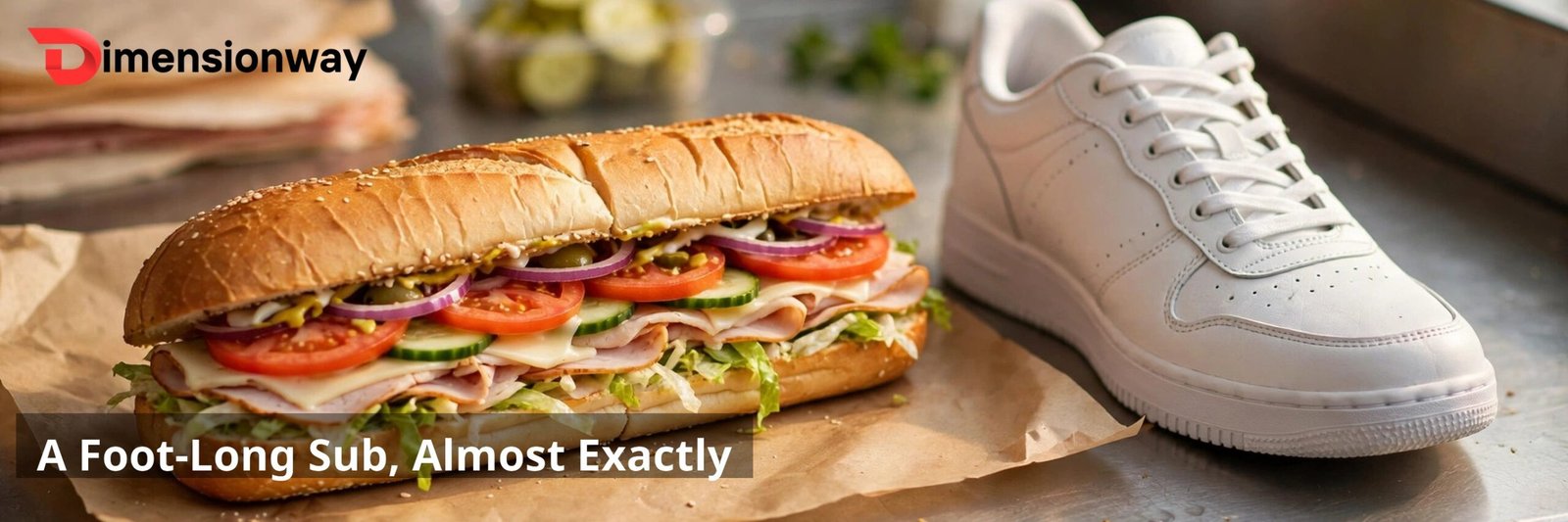
The foot-long sub is advertised at 12 inches, and a men’s size-10 shoe lands within an inch of it. The famous 2013 discovery that some subs measured closer to 11 inches only makes the match better: shoe and sandwich are the same animal.
Both are called foot-long, and now the name makes sense: a foot is 12 inches and a size-10 shoe is nearly 12 inches. The sandwich shop stumbled into the most accurate product name in fast food.
Just Under Two Dollar Bills
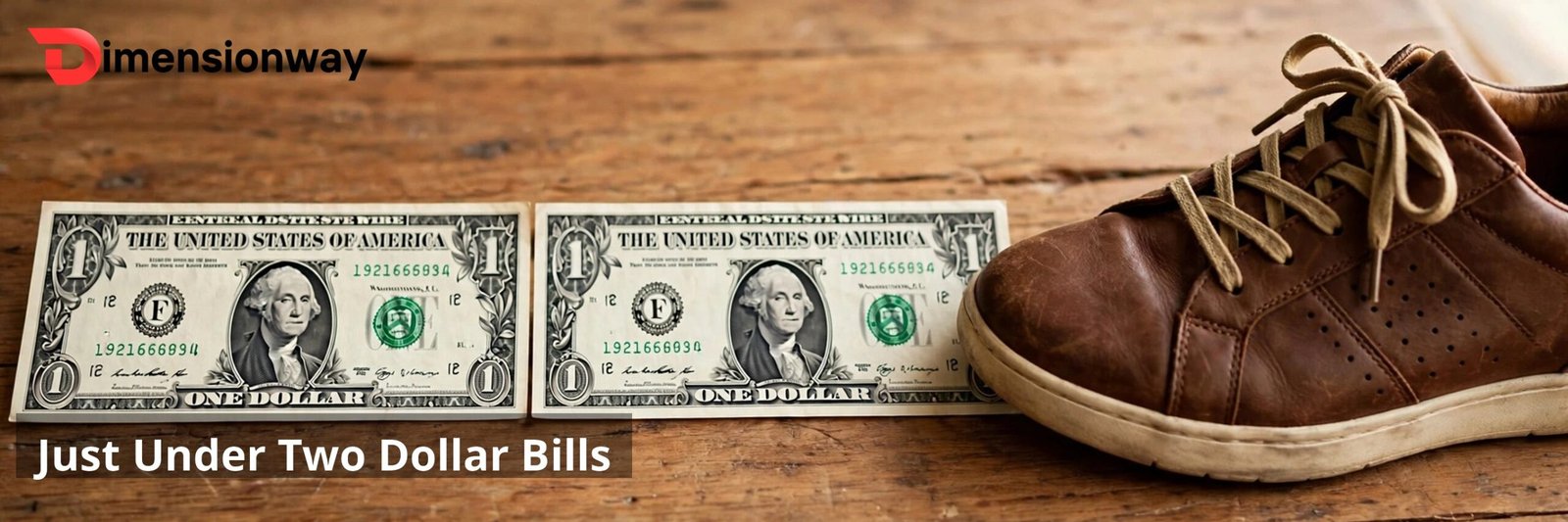
A US dollar bill measures 6.14 inches long. Two end to end make 12.28 inches, just a hair longer than a size-10 shoe. The shoe falls short by about a quarter inch, close enough that your eye calls it even.
Try it as a store trick. Two bills laid flat approximate any men’s size-10 shoe. Our guide to what 6 inches looks like uses the same bill from the other direction. Bills are everywhere and tape measures are not.
Three Credit Cards in a Row

Here is the comparison for the foot inside the shoe. A credit card measures 3.370 inches tall. Three cards in a row span 10.11 inches, and the foot inside a men’s size-10 shoe measures about 10.56 inches. The foot runs just under half an inch longer than the three-card chain.
Flip it around and it becomes a foot-measuring tool: stand on three cards heel to toe and you are roughly a size 10. Our guide to how big a credit card is breaks the card’s dimensions down further.
The Brannock Device
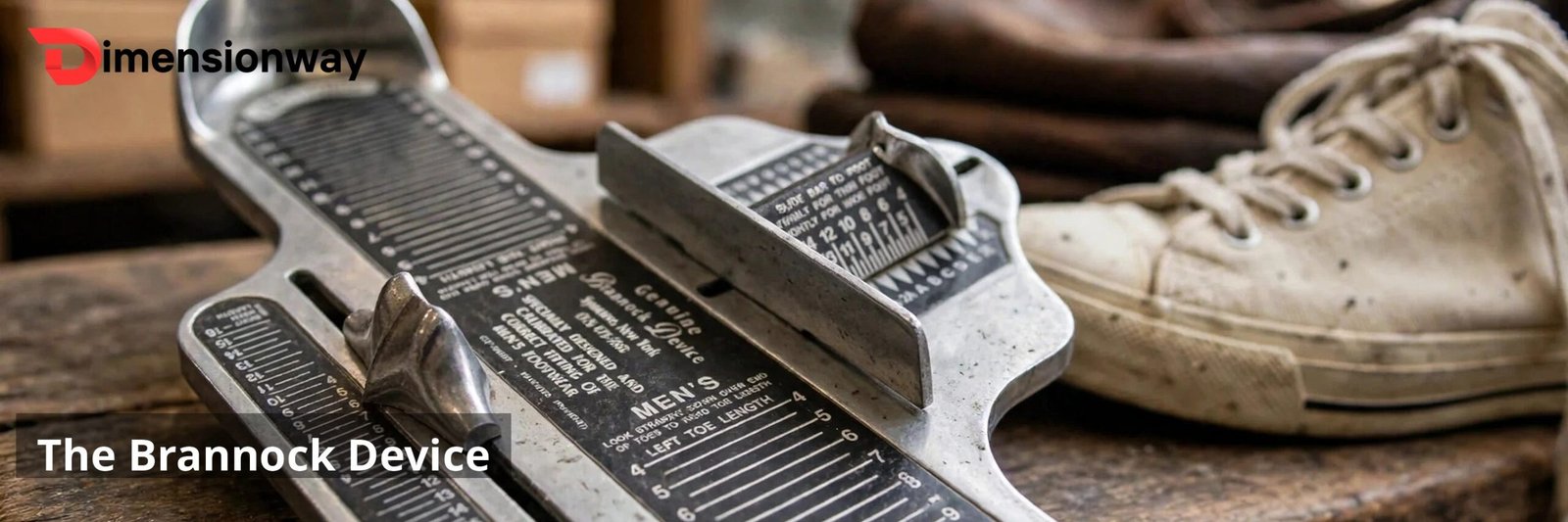
The Brannock device is the sliding metal scale in every shoe store, and the reason your size is your size. Its length scale is marked in barleycorn steps of one-third inch. Slide your heel to the back, bring the bar to your longest toe, and the window reads your size directly: a 10.5-inch foot reads 10.
It also measures width, in letters from AAA to EEE, which is why two people with the same numbered size can need different shoes. Most stores measure you for free, and most people wear the wrong size. If you have never stood on the metal plate, you do not know your size. You know a guess.
Two iPhones End to End
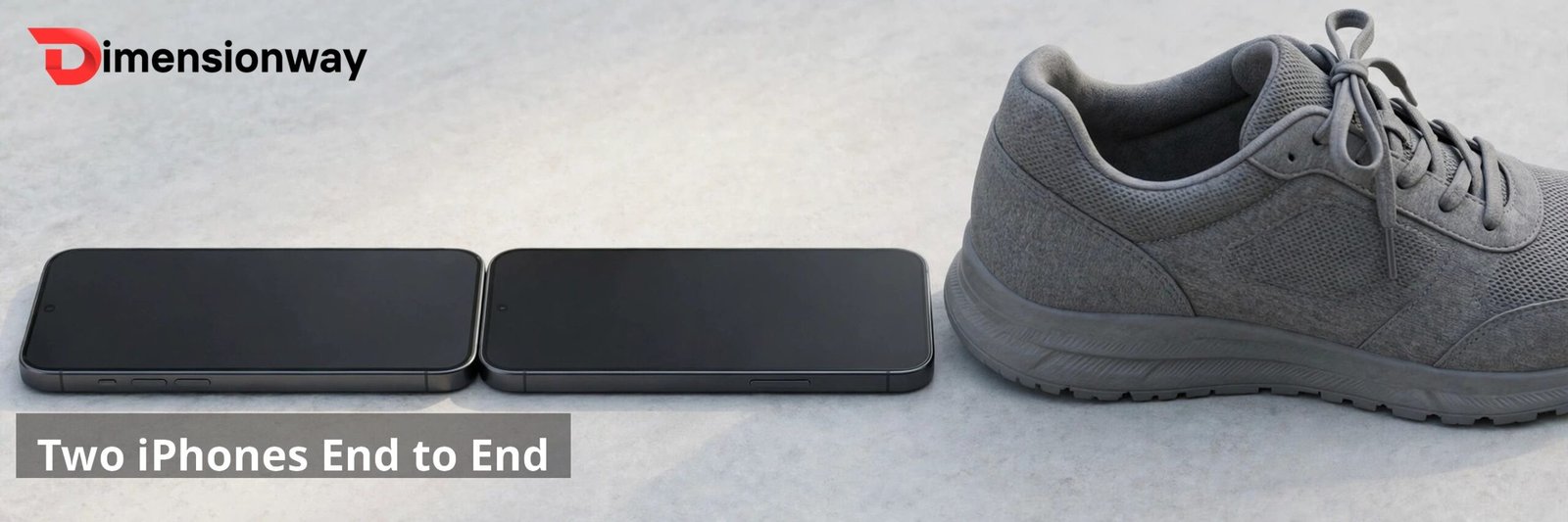
An iPhone 16 measures 5.81 inches tall. Two of them end to end stretch 11.62 inches, landing almost exactly on a size-10 shoe’s outsole length: phone, phone, shoe, all the same line.
The phone is always in your pocket, which makes this the store trick: lay it down twice along the shoe. Two phone-lengths is a size 10. One and three-quarter is a size 8. The math is instant.
A Sheet of Letter Paper
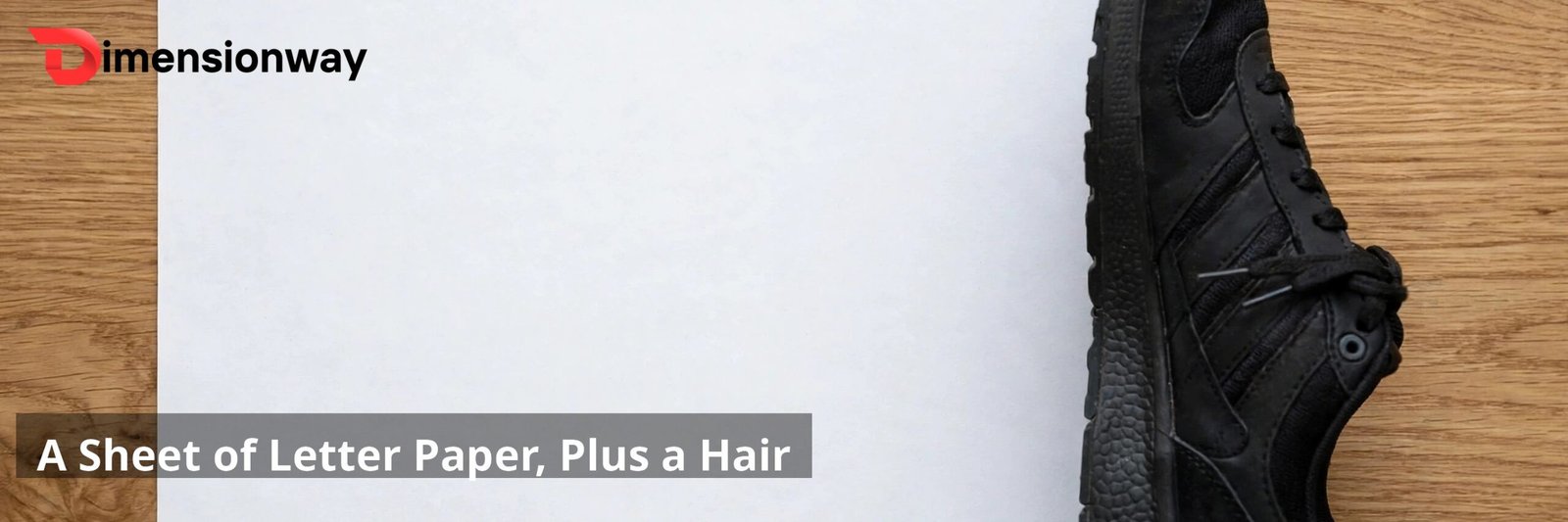
US letter paper measures 11 inches on its long edge. Stand a men’s size-10 shoe against it and the shoe runs a hair longer, overhanging the paper by roughly half an inch. It is the closest paper product to a shoe’s length.
Desks are full of these, which makes paper the office worker’s ruler. Need to know if a shoebox fits on a shelf? The paper tells you in one glance, no tape measure needed.
A Standard Wine Bottle

A standard wine bottle stands about 12 inches tall. Lay a men’s size-10 shoe on its side next to the bottle and the two match almost exactly, heel to toe against base to cork. Dinner guests have been performing this comparison by accident for years, kicking shoes off near the wine rack.
Both objects converged on the same human scale: easy to grip, easy to carry, easy to store. Twelve inches is the length things become when they are made for hands and feet.
A Barbie Doll
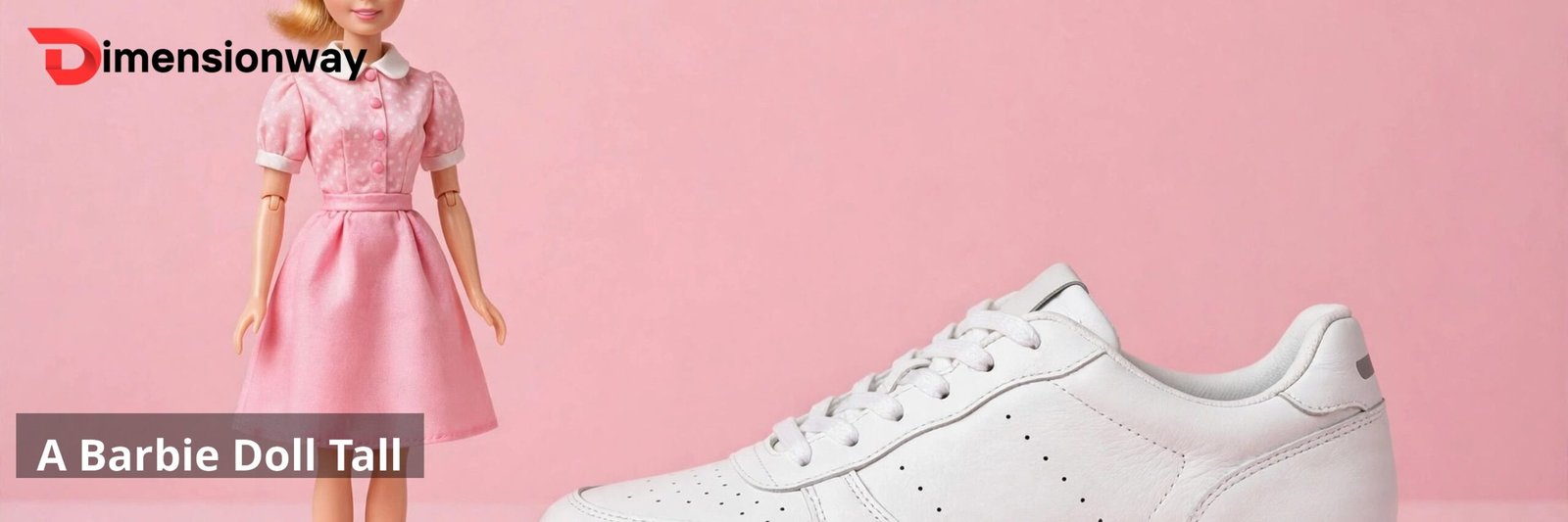
Barbie stands 11.5 inches tall, and a men’s size-10 shoe is about 11.5 to 12 inches long. The doll and the shoe are the same length, which makes the toy box an unlikely but precise measuring kit.
The doll was scaled to look like a person at one-sixth size; the shoe is scaled to fit an actual person. Two different design processes landed on the same 11.5 inches. Coincidence is the wrong word. Human proportion is the right one.
32 Barleycorns in a Row

Thirty-two grains of barley, laid end to end, span 10.67 inches: 32 times one-third of an inch. The foot inside a men’s size-10 shoe measures about 10.56 inches. The ancient grain and the modern foot agree within a tenth of an inch.
This is the comparison the whole article has been building toward: the barleycorns, physically spanning the foot they were invented to measure. Seven centuries of shoemaking, one row of grain.
How to Picture Shoe Size Without a Shoe
Three tricks that stick.
First, use the ruler. A men’s size-10 shoe is a 12-inch ruler minus a fingertip. Scale from there: a size 8 is about two inches shorter, a size 13 about an inch and a half longer.
Second, use the cards. Three credit cards in a row are about 10.1 inches, which is the foot, not the shoe. Add the width of your thumb and you have the shoe. Cards for the foot, thumb for the toe margin.
Third, use the paper. A sheet of letter paper is 11 inches. A size-10 shoe is a paper plus a hair. If the object you are picturing is longer than a sheet of paper, it is longer than most men’s shoes.
FAQs

How long is a men’s size 10 shoe in inches?
About 11.5 to 12 inches from heel to toe on the outside. The foot it fits measures about 10.5 inches (10 9/16 inches on the Brannock scale). The extra inch is toe margin built into the shoe’s last.
How long is a women’s size 8 shoe?
The foot measures about 9.7 inches (24.6 cm). The shoe itself runs about an inch longer, roughly 10.5 to 10.75 inches on the outside. A women’s 8 fits roughly the same foot as a men’s 6.5.
What is the average men’s shoe size in the US?
About 10.5. Most American men fall between sizes 9 and 12, and the average has crept upward over the decades as people have gotten taller. The average woman wears about an 8.5 to 9.
How many inches is one full shoe size?
One-third of an inch, exactly one barleycorn. A half size is one-sixth of an inch. Two full sizes equal two-thirds of an inch. That is the entire arithmetic of shoe sizing.
Why is it called a “foot” when sizing shoes?
Because the system grew out of measuring feet with the inch, and the inch was defined through the foot: three barleycorns to the inch, twelve inches to the foot. Shoe sizes count how many barleycorns long your foot is, starting from a 4-inch baseline. The name is literal.
What is the difference between US and UK shoe sizes?
US men’s sizes run one full size above UK sizes: a US men’s 10 is a UK 9. Women’s US sizes run about two above UK: a US women’s 8 is a UK 6. The steps are the same barleycorn thirds in both systems, only the numbering differs.
What EU size is a US men’s 10?
EU 44. EU sizes use Paris points of two-thirds of a centimeter each, so the numbers climb faster than US sizes. Always check the brand’s own chart, because EU conversions vary more than US or UK ones.
How do I measure my foot for shoe size?
Stand on paper against a wall, mark your longest toe, and measure heel to mark. Do both feet, use the longer one, and measure in the evening when feet are largest. Size up if you fall between sizes.
Do shoes run true to the Brannock size?
Often not exactly. Brands carve their own lasts, so a 10 in one brand can fit like a 10.5 in another. Nike notes that the centimeter number on its boxes is not your foot length. The Brannock size is the honest starting point; the brand’s chart is the final word.
What kids’ size is closest to an adult size 1?
A kids’ 13. Children’s sizes run 0 to 13 on the barleycorn scale starting at 4 inches, and adult sizes restart at 1 one step later. The two sizes sit back to back, which is why the jump from kids’ to adult shoes feels like a border crossing.
Conclusion
A men’s US size 10 shoe is about 11.5 to 12 inches long, built for a foot of about 10.5 inches. Each full size steps by one-third of an inch, one barleycorn, a unit named for a grain of barley and set by a king in 1324. The number on the box was never the shoe’s length. It was always your foot, counted in grain.
Keep two or three comparisons that clicked. The ruler minus a fingertip. The three credit cards. The 32 barleycorns. The next time a size chart looks like code, you will read it like a sentence.
Related Reading
– How Long Is 3 Feet? 10 Everyday Comparisons: the yard-long history behind the inch your shoe is counted in. – What Does 6 Inches Look Like? 10 Everyday Comparisons: two dollar bills are 12 inches, the neighborhood of a size-10 shoe. – How Big Is a Credit Card? 10 Things Exactly That Size, Visualized: three cards in a row span the foot inside the shoe. – How to Estimate Distance Without a Tape Measure: more household objects that double as rulers.
Sources
- Brannock Device Co.
- Wikipedia
- Milk & Honey Shoes
- Best Walking Feet
- Marmon Sports
- Footwearbiz
- Pro Calculator
- Decent Foot

James Carter is the founder and editor of DimensionWay, where he researches, measures, and verifies real-world dimensions, from everyday objects to world-famous landmarks. Every number published on DimensionWay is cross-checked against manufacturer specifications and official sources, so readers always get accurate, easy-to-visualize comparisons.
