
You are standing in a kitchen store, holding a mug that says 11 oz on the bottom, and you have no idea what that means. Eleven ounces of what? Is that a lot? The mug next to it says 15 oz and looks barely bigger. The tiny one says 3 oz and costs the same. You buy the one with the prettiest color and hope for the best.
That confusion is built into the product. Unlike a ruler or a shoe size, a coffee mug has no official standard. The “standard” mug is a range, not a number: somewhere between 8 and 12 ounces, shaped by whatever the manufacturer felt like making that year. Ask three brands for their “standard” mug and you will get three different answers.
This guide pins down the real numbers behind the most common sizes, explains why the numbers wobble, and gives you ten everyday things that make the size click.
How Big Is a Coffee Mug?
A standard coffee mug is about 3.75 inches tall and 3 inches wide, holding 11 ounces (325 ml) of coffee.
Here are the numbers that matter most. The classic 11 oz mug measures 3.75 inches tall by 3 inches in diameter (9.5 by 7.6 cm). The everyday kitchen mug most people actually own is a 12 oz mug, roughly 4 to 5 inches tall and 3.25 to 4 inches wide. Smaller mugs run 8 oz, larger ones 15 oz, and the whole family sits between 2 and 20 ounces if you count espresso cups and soup mugs.
Why does it matter? Because “cup” is the most dishonest word in your kitchen. Your coffee maker’s cup is 5 ounces. Your measuring cup is 8 ounces. Your mug is 11 ounces. Once you know which cup is which, recipes make sense, coffee makers stop disappointing you, and you never again buy a “large” mug that turns out to be your old mug with a new price tag.
Coffee Mug Dimensions by Capacity

| Mug type | Capacity | Height | Diameter |
|---|---|---|---|
| Espresso / demitasse | 2-3 oz | 2-2.5 in | 2.3-2.9 in |
| Small mug | 8 oz | 3.5-3.75 in | 3-3.5 in |
| Standard mug | 11 oz | 3.75 in | 3 in |
| Kitchen classic | 12 oz | 4-5 in | 3.25-4 in |
| Large mug | 15 oz | 4.5 in | 3.25 in |
| Travel mug | 16 oz | 7-8.5 in | 3-3.5 in |
| Soup mug | 16-20 oz | about 4.5 in | about 5 in |
A few patterns worth noticing. Diameter barely moves across the whole family: almost every mug mouth measures between 3 and 3.5 inches, because that is the width a human hand comfortably wraps around. Height is what changes the capacity, which is why a 15 oz mug looks like a stretched 11 oz mug rather than a wider one. And the travel mug breaks the pattern entirely: it holds only a little more than a large mug but stands twice as tall, because the lid and the insulation demand the extra inches.
Why There Is No True Standard
Here is the finding that surprised every source we checked: nobody agrees on what a standard coffee mug is. The drinks industry puts the standard range at 8 to 12 ounces. The personalized-mug industry, the one printing photos on mugs for gifts, treats 11 ounces as the classic because 11 oz blanks are cheap and print well. Diners and offices tend to buy thick-walled 12 oz mugs because they survive dishwashers. All three call theirs “standard,” and all three are right in their own world.
Cafes made it messier. A Starbucks Tall is 12 ounces, which nudged a generation into thinking 12 is the baseline, while Italian tradition says a proper coffee is 2 to 3 ounces in a demitasse and anything bigger is just hot milk with ambitions. The American mug kept growing because refills are free and desks are far from kitchens.
So treat “standard” as a habit, not a rule. When this guide says standard, it means the 11 oz ceramic mug at 3.75 by 3 inches: the shape your hand already knows, the one that fits under nearly every drip coffee maker, the one most gift mugs copy. Everything else is measured against it.
Standard Coffee Mug Dimensions in Inches, Centimeters, and Millimeters
| Dimension | Inches | Centimeters | Millimeters |
|---|---|---|---|
| Height, 11 oz standard | 3.75 | 9.5 | 95 |
| Diameter, 11 oz standard | 3 | 7.6 | 76 |
| Width including handle, 11 oz | 4.5-5 | 11.4-12.7 | 114-127 |
| Height, 15 oz large | 4.5 | 11.4 | 114 |
| Diameter, 15 oz large | 3.25 | 8.3 | 83 |
| Height, espresso cup | 2-2.5 | 5.1-6.4 | 51-64 |
| Height, 16 oz travel mug | 7-8.5 | 17.8-21.6 | 178-216 |
The handle adds roughly 1.5 to 2 inches to the total width, which matters more than people expect. A mug that measures 3 inches across the mouth needs about 5 inches of shelf depth once the handle is counted. This is why mugs rattle in cabinets: the shelves were built for plates, and the handles were an afterthought.
The Two Cups That Lie to You
Forget memorizing the chart. Two facts explain nearly every mug disappointment.
Fact one: your coffee maker’s “cup” is 5 ounces. Brew a “12-cup” pot and you get 60 ounces, not twelve mugs. Pour that into 11 oz mugs and you fill about five and a half of them. The machine is not cheating you; it is using a 5-ounce cup invented when coffee was served in tiny cups with saucers. Every coffee maker brand from Mr. Coffee up uses it, and the number is printed in the manual nobody reads.
Fact two: ounces measure volume, inches measure shape. A 12 oz soda can and a 12 oz mug hold the same amount of liquid and look nothing alike. The can is 4.83 inches tall and 2.6 inches wide. The mug is about 4 inches tall and 3.5 inches wide. Same 12 ounces, completely different silhouette. When a mug “looks small,” you are judging shape, not capacity.
The math that follows from those two facts:
| Fill this | Equals |
|---|---|
| Espresso shots in one standard mug | about 4 double shots |
| Standard mugs in a 12-cup carafe | about 5.5 (60 oz divided by 11 oz) |
| Standard mugs in 1 liter of water | about 3 (1,000 ml divided by 325 ml) |
| Mugs in a row to make 1 foot | 4 (4 times 3 in) |
| Mugs stacked to reach 3 feet | 10 (10 times 3.75 in is 37.5 in) |
Our guide to how long 3 feet is puts that ten-mug stack in perspective. And the four-mug foot is worth memorizing: it turns every kitchen shelf into a ruler.
10 Things the Size of a Coffee Mug
A 12 oz Soda Can

Here is the comparison that reframes everything. A standard 12 oz soda can measures 4.83 inches tall and 2.6 inches in diameter. A standard 12 oz kitchen mug measures about 4 inches tall and 3.5 inches across. Pour the can into the mug and the volumes match almost exactly, yet the two objects look like different species: the can is a tower, the mug is a bowl with a handle.
Try it literally some time. Pour a full can of soda into an 11 oz mug and about an ounce spills over the rim, because the mug holds one ounce less than the can. That missing ounce is the cheapest possible lesson in the difference between “looks bigger” and “holds more.”
A Tennis Ball

A regulation tennis ball measures 2.57 to 2.70 inches in diameter, and a standard mug’s mouth measures about 3 inches across. Drop the ball in and it falls straight to the bottom with a hollow rattle. The fit is almost suspiciously perfect: the ball is the largest everyday sphere that still fits through the opening.
This makes the tennis ball the best pocket test of mug size. If a ball drops in cleanly, you are holding a standard or larger mug. If it perches on the rim, you are holding something closer to an espresso cup. Dog owners already know this test by accident: the ball they fish out of the mug on the coffee table went in easier than they expected.
An iPhone Standing in a 15 oz Mug
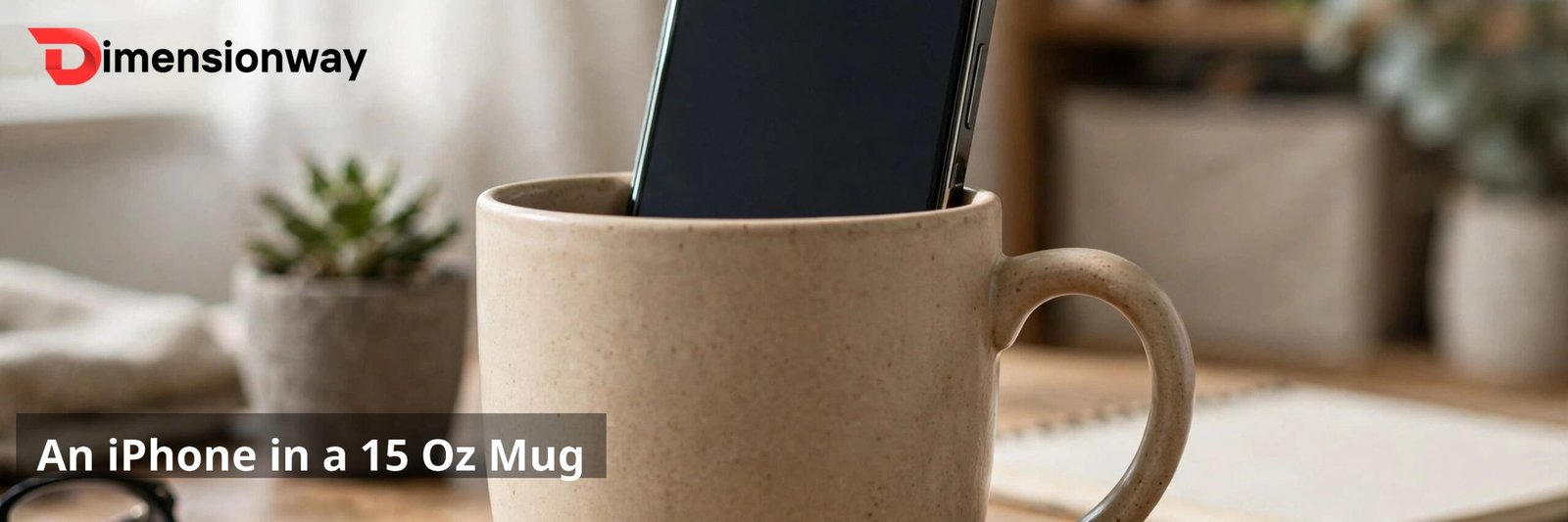
An iPhone 16 measures 5.81 inches tall and 2.82 inches wide. A large 15 oz mug measures 4.5 inches tall and 3.25 inches across. Drop the phone in and it slides to the bottom, standing about 1.3 inches proud of the rim like a periscope. In a standard 11 oz mug at 3.75 inches tall, the same phone sticks out a full 2 inches.
People actually do this. The mug is the desk’s phone stand: heavy enough not to tip, tall enough to hold the phone upright, open enough that the speaker still sounds fine. If your phone disappears completely inside the mug, you are not holding a mug. You are holding a soup mug or a small bucket.
An Espresso Cup

The demitasse, the classic espresso cup, holds 2 to 3 ounces and stands about 2 to 2.5 inches tall. Set it next to a standard mug and it looks like the mug’s child: same handle, same ceramic, roughly a quarter of the capacity. Four double espressos fill one standard mug almost exactly.
The French name says it all: demitasse means “half cup.” It was designed when coffee was strong, expensive, and served after dinner in small doses. The American mug is the opposite philosophy in ceramic form: coffee as a long, slow companion to the workday. Same drink, opposite ideas about how much of it a person needs.
A Soup Mug

The soup mug is the standard mug’s big sibling: 16 to 20 ounces, about 4.5 inches tall and 5 inches wide, with a handle on each side. It holds roughly one and a half standard mugs of liquid, which is exactly the point. Soup is a meal, and a meal needs a bigger vessel than a beverage.
The two handles are the giveaway. A single handle means “drink me.” Two handles mean “cradle me with both hands because I am hot and heavy.” If you have ever tried to drink soup from a standard mug, you know the problem: it empties in four sips and burns your palm. The soup mug exists because the standard mug is, for soup, too small.
A Credit Card

A credit card measures 3.370 inches tall. A standard mug measures 3.75 inches tall. Stand the card against the mug and the card’s top edge lands just below the rim, about four-tenths of an inch short. It is one of the tidiest comparisons in this guide: the most standardized object in your wallet against the least standardized object in your kitchen.
Our guide to how big a credit card is breaks the card’s dimensions down further. And the trick works in reverse: if you ever need to estimate a mug’s height in a store, hold your card against it. Card plus a fingertip is a standard mug.
A Travel Mug

A 16 oz travel mug stands about 8 inches tall, more than twice the height of the 3.75-inch standard mug, while holding only about 45 percent more coffee. The extra height is the price of the lid, the drinking spout, and the double-wall insulation. The diameter stays near 3 inches at the base, because it has to fit the car’s cup holder.
This is the mug that proves the “ounces lie” rule from earlier. Sixteen ounces sounds modestly bigger than eleven. But the travel mug looks like a different animal entirely: a thermos wearing a mug’s name. If you ever wondered why your travel mug never feels “right” at the desk, it is because your hand learned its grip on something half as tall.
A 12-Cup Coffee Maker Carafe

A “12-cup” drip coffee maker brews 60 ounces, because its cup is 5 ounces. Divide 60 by 11 and you get 5.45: one full pot fills about five and a half standard mugs. The carafe looks enormous next to a single mug, and now you know the exact ratio.
This is the comparison that ends the morning argument. When the pot is empty after five mugs and someone accuses someone else of drinking “twelve cups,” everyone is wrong in an interesting way. Nobody drank twelve of anything. Five and a half mugs drank the pot, and the machine’s cups were never mug-sized to begin with.
A Dollar Bill

A US dollar bill measures 6.14 inches long. A standard mug stands 3.75 inches tall, which is about 61 percent of the bill’s length. Lay the bill flat and stand the mug on one end of it: the mug covers a comfortable majority of the bill with a couple of inches to spare.
It is a handy store trick because bills are everywhere and tape measures are not. If the mug is clearly taller than half a bill but shorter than the full bill, you are looking at the standard 11 to 12 oz range. If it matches the bill’s length, you have found a large 15 oz mug or a small vase, depending on the handle.
Four Mugs in a Row

Four standard mugs in a row measure 12 inches: four times the 3-inch diameter equals exactly one foot. Line them up on the counter and you have built a ruler out of drinkware. Two mugs side by side make 6 inches.
Our guide to what 6 inches looks like uses the same trick from the other direction. Once you see it, you cannot unsee it: kitchen shelves, cabinet widths, and countertop depths all start measuring themselves in mugs. A standard 24-inch cabinet shelf is eight mugs wide. A 36-inch countertop is twelve.
How to Picture a Coffee Mug Without One
Want a faster way to lock in the size? Try these three tricks.
First, use the can. A 12 oz soda can holds almost exactly what your 12 oz mug holds. The mug is just the can’s volume poured into a shorter, wider shape with a handle attached. If you can picture a can, you can picture the mug’s capacity.
Second, use the card. Stand a credit card upright in your mind: your standard mug is about half an inch taller than the card. Card plus a fingertip. You will never be in a store without a card, which means you will never be without a mug measuring tool again.
Third, use the foot. Four mugs in a row make 12 inches. Walk into any kitchen, count the mugs on the shelf, divide by four, and you know the shelf’s width in feet. It is the most DimensionWay sentence ever written, and it works.
FAQs

What is the standard size of a coffee mug?
The classic standard is an 11 oz mug measuring 3.75 inches tall by 3 inches in diameter (9.5 by 7.6 cm). In practice, “standard” covers 8 to 12 ounces, and the most common kitchen mug is a 12 oz model roughly 4 to 5 inches tall. There is no official standard: manufacturers vary, so check the ounce rating on the bottom of the mug.
How many ounces is a normal coffee mug?
A normal coffee mug holds 8 to 12 ounces. The 11 oz mug is the traditional classic, the 12 oz mug is the most common everyday size, and 8 oz mugs suit smaller servings of strong coffee or tea. Larger mugs run 15 to 16 ounces, and soup mugs reach 16 to 20 ounces.
How tall is a standard coffee mug?
A standard 11 oz coffee mug is 3.75 inches (9.5 cm) tall. A 12 oz kitchen mug runs 4 to 5 inches tall, a 15 oz large mug is 4.5 inches tall, and a 16 oz travel mug stands about 8 inches tall. Espresso cups are the shortest at 2 to 2.5 inches.
What is the diameter of a coffee mug?
The mouth of a standard mug measures about 3 inches (7.6 cm) across, with most mugs falling between 3 and 3.5 inches. Including the handle, the total width grows to about 4.5 to 5 inches, which is the number that matters for shelf space.
How big is a 12 oz coffee mug?
A 12 oz coffee mug is typically 4 to 5 inches tall and 3.25 to 4 inches in diameter (about 10 to 13 cm by 8 to 10 cm). It holds the same volume as a standard soda can, just in a shorter, wider shape. This is the size most people picture when they think “coffee mug.”
How many espresso shots fit in a coffee mug?
About four double shots. A standard mug holds 11 ounces and a double espresso is about 2.5 ounces, so four shots fill it almost exactly. A single demitasse cup holds 2 to 3 ounces, roughly a quarter of a standard mug.
What is the difference between a coffee cup and a mug?
A coffee cup is the smaller, formal vessel: usually 6 to 8 ounces, often with a saucer, designed for measured servings. A mug is the casual workhorse: 8 to 12 ounces or more, always with a handle, never with a saucer, designed to be cradled. The demitasse or espresso cup is smaller still at 2 to 3 ounces.
Will a standard mug fit under my coffee maker?
Almost certainly. A standard 11 oz mug is 3.75 inches (95 mm) tall, and most drip coffee makers leave 5 to 6 inches of clearance under the brew basket. Large 15 oz mugs at 4.5 inches also fit. Only tall travel mugs at 7 to 8 inches tend to collide with the basket, which is why single-serve machines have adjustable or removable drip trays.
How many mugs does a 12-cup coffee maker fill?
About five and a half. A coffee maker’s “cup” is 5 ounces, so a 12-cup pot brews 60 ounces total. Divide 60 by 11 ounces per standard mug and you get 5.45 mugs. If you drink from 15 oz large mugs, one pot fills exactly four.
What size mug does Starbucks use?
A Starbucks Tall is 12 ounces, the closest cafe equivalent to a standard home mug. A Grande is 16 ounces and a hot Venti is 20 ounces. So when a recipe calls for “a mug of coffee,” the Tall is your reference: 12 ounces, about 4 to 5 inches tall in ceramic form.
Conclusion
A standard coffee mug is 3.75 inches tall, 3 inches wide, and holds 11 ounces of coffee. It holds the same as a soda can in a shorter, wider body. A tennis ball drops through its mouth. An iPhone stands in a large mug with an inch to spare. Four espresso shots fill it, four of them in a row make a foot, and a credit card stands just shorter beside it.
Keep the two or three comparisons that clicked for you. The next time you pick up a mug and wonder what “11 oz” actually means, you will not need to guess. You will already know exactly how big that coffee mug is.
Related Reading
- How Big Is a Credit Card? 10 Things Exactly That Size, Visualized: the 3.37-inch card stands just shorter than a standard mug.
- What Does 6 Inches Look Like? 10 Everyday Comparisons: two mugs side by side are 6 inches.
- How Long Is 3 Feet? 10 Everyday Comparisons: stack ten standard mugs and you reach 3 feet.
Sources
- Shutterfly
- The Drinks Project
- A Great Coffee
- The Donut Whole
- Queen Dimensions
- Wikipedia
- 9to5Mac
- Mr. Coffee

James Carter is the founder and editor of DimensionWay, where he researches, measures, and verifies real-world dimensions, from everyday objects to world-famous landmarks. Every number published on DimensionWay is cross-checked against manufacturer specifications and official sources, so readers always get accurate, easy-to-visualize comparisons.
