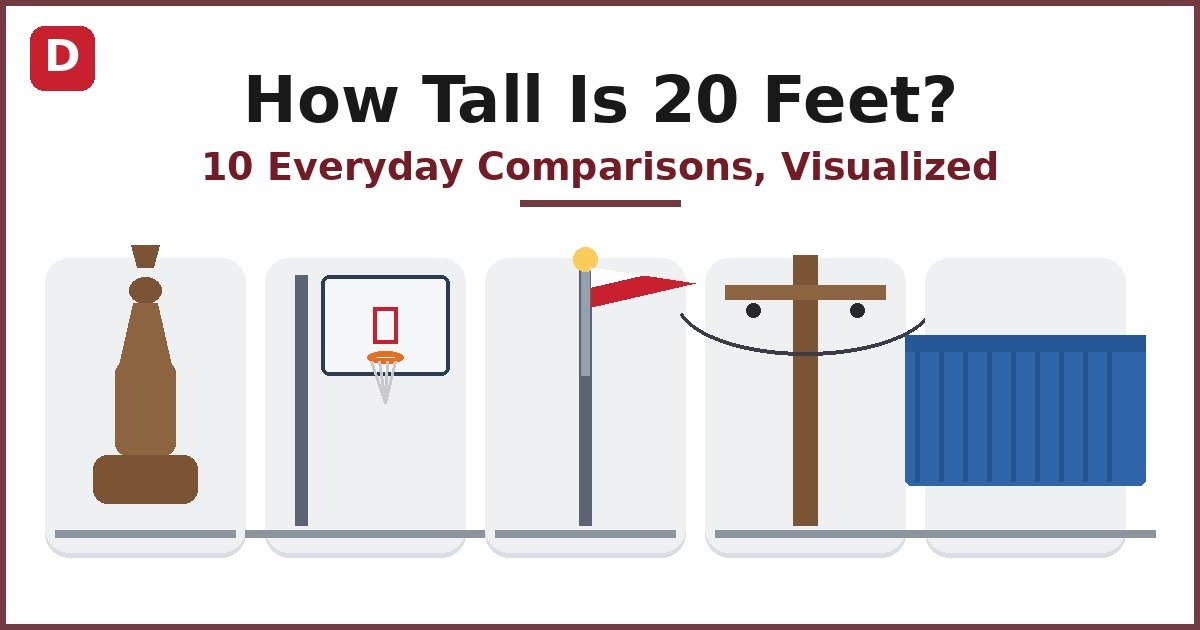
Look at the wooden utility pole outside your window, the one carrying power lines down your street. The wires usually hang about 20 feet above the sidewalk. So how tall is 20 feet, really? Is it the height of a house, a tree, or something stranger?
It is all of those, and one thing you would never guess. Twenty feet equals 240 inches, about 6.1 meters, and it turns up in world records, rulebooks, and the trees on your block. This guide gives you the exact conversions, 10 everyday comparisons verified against real sources, and a real picture of each one, so 20 feet becomes a height you can see in your head.
How Tall Is 20 Feet?
Twenty feet is the height where “tall” starts to feel serious. It is exactly double the height of a basketball rim, about two residential stories, and just over 6 meters. A tape measure stretched to 20 feet runs 240 inches, with nothing left over.
The exact numbers: 20 feet equals 240 inches, 609.6 centimeters, 6.096 meters, and 6.67 yards. In everyday metric terms, “just over six meters” is close enough.
This height matters when you buy a ladder, size a flagpole, or wonder whether a tree will reach your second-floor window. The fastest mental shortcut is two basketball hoops stacked: the rim is fixed at exactly 10 feet by the NBA rulebook, so two rims, one above the other, draw a perfect 20-foot line.
20 Feet Conversion Tables

20 Feet to Inches
| Feet | Inches |
|---|---|
| 18 | 216 |
| 19 | 228 |
| 20 | 240 |
| 21 | 252 |
| 22 | 264 |
20 Feet to Meters
| Feet | Meters |
|---|---|
| 18 | 5.49 |
| 19 | 5.79 |
| 20 | 6.10 |
| 21 | 6.40 |
| 22 | 6.71 |
20 Feet to Centimeters
| Feet | Centimeters |
|---|---|
| 18 | 548.64 |
| 19 | 579.12 |
| 20 | 609.60 |
| 21 | 640.08 |
| 22 | 670.56 |
10 Real-Life Examples of Things That Are 20 Feet Tall
The World’s Largest Chess Piece

The most exact 20 feet on this list is also the strangest. The world’s largest chess piece, a king standing in front of the World Chess Hall of Fame in St. Louis, Missouri, measures exactly 20 feet tall (6.096 meters), with a base 9 feet 2 inches across and a weight of 10,860 pounds. Guinness World Records certified it on April 6, 2018.
It was built as a publicity piece, but the builders did not round the number. Twenty feet flat, measured and certified. The king towers over the sidewalk like a small building, and visitors pose at its base the way they would next to a statue.
You will probably never measure one in person, but that is the point of a record: it fixes the number to something real. Twenty feet is exactly as tall as the biggest chess piece on the planet.
Two Basketball Hoops Stacked

Here is the cleanest 20 feet in sports. The NBA rulebook, Rule 1, fixes every rim at exactly 10 feet above the floor, a number unchanged since 1891. Stack two rims, one directly above the other, and you get 20 feet with no “about” and no rounding.
This works as a mental ruler anywhere there is a court. Picture the rim you shoot at, then picture the exact same height again on top of it. The top of that imaginary second hoop is 20 feet off the ground, and every player who has ever played the game has that 10-foot anchor in their muscles.
It also settles a common mix-up. People guess the backboard top is 20 feet; it is actually about 13 feet. Twenty feet is a full seven feet above the glass, which is why dunking from the free-throw line looks impossible. It nearly is.
A 20-Foot Telescoping Flagpole

The 20-foot flagpole is the step up from the common 15-foot residential model, and it is a real catalog size. Titan’s 20-foot heavy-duty telescoping pole, sold through flag retailers, lists an installed height of exactly 20 feet above the ground, with four sections and a 95 mph wind rating.
One honest detail matters when you shop. The light-duty “20-foot” version of the same pole actually installs at about 18.5 feet, because the sections overlap. The article’s rule is simple: if the spec sheet says installed height, trust it; if it only says pole length, subtract the overlap. The heavy-duty model’s 20 feet is the real, anchored number.
Twenty feet of pole clears a two-story roofline and keeps a 3-by-5-foot flag flying free of the gutters. Drive through a neighborhood with big lots and look for the tallest yard poles. Those are the 20-footers.
The White House Christmas Tree

Every December, one 20-foot tree becomes the most photographed in America. The official White House Christmas tree, a Fraser fir displayed in the Blue Room, has often measured 20 feet tall, including the 2024 tree from Cartner’s Christmas Tree Farm in Newland, North Carolina, reported by Fox Weather and the USA Today network.
The tree is chosen more than a year in advance, and the height is part of the specification: it has to fill the Blue Room’s tall space without touching the chandelier. Growers submit candidate trees, and the winner gets cut, trucked to Washington, and decorated with thousands of ornaments.
A 20-foot fir in a living room would be absurd, which is exactly why this example works. The Blue Room is one of the few indoor spaces built for it, and the photos of the tree against those tall windows give you a perfect sense of what 20 feet looks like indoors.
A Mature Crape Myrtle

For a tree you can actually plant, the crape myrtle is the 20-foot standard. Mississippi State University Extension lists standard varieties like ‘Byer’s White’ at a mature height of 20 feet, and the University of Arkansas Extension describes standards growing “up to 20 feet or more.” These are the flowering trees lining streets and parking lots across the South.
The number is useful because it is a choice, not an accident. Nurseries breed crape myrtles in three size classes: dwarf (under 5 feet), semi-dwarf (5 to 12 feet), and standard (up to 20 feet and beyond). When the tag says standard, it is promising you a 20-foot tree in about a decade.
If one grows on your street, stand under it in summer when it blooms. The top of that canopy is 20 feet, and it got there one growing season at a time. For a shorter tree reference, see how a 12-foot tree compares, which is about the height of a semi-dwarf at maturity.
A Werner 20-Foot Extension Ladder
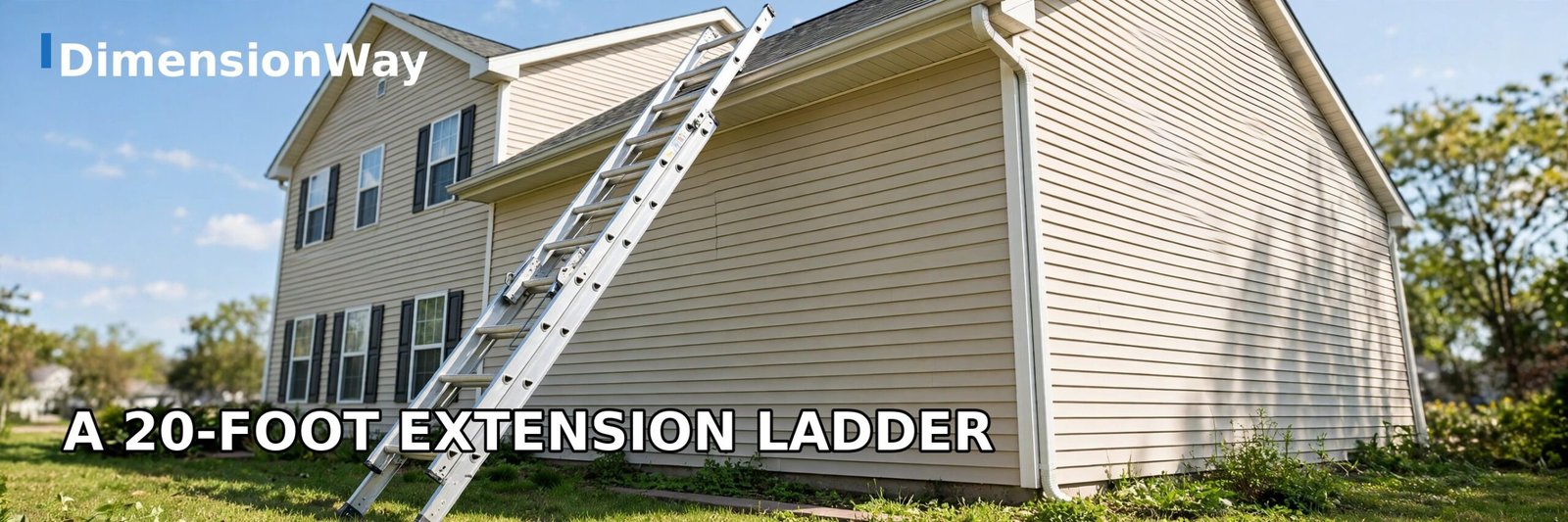
Extension ladders are sold by trade size, and the 20-foot model is the workhorse of the lineup. Werner’s D6220-2, the classic aluminum 20-footer, is the ladder painters and gutter cleaners reach for, and its spec sheets list a maximum working reach of about 19 to 20 feet.
Here is the honest framing this example needs. A “20-foot extension ladder” does not extend to a full 20 feet of ladder: the sections overlap for strength, so the Werner extends to about 17 feet of actual ladder, and a worker standing on it can reach roughly 19 to 20 feet up a wall. The trade name is the size class, not a tape-measure promise.
That is also why sizing guides exist. Oregon State Extension’s ladder table recommends a 20-foot extension ladder for reaching about 13.5 feet safely, because you should never stand on the top three rungs. The ladder is named for 20 feet, it gets you to about 20 feet of reach, and now you know exactly what the number means.
A Class 4 Wood Utility Pole

The wooden poles carrying power lines down residential streets are the most common 20-footers in America. A standard 25-foot Class 4 pole, built to ANSI O5.1 from Southern Yellow Pine, is buried about 4.5 feet deep, which leaves roughly 20.5 feet standing above the ground, according to manufacturer spec sheets.
The buried part surprises most people. Poles are set about 10 percent of their length plus 2 feet into the ground, so every pole you see is taller than it looks. The wires themselves usually hang a foot or two below the top, which puts them right around 19 to 20 feet over the sidewalk.
Next time you wait at a bus stop, look up at the nearest pole. The ground-to-wire distance you have ignored your whole life is 20 feet, measured and standardized by the utility industry.
Three Standard Interior Doors Stacked

The standard US interior door is 80 inches tall, 6 feet 8 inches, a number printed in every Home Depot door aisle in the country. Stack three of them and the math is perfect: 3 times 80 inches equals 240 inches, which is exactly 20 feet. No rounding, no “about.”
This is the most exact household 20 feet on the list, and it uses the stacking trick honestly. Each door is a familiar object you have walked through thousands of times. Three of them, one on top of another, draw a line 20 feet up the side of a house, which is roughly where the second-floor windows start.
Try it with your own front door. Picture two more doors balanced on top of it. The top of that stack is 20 feet, and you built it from something you touch every day.
Two School Buses Stacked

A school bus is one of the biggest familiar objects on the road, and two of them make a fine 20 feet. Blue Bird’s official specs for the Vision school bus list an overall height of 122 to 128 inches, which is 10 feet 2 inches to 10 feet 8 inches. Stack two and you get 20.3 to 21.3 feet, essentially 20 feet.
The range exists because buses come in different configurations: roof hatches, air conditioning pods, and wheelchair lifts all add inches. But every full-size school bus on the road today falls in that 10-foot-plus band, so the doubled number always lands within a foot of 20.
School buses are also a useful reality check on the “how tall is 20 feet” question because people consistently underestimate them. A bus looks tall from the sidewalk, and it is: one bus is already halfway to 20 feet before you stack the second one.
A 20-Foot Shipping Container

The 20-foot shipping container, the TEU that the whole global shipping industry counts in, measures exactly 20 feet long, 8 feet wide, and 8 feet 6 inches high under ISO standards. It is the most precise everyday anchor for the number 20, and it deserves one honest label: the 20 feet is its length, not its height.
That distinction is the whole lesson. The container is 20 feet long but only 8.5 feet tall, which is why it fits under highway overpasses while carrying a full 20-foot load. When people say “a 20-foot container,” they are naming the long dimension, and the box you picture in a port is drawn by that number.
Stand next to one at a construction site or a storage yard. Walk its length heel to toe and count about eight paces. You have just walked 20 feet, and the container industry measured it for you. For a shorter container-free comparison, our guide to how tall 10 feet is covers objects at half this length.
How to Visualize 20 Feet in Everyday Life
You do not need a tape measure to feel what 20 feet is like. Here are a few fast tricks that work anywhere:
Stack two hoops. Every basketball rim is exactly 10 feet. Picture one rim, then the same height again above it. The top of the imaginary second rim is 20 feet.
Read the pole. The utility pole on your street stands about 20 feet above the ground. The wires hang right at that line, so the pole is a free ruler on every block.
Count doors. A standard interior door is 80 inches. Three doors stacked is exactly 20 feet. Your front door is one third of the measurement.
Pace it off. Eight normal steps cover about 20 feet. Walk it across a parking lot and feel the distance in your legs.
FAQs

How many inches is 20 feet?
20 feet equals exactly 240 inches. Multiply 20 by 12, the number of inches in one foot, and the answer comes out clean with no fractions.
How many meters is 20 feet?
20 feet equals 6.096 meters. One foot is exactly 0.3048 meters, so the math is 20 times 0.3048. In everyday terms, “just over six meters” is close enough.
How many yards is 20 feet?
20 feet equals 6.67 yards, since one yard is 3 feet. This one catches a real error floating around Q&A sites, where 20 feet is sometimes wrongly called 20 yards.
How tall is 20 feet compared to a person?
About three and a half people. The average American adult is roughly 5 feet 9 inches tall, so 20 feet is about 3.5 average adults stacked head to toe. It is also exactly 10 average 2-foot toddlers, if you prefer a sillier ruler.
How many stories is 20 feet?
About two residential stories. A typical house story, floor to floor, runs about 9 to 10 feet, so 20 feet lands right at two stories. Commercial stories run taller, closer to 12 or 14 feet, so 20 feet would be about one and a half commercial floors.
How tall is 20 feet compared to a basketball hoop?
Exactly double. The rim sits at a regulation 10 feet, so 20 feet is two rims stacked. The top of a backboard is about 13 feet, which means 20 feet is a full seven feet above the glass.
How can I measure 20 feet without a tape measure?
Pace it: eight normal adult steps cover about 20 feet. Or use the pole trick: the utility pole on a residential street stands about 20 feet above the ground. Two pickup trucks parked bumper to bumper also run close to 20 feet.
What size ladder do I need to reach 20 feet?
A 20-foot extension ladder gets a worker’s reach to about 19 to 20 feet up a wall, but safe standing height is lower: never stand on the top three rungs. Oregon State Extension’s sizing table recommends a 20-foot ladder for about 13.5 feet of safe reach height. For anything near 20 feet of actual work height, step up to a 24 or 28-foot ladder.
How tall is a giraffe compared to 20 feet?
Just short of it. Adult male giraffes reach up to 18 feet, and the tallest ever recorded, a Masai bull named George at Chester Zoo, measured 19 feet. Even the all-time record holder fell one foot short of 20 feet, which tells you how tall 20 feet really is.
Is a 20-foot shipping container 20 feet tall?
No. The 20 feet is its length. A standard container is 20 feet long, 8 feet wide, and 8 feet 6 inches tall. It is a perfect 20-foot reference for length, but only about 8.5 feet of height.
Conclusion
Twenty feet is 240 inches, 6.096 meters, and about two stories, a height you can now picture without a tape measure. The world’s largest chess piece, two basketball rims stacked, or the utility pole on your street all draw the same 20-foot line. The next time a ladder box, a flagpole listing, or a tree tag says 20 feet, you will know instantly whether it clears your roof, reaches your window, or fits your yard. Keep these pictures in mind and the number stops being a number.
Related Reading
- How Tall Is 10 Feet? 10 Objects, Visualized
- How Tall Is 12 Feet? 10 Examples, Visualized
- How Tall Is 6 Feet? See It Next to Everyday Objects
- How Tall Is a 2-Story House? Heights Explained in Feet
Sources
- Guinness World Records (April 6, 2018): world’s largest chess piece, 20 ft tall, 10,860 lbs, via World Chess Hall of Fame, St. Louis.
- NBA Official Rulebook, Rule 1: basket ring upper edge exactly 10 ft above the floor.
- Flagman.com and FlagpoleStore.com: Titan 20-ft heavy-duty telescoping flagpole, installed height 20 ft, 95 mph wind rating.
- Fox Weather, Avery Journal-Times, Beacon Journal (USA Today network): 2024 White House Christmas tree, 20-ft Fraser fir, Cartner’s Christmas Tree Farm, Newland, NC.
- Mississippi State University Extension: standard crape myrtle varieties (e.g. ‘Byer’s White’) at 20 ft mature height.
- University of Arkansas Extension: standard crape myrtle growing up to 20 feet or more.
- Werner specifications (via powertoolandsupply.com, zoro.com): D6220-2 20-ft extension ladder, ~19-20 ft max reach.
- Oregon State Extension: ladder sizing table, 20-ft ladder for ~13.5 ft safe reach height.
- LED Lighting Supply (ANSI O5.1): 25-ft Class 4 Southern Yellow Pine utility pole, 20.5 ft above grade at 4.5 ft burial depth.
- Home Depot door size specs: standard US interior door height 80 in (3 stacked = 240 in = 20 ft).
- Blue Bird Corporation: Vision school bus overall height 122-128 in (two stacked = 20.3-21.3 ft).
- ISO standard dimensions (via maritime-executive.com): 20-ft container, 20 ft x 8 ft x 8 ft 6 in.
- San Diego Zoo Wildlife Alliance: adult giraffes up to 18 ft tall.
- Guinness World Records: tallest giraffe ever, George the Masai bull, 19 ft (5.8 m).
- NIST definition: 1 foot = 12 inches = 30.48 centimeters = 0.3048 meters exactly.

James Carter is the founder and editor of DimensionWay, where he researches, measures, and verifies real-world dimensions — from everyday objects to world-famous landmarks. Every number published on DimensionWay is cross-checked against manufacturer specifications and official sources, so readers always get accurate, easy-to-visualize comparisons.
